Somewhere in the middle of this month, robotic process automation (RPA) software company, Automation Anywhere, announced an infusion of $300 million by Softbank and the closure its Series-A round, at $550 million. But what’s remarkable is that between July this year when it raised $250 million from NEA and Goldman Sachs as a part of this round and now, the valuation of the company had jumped nearly 45 per cent, to a staggering $2.6 billion.
This speaks volumes about a company which today is at the forefront of building intelligent bots capable of replacing human workforce in most of the processes. In fact, the company aims to roll out a virtual workforce of more than three million by 2020, which could potentially make it the world's largest player in this space.
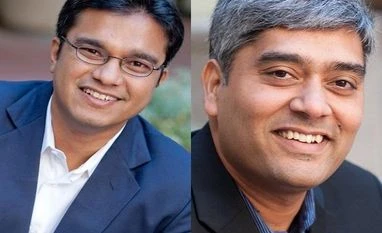
And the people who are creating such massive value are four Indians -- three studied computer science and one, marketing -– neither of whom had any entrepreneurial background though they all brought with them varied experience working with tech companies in the US.
While their entrepreneurial journey started in 2003 when they were still in the US, they were quick to realise that building a software products-focused technology company without leveraging the Indian skillset is going to be an uphill task. But between so many options such as Bengaluru, Mumbai, Pune and Hyderabad, the founders of the company which was known as Tethys Solutions back then, picked Vadodara, a city that houses the prestigious Maharaja Sayajirao University known for nurturing some of the best engineering talent in the country. Even though Automation Anywhere started another centre in Bengaluru about four years ago and its engineering centre in San Jose is also fast growing, Vadodara continues to be the company's largest development centre.
While it is true that founder and CEO Mihir Shukla has a strong Vadodara connection, being an alumnus of MS University, the reasons for choosing the city stretch beyond. “When we started 15 years ago, there are very few product companies. We didn't want to be in a tier-I town because employee attrition in bigger cities always tends to be higher. We also required a different kind of talent that needs to be with us for a few years to build a good product," says Ankur Kothari, co-founder and chief revenue officer at Automation Anywhere. "Baroda was a natural choice as it is a university town, surrounded by good talent and with a strong engineering culture."
Like Shukla, Kothari also graduated in engineering from the University of Mumbai, before moving to the US to pursue a BS in Computer Science from the University of Wisconsin, He subsequently landed in a job with Siebel Systems. Another co-founder, Neeti Mehta, who currently heads brand strategy and culture at Automation Anywhere as a senior VP, did her schooling from Sacred Heart Matriculation Higher Secondary School in Chennai before going for an MBA from Bond University in Australia. The fourth co-founder, Rushabh Parmani, is a computer science graduate from University of Wisconsin, Madison.Interestingly, until they tapped external funding in July this year, Automation Anywhere was completely bootstrapped, and had never felt the need to go for external resources. This was partly because the company was profitable for the past 7-8 years, says Kothari, and did not have any debt in the balance sheet. The company grew organically to become the largest in this segment and among the most valuable ones.
“It's not that we're against any external funding. Every year we plan exponential growth, and then we see if our capital is enough (to fund those). We've always outperformed on every front and never needed the capital because we kept on self-funding the exponential growth,” says Kothari.
In fact, the RPA market itself is seeing an exponential growth as automation takes centrestage at global enterprises that focus on improving efficiency and optimising costs. Almost every company that is developing software bots — UiPath, Blue Prism, Contextor, EdgeVerve Systems, Pegasystems, WorkFusion, Kryon Systems, among others — is witnessing a surge in demand like never before, as RPA is going mainstream and organisations are adopting it, shedding early inhibitions.
This wasn't the case in 2003 when Shukla, Kothari and other co-founders started the company with focus on developing software bots that can mimic human workforce, interact with the system just like a person and also can move data without human interface.
Kothari says the adoption of automation happened in three phases. In the first eight years, it was used by several companies predominantly in US, but more at the departmental level. Then came the next phase which started just after the recession ended in 2013, when people started openly talking about it. “Now we are in the middle of the next phase, when pretty much every single company globally is adopting it and people are looking at it as a medium of improving efficiency.”
In the last 15 years, the company has not only deployed more than 100 bots in different enterprises, but also has more than 1,100 enterprise customers globally, including marquee names such as Google, Cisco and Siemens, among others.