We all know the routine by heart: “Please ensure your seats are in the upright position, tray tables stowed, window shades are up, laptops are stored in the overhead bins and electronic devices are set to flight mode”.
Now, the first four are reasonable, right? Window shades need to be up so we can see if there’s an emergency, such as fire. Tray tables need to be stowed and seats upright so we can get out of the row quickly. Laptops can become projectiles in an emergency, as the seat back pockets are not strong enough to contain them.
And mobile phones need to be set to flight mode so they can’t cause an emergency for the aeroplane, right? Well, it depends whom you ask.
Technology has advanced a great deal
Aviation navigation and communication relies on radio services, which have been coordinated to minimise interference since the 1920s.
The digital technology currently in use is much more advanced than some of the older analogue technologies we used even 60 years ago. Research has shown personal electronic devices can emit a signal within the same frequency band as the aircraft’s communications and navigation systems, creating what is known as electromagnetic interference.
But in 1992, the US Federal Aviation Authority and Boeing, in an independent study, investigated the use of electronic devices on aircraft interference and found no issues with computers or other personal electronic devices during non-critical phases of flight. (Take-offs and landings are considered the critical phases.)
The US Federal Communications Commission also began to create reserved frequency bandwidths for different uses – such as mobile phones and aircraft navigation and communications – so they do not interfere with one another. Governments around the globe developed the same strategies and policies to prevent interference problems with aviation. In the EU, electronic devices have been allowed to stay on since 2014.
2.2 billion passengers
Why then, with these global standards in place, has the aviation industry continued to ban the use of mobile phones? One of the problems lies with something you may not expect – ground interference.
Wireless networks are connected by a series of towers; the networks could become overloaded if passengers flying over these ground networks are all using their phones. The number of passengers that flew in 2021 was over 2.2 billion, and that’s half of what the 2019 passenger numbers were. The wireless companies might have a point here.
Of course, when it comes to mobile networks, the biggest change in recent years is the move to a new standard. Current 5G wireless networks – desirable for their higher speed data transfer – have caused concern for many within the aviation industry.
Radio frequency bandwidth is limited, yet we are still trying to add more new devices to it. The aviation industry points out that the 5G wireless network bandwidth spectrum is remarkably close to the reserved aviation bandwidth spectrum, which may cause interference with navigation systems near airports that assist with landing the aircraft.
Airport operators in Australia and the US have voiced aviation safety concerns linked to 5G rollout, however it appears to have rolled out without such problems in the European Union. Either way, it is prudent to limit mobile phone use on planes while issues around 5G are sorted out.
Ultimately, we can’t forget air rage
Most airlines now provide customers with Wi-Fi services that are either pay-as-you-go or free. With new Wi-Fi technologies, passengers could theoretically use their mobile phones to make video calls with friends or clients in-flight.
On a recent flight, I spoke with a cabin attendant and asked her opinion on phone use during flights. It would be an inconvenience for cabin crew to wait for passengers to finish their call to ask them if they would like any drinks or something to eat, she stated. On an airliner with 200+ passengers, in-flight service would take longer to complete if everyone was making phone calls.
For me, the problem with in-flight use of phones is more about the social experience of having 200+ people on a plane, and all potentially talking at once. In a time when disruptive passenger behaviour, including “air rage”, is increasingly frequent, phone use in flight might be another trigger that changes the whole flight experience.
Disruptive behaviours take on various forms, from noncompliance to safety requirements such as not wearing seat belts, verbal altercations with fellow passengers and cabin crew, to physical altercations with passengers and cabin crews – typically identified as air rage.
In conclusion – in-flight use of phones does not currently impair the aircraft’s ability to operate. But cabin crews may prefer not to be delayed in providing in-flight service to all of the passengers – it’s a lot of people to serve.
However, 5G technology is encroaching on the radio bandwidth of aircraft navigation systems; we’ll need more research to answer the 5G question regarding interference with aircraft navigation during landings. Remember that when we are discussing the two most critical phases of flight, take-offs are optional – but landings are mandatory.
Doug Drury, Professor/Head of Aviation, CQUniversity Australia
This article is republished from The Conversation under a Creative Commons license. Read the original article.

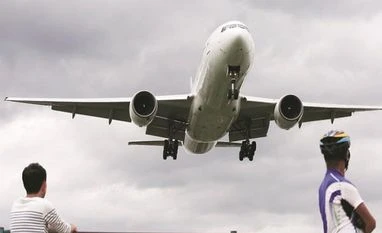 "The real reason to turn on aeroplane mode when you fly is frequency band")


 Connect with us on WhatsApp