This wheelchair allows users to stand up on their own and function normally

Developed by students at IIT Madras, the device is can be customised and mass-produce and is likely to be priced as low as Rs 15,000
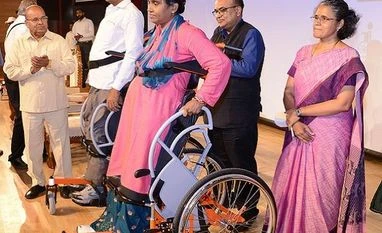
Standing wheelchair
Minister for Social Justice and Empowerment Thaawarchand Gehlot (extreme left), with ‘Arise,’ the Standing Wheelchair. Sujatha Srinivasan of IIT-Madras is on extreme right.
Gireesh Babu Chennai
6 min read Last Updated : Nov 19 2019 | 1:23 PM IST
For people with physical disabilities, whether permanent or temporary, the importance of wheelchairs is cannot be undermined. But if a patient becomes completely dependent on one to move around, and sits on the wheelchair for long, he could suffer from secondary health issues such as poor blood circulation and pressure sores. 

Such patients may need a great deal of effort and assistance to attain a standing position off and on. And indeed there are wheelchairs in the market that allow one to both sit and stand even while using them. But they are mostly not affordable for Indian users, coming at a price tag of at least Rs 60,000. 

This is what led to a path-breaking innovation by some students at the Indian Institute of Technology, Madras, led by Sujatha Srinivasan, a Professor in the Department of Mechanical Engineering. They invented 'Arise', said to be the first indigenously-designed ‘Standing Wheelchair’, in collaboration with Phoenix Medical Systems. The contraption enables a wheelchair-bound person to manually shift from sitting to standing position, and vice versa, independently and in a controlled manner.

‘Arise’ was designed and developed by the TTK Center for Rehabilitation Research and Device Development (R2D2) at IIT-Madras, which is headed by Prof Srinivasan. Since 2015, with CSR support from TTK Prestige, R2D2 has been involved in research related to human movement, influence of orthotic and prosthetic devices on human movement, and the design and development of mechanisms, products and assistive devices for people with impairments.

The commercialisation of the standing wheelchair technology was made possible through support from Wellcome, UK, through an ‘Affordable Healthcare in India’ Award that brought together the research and manufacturing partners. A mass-manufacturable mechanical design with one Indian patent already granted (other Indian, US and Chinese patents are pending), and backed by Phoenix’s manufacturing capabilities, ‘Arise; will soon be available to Indian users at affordable price points.

Designing ‘Arise’

The wheelchair was designed in three stages. The first prototype developed by Harshal Chaudhari, then a student at IIT-Madras, was showcased in the Joy of Engineering, Design, and Innovation (JED-I) annual project challenge in 2012. It won the first price in the mechanical engineering category and also in the overall best project category at the competition organised by Jed-I Technologies Pvt Ltd, Bengaluru.

According to Chaudhari, manual wheelchairs weren't available in India till then. Apart from sitting and standing position, his prototype also had a sleeping position, though the assistance from one more person was required to recline the wheelchair. This led Chaudhari and his friends to refine the design to help the user go to sleeping position all by himself. Also, the plan that time was to market the product at Rs 20,000, almost the third of the price of similar products available then. Now, seven years later, when the project is seeing the light of day, Phoenix Medical Systems is expected to sell it for Rs 15,000, lower than what Chaudhari had initially estimated.

The second prototype was developed by IIT-Madras students N T Saikiran, Sai Prakash Reddy and Parivarthan among others. In this version, the reclining mechanism was removed to reduce complexity. Other students who worked on the project include Sushant Veer (B.Tech, 2013) and Sumit Pethwajadkar (DD, 2013). 

The third prototype, designed by project officer Vivek Sarda and co-inventor Swostik Dash, was tested on several users with spinal cord injury (SCI). The product evoked good response from the users during the trial phase. Till December 2014, the project was funded by the Socially Relevant Projects scheme of IIT Madras. With the TTK's CSR support coming in the next year, the innovators could take the product towards commercialisation in partnership with Phoenix Medical Systems. In May 31, 2017, the invention received a design patent for ‘portable manual standing wheelchair’ by the Indian Patent Office.

In the first stage, a hand-operated, linkage-based mechanism was developed to achieve the standing functionality. A proof-of-concept prototype was used to validate the functioning of the standing mechanism. ‘Arise’ was designed to help the user move from the sitting position to the standing position and vice versa independently and in a controlled manner. This was achieved by using the power of the user’s arms. An optimal one-time fitting ensures that all one need to do is simply propel the wheelchair. It has been fitted with a gas-spring that helps reduce efforts by the user. 

This early prototype was tested by able-bodied persons. Subsequently, testing partners including NGOs, hospitals, rehabilitation centres and individual users, and even clinicians provided inputs. In further iterations, the mechanical complexity was reduced, and the customisation and manufacturability improved. Besides, the ergonomics, user-interface aspects and aesthetics of the product were addressed. Rigorous mechanical testing ensured that the device was rugged and of high quality, according to IIT Madras. 

At the end of the third stage, ‘Arise’ was tested on more than 50 people with spinal injuries. Their feedback was positive with some of them pointing out that they were able to stand independently after three years, thanks to ‘Arise’. One user said that he found it easier to stand with Arise than with using callipers while with another pointed out that by using the wheelchair, he was able to interact with people at eye level. A third said that he was able to order and collect food from a canteen counter independently. ‘Arise’ was also found to be stable on uneven terrain in rural areas.

According to Prof Sujatha Srinivasan, the standing wheelchair is available in four different sizes. “Several adjustments are built into the design to provide the user proper posture when they are either sitting or standing. It is fully customisable and can be mass manufactured, which is why it is so affordable at just Rs 15,000.” 

Sashi Kumar, MD, Phoenix Medical Systems, said that since his is a medical equipment company, safety is one of the primary things they look into in any product. “Even though, there is no safety requirement as per regulation, we have an ankle support, knee block and chest wrap to make sure the person does not fall,” he says. "One safety feature of ‘Arise’ is the interlocking mechanism, which ensures that the wheelchair remains in a locked state if the knee block is not in position. Arise's dimensions were made adjustable and adequate safety features were incorporated." 

According to Prof Srinivasan, R2D2 will be applying the learnings from this project to its other projects. A one-time custom-fitting of ‘Arise’ is necessary to provide maximum benefit to the user. “To maximise impact of its devices, R2D2 will work to create awareness about their suitability, availability, and necessary fitting and training.” 

One subscription. Two world-class reads.

Already subscribed? Log in

Subscribe to read the full story →
*Subscribe to Business Standard digital and get complimentary access to The New York Times

Smart Quarterly

₹900

3 Months

₹300/Month

SAVE 25%

Smart Essential

₹2,700

1 Year

₹225/Month

SAVE 46%
*Complimentary New York Times access for the 2nd year will be given after 12 months

Super Saver

₹3,900

2 Years

₹162/Month

Subscribe

Renews automatically, cancel anytime

Here’s what’s included in our digital subscription plans

Exclusive premium stories online

  • Over 30 premium stories daily, handpicked by our editors

Complimentary Access to The New York Times

  • News, Games, Cooking, Audio, Wirecutter & The Athletic

Business Standard Epaper

  • Digital replica of our daily newspaper — with options to read, save, and share

Curated Newsletters

  • Insights on markets, finance, politics, tech, and more delivered to your inbox

Market Analysis & Investment Insights

  • In-depth market analysis & insights with access to The Smart Investor

Archives

  • Repository of articles and publications dating back to 1997

Ad-free Reading

  • Uninterrupted reading experience with no advertisements

Seamless Access Across All Devices

  • Access Business Standard across devices — mobile, tablet, or PC, via web or app

Topics :health caremedical device

Next Story



