Arijit Kulkarni was excited about his parents’ visit to his house in New Jersey in the US. But he was also apprehensive. It was the senior Kulkarnis’ first international trip and he wasn’t sure if they would be comfortable finding their way around in a foreign city.
However, much to his surprise, he found that his parents not only knew the way from the airport to his house, but also knew about the nearest utility stores, beach and multiplex.
“Your cousin showed us the neighbourhood on Google Earth so we wouldn’t have to depend on you when you are busy at work,” Kulkarni’s mother told him, smiling.
The senior Kulkarnis haven’t heard about immersive technologies such as virtual reality (VR), augmented reality (AR) or mixed reality (an umbrella term for AR and VR). But they have experienced it in more ways than they realise. Just as internet-addicted teens have experienced it whenever they’ve posted funny images of themselves with dog ears, cat whiskers, sunglasses and fake moustaches.
But these are just the tip of the proverbial iceberg. Today, immersive technologies are increasingly being used across industries. The biggest use of AR/VR is in the entertainment and marketing sectors where ‘customer experience’ has replaced ‘customer service’. During the Kumbh Mela this year, telecom operators were offering virtualdarshan (virtual viewing) of holy sites. VR company Kalpnik creates this experience by painstakingly shooting videos in temples across the country and converting them into a 360-degree video format. A number of travel and tourism companies also offer tourists the facility to virtually experience locations to help them decide if they want to visit these places.
Or take Meraki, one of India’s earliest VR studios, which is letting social organisations and documentary filmmakers use its services for the art of storytelling. For example, the India Literacy Project (ILP) commissioned Meraki to document the changes in the lives of the neo-literates in the tribal villages of Odisha’s Keonjhar district. “The VR documentary transports viewers to Keonjhar to experience the changes firsthand and empathise with them,” says Sairam Sagiraju, co-founder of Meraki, which also caters to customers like Tata and Infosys.
The adoption of immersive tech is fairly nascent in India. But its use is picking up worldwide. Goldman Sachs has pointed to nine enterprise class use cases for AR/VR — video games, live events, video entertainment, healthcare, real estate, retail, education, engineering and the military. According to International Data Corporation (IDC), the worldwide spending on AR/VR is estimated to touch $20.4 billion in 2019, an increase of 68.8 per cent over the previous year, More than half of that revenue will come from hardware sales.
Moreover, the latest edition of IDC’s Worldwide Semiannual Augmented and Virtual Reality Spending Guide shows that spending on AR/VR products and services will grow briskly at a compounded annual growth rate (CAGR) of 69.6 per cent throughout 2017-2022.
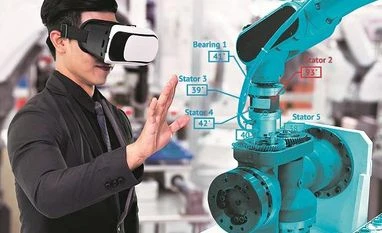
With Industrie 4.0 being the next big thing in technology, industries are turning to immersive technologies to make their businesses smarter. Infosys has used Microsoft’s HoloLens, an MR headset, to transport the plant growth cycle into mixed reality for agriculture. Infosys also has an AR solution that allows aircraft technicians to identify equipment faults by viewing the parts through their AR app.
Mumbai based Parallax Labs works with manufacturers across the country to provide MR solutions in maintenance as well as corporate training. “One of our FMCG clients had difficulty in repairing their German machines as their plants are located in a remote place in the northeast. This AR solution with a HoloLens helps technicians fix the equipment,” says Krupalu Mehta, founder and CEO of Parallax.
Parallax works with several large business conglomerates, pharma companies and even the Indian Space Research Organisation (ISRO), among others, to build MR-based solutions. AR, says Mehta, is particularly useful in maintenance and repair work because it allows technicians to work while they track performance and speed of completion.
In the field of aerospace, Accenture and Airbus have collaborated to develop an application using industrial grade smart glasses to improve the accuracy of cabin furnishing. Using contextual marking instructions, the smart glasses display all the necessary information so the aircraft’s seat locations can be marked down to the last millimetre and checked for accuracy and quality.
A lot of these industrial solutions also have defence and military applications, although these have been largely kept under wraps.
At the recent Immersion India VR Film Festival in Mumbai, entrepreneurs and tech evangelists brainstormed on overcoming the challenges before the technology and agreed that the main difficulty of producing quality AR/VR tech in India was the relative unavailability of global products and the prohibitive cost of importing them. Moreover, since there is no dedicated hardware to support the application needs, most developers have been relying on gaming technologies to create their MR content.
When it comes to viewing such content, the range is wide in terms of cost and the quality of products available. On the one hand there is Microsoft’s state-of-the-art Hololens 2 which is priced at $3500, and on the other, there are the likes of Dr Dattatreya Parle, who not only retails his cardboard variant for Rs 200, but also teaches institutions how to create their own VR lens for educational purposes.
“In industries like training and education, the cost of headsets can be an obstacle. Low cost contraptions like these, coupled with smartphones, can simplify the adoption of this technology,” says Parle who has created use cases in immersive tech for Infosys and BARC among others, and is a guest faculty at several leading engineering institutions across the country. He has also developed a training app for medical students to help them study the human heart in 3D.
Research is going on to come up with MR solutions in healthcare, especially to provide virtual support to doctors in remote areas. Indeed, the day may not be far when a villager no longer needs to travel to a city to undergo expensive medical tests because a headset-wearing primary healthcare centre doctor can hook up with a colleague in a hospital to come up with a quick diagnosis.

 "Vision VR: Immersive technologies turn businesses, industries smarter")












 Connect with us on WhatsApp