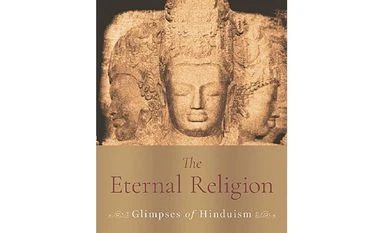
THE ETERNAL RELIGION: Glimpses of Hinduism
Author: Karan Singh
Publisher: Speaking Tiger
Pages: 277
Price: Rs 599
Across the world, whether it is Islam, Christianity or the subject of this book, Hinduism, religion is caught between a rock and a hard place. On one side are a set of hardliners who consider all faiths other than the one they profess to be imposters in the kingdom of god. On the other extreme are those who consider religion an irrational force and a scourge on modernity.
Neither side is willing to find common ground, creating impenetrable cubby holes of alienation in a polarised world. Worse, the sharp divisions that have emerged in India over Hinduism have damaged its accommodative fabric and intellectual abilities.
Author Karan Singh, politician and son of the erstwhile Maharaja of Kashmir, has been a keen advocate of Hinduism for several decades. He believes that political discourse around religion has been vitiated by an extreme set of views from all parties, by those who extol its virtues as well as those who denounce its faults. This book is his attempt to set the record straight on one of the oldest religions of the world.
Ancient religions such as Hinduism were born as a way of life, as a web of practices and traditions that held a community together. They grew out of and nourished philosophical thought. As a result, religious thinking was embedded with a tradition of questioning and doubt and its core tenets revolved around building communities, being compassionate, and generating hope. All this gets easily overlooked today when
religion is used as just another tool to further personal and political gain.
How does one untangle the idea of Hinduism from the political jingoism that has grown around it?
This book takes readers out of the popular narratives around the religion. Simply, sensitively and without too much fuss, it helps understand Hinduism’s evolution from a set of disparate practices into a universal ideology.
The book is a mix of essays and short explanatory passages. The essays offer a commentary on the ancient texts, the influences and some of the ideas that have dominated the evolution of Hinduism while the introductory chapter provides an overview of its basic tenets. On many topics, the book treads familiar ground— whether it is the ability to assimilate other ideas and faiths or the non-didactic approach of its texts, others have explored these ideas too. But this book does it simply and sensitively, without burdening the ideas with jargon and footnotes.
Dr Singh is eager to establish the inclusive nature of Hinduism. In one essay on the wisdom of the Upanishads, he writes that Hinduism did not hesitate to absorb heretic orders into its fold, or rebuild its pantheon from time to time. It was absorptive and respectful of different faiths.
Many ancient theologians and scholars of Hinduism have offered a similar perspective. Aurobindo Ghosh, Sri Aurobindo, as he was popularly known, one of the gurus of Hinduism that Dr Singh references in the book, dealt with this repeatedly. One of his students, K M Munshi, who was part of the team that drafted the Indian Constitution, took his guru’s ideas forward and likened the Indian civilisation to a flowing stream that gathered everything unto itself. Do not lock the region in a chronological sequence of invaders and rulers, he had said. Instead, consider Hinduism as a flowing stream, gathering everything into its fold.
Hinduism has survived by being assimilative and not antagonistic. The book looks at these attributes of the religion in detail and also explores the rise and influence of large movements such as the Bhakti movement which, as Mr Singh writes, “broke away from the rigid and conservative Brahmin-dominated tradition” and developed a whole new vocabulary for faith and devotion.
The book also looks at the idea of religious tolerance — a word that has been misused and abused in recent times. Tolerance in the Vedas is not about the absence of opposition towards other religions. It is instead the positive acceptance of all religions as equal. This is, as several other scholars have written, a sign of the pluralistic nature of ancient faiths. Pluralism treats all religions as equal; this is different from tolerance where one religion believes itself to be superior even though it does not banish other faiths and traditions.
Hinduism is evolutionary and continuously changing — this is the key to survival. It can restate the “eternal truths” without destroying its core beliefs, Mr Singh writes. For instance, even though Swami Vivekananda’s (1863-1902) call for unity of all religions appeared to be a novel one for its time, the Rig Vedic dictum Ekam Sat Vipraha Bhaudha Vadanti (Truth is one, the wise call it by many names), conveyed the same message several thousand years ago. This is what makes Hinduism a religion that can be repurposed for every age.
An interesting read, the book could have done without the sloppy editing that seems to be the norm today, no matter how large or reputed the publishing house. That said, this is a book that would help many readers understand the meaning of faith and devotion as it was developed under the broad umbrella of Hinduism.
The reviewer is a Mumbai-based journalist and co-founder of The Mythology Project