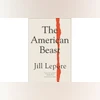
The American Beast, Essays, 2012-2022
Author: Jill Lepore
Publisher: Hachette
Pages: xii+283
Price: Rs 799
Jill Lepore is furious at America: At its gun-owning culture that spawns horrifying killings, including all-too-frequent mass shootings, at what seems to be institutionalised racism and at “the decay of the party system, the celebration of political intolerance by both the right and the left, the contribution of social media to political extremism, and the predicament of American journalism.”
The quote appears towards the end of the book of her essays under review, in the context of why “two in five Americans and three in five Republicans still believe” in the narrative of the stolen 2020 election and on January 6, 2021, 147 Republican members of the House still voted against the confirmation of Joe Biden’s victory no sooner had they re-assembled after running for their lives fearing the insurrectionists. That is the leitmotif of all the 19 essays in the collection, all of which first appeared in The New Yorker over the last decade.
In any given week, especially in this election season in the United States, a dozen or more criticisms of varying intensity of American society by known columnists or guest commentators appear in the opinion sections of The New York Times, The Washington Post and numerous on-line liberal media. But this collection of such critiques matters because Ms Lepore is not just a columnist but a recognised scholar of American political history as well, with prestigious academic appointments and more than a dozen well-received books to her credit. She is also a staff-writer for The New Yorker.
She gives us a guided tour of the rise and presumed decline of the US, starting with the history of arms and militias in the colonies, which later became states. She tells us that the US has the highest rate of gun ownership. Four out of five American homicides are due to gunshots. She cites The Guardian observation that in the first 24 days of 2015, police in the US shot more people than the police in England and Wales did in the preceding 24 years. We revisit race riots, including the worst of all, the 1965 Watts riot. Commissions of enquiry inevitably follow them, being set the same terms of reference again and again, with negligible follow-up. She recalls political conventions, and Senate confirmation hearings of Supreme Court nominees, approvingly mentioning the sangfroid of Ruth Bader Ginsberg. We get a ringside glimpse of the January 6, 2021 armed insurrection on the Capitol at the instigation of Donald Trump as a last ditch effort to cling to power. And learn how the Congressional Select Committee probing it produced a mountain of a report without raising relevant questions, leave alone answering them.
Ms Lepore asks, “And what about the written constitution, by which the living are ruled by the dead?” No question can be more pertinent at present, since the US Supreme Court is now packed with Trump nominees who believe that the constitution must be obeyed to the strict letter, and that too, in the manner expected by its framers. The same institution — the Supreme Court — and the same instrument — the Constitution — which helped advance civil rights and freedoms in the second half of the twentieth century, could well cause coercion and oppression now.
All through this narrative, Trump is the object of Ms Lepore’s ultimate scorn. He is a lying, venomous, racist, fool as well as an utterly egocentric schemer bereft of any morals whatsoever. “The Trump presidency nearly destroyed the United States…Out of a job and burdened by debt, [Trump] would want to make money, billions. He’d need, crave, hunger to be seen, looked at, followed, loved, hated…Would he sell secrets to American adversaries…? It [isn’t] impossible.”
The author wears her erudition lightly, a trait she shares with some noted American academic historians, such as Doris Kearn Goodwin and Martin J Sherwin, who have authored eminently readable yet scholarly histories and biographies. The New Yorker staff-writer template, which includes vivid descriptions of people and events, adds to the sheen of her prose: “Trump took the stage [at the 2016 Cleveland Republican convention], in a suit as black as a cinder…His face turned as red-hot as the last glowing ember of a fire, dying.”
Right at the beginning of the introduction to the book (the only previously unpublished piece of writing in the collection), Ms Lepore asks, “What if the problem of the United States in the twenty-first century is not the decline of democracy but the persistence of violence?” As a keen student of that society for over six decades, this reviewer would have to answer that question in the affirmative. One encounters daily in the American print and digital media investigative reports and opinion pieces severely critical of the political establishment, the system of governance, including the highest echelons of the judiciary and leaders including the incumbent president and his rival for the position in 2024, some of which would surely attract legal action under charges of libel or worse, sedition, in some other democracies. Hence my unsolicited advice to Ms Lepore and her cohorts would be, to paraphrase the seventeenth century English cavalier poet Robert Herrick, “Savour ye Freedoms while ye may.” Reports of the demise of American democracy are greatly exaggerated, as Mark Twain would have put it.
The reviewer is an economist based in Baroda