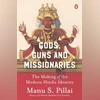
GODS, GUNS AND MISSIONARIES: The Making of the Modern Hindu Identity
The second chapter of Lao Tzu’s Tao Te Ching speaks of the interplay of opposites: “For being and nonbeing arise together; hard and easy complete each other; long and short shape each other; high and low depend on each other; note and voice make the music together; before and after follow each other.” So it is, and has been, that to define is to exclude; to unite is also to separate.
Manu Pillai’s Gods, Guns and Missionaries rests on this truth: Identity is born through the act of othering. How did the Hindu culture originate? How did this tradition leap rivers, climb mountains, and cross deserts to spread its roots? What stories did this culture tell itself as it stood against sectarian waves and alien faiths? And, lastly, how did these historical threads, from colonialism to the threat of Christianity, knot themselves into the militant, exclusionary Hindutva of today? These questions form the heartbeat of Mr Pillai’s study through centuries of history. Like the subject, the answers, too, are plural, complex and consisting of many, many stories.
Unlike the neat narratives sold today, the roots of Hinduism were dynamic, adapting, and endlessly malleable. Turning over the stones of history, Mr Pillai exposes a faith shaped by centuries of myths, rituals, and sacred spaces stretching across the subcontinent. What we see is a faith that shifts and flows, shaped by external forces but grounded in its cultural heart. Mr Pillai brings this history alive through a cast of characters embodying the clashes and compromises of their time and geography.
Take, for example, the fascinating figure of de Nobili, a committed Catholic missionary who rewrote the rules, scandalising many Jesuits in the process. He adopted the cultural markers of Tamil Brahmins to advance his evangelical mission—publicising the Bible as a Veda, wearing the sacred thread (with a cross tied to it), and even discriminating against Christians of “lower caste”—essentially repackaging Christianity as something native. His extreme approach discloses the fluidity and, at times, the contradictions within religious adaptation. Mr Pillai’s narrative brings out the unending tug-of-war and redrawing of boundaries of these times, where faith and identity collide, adapt, and emerge altered, never settling into static forms.
In another amusing incident, Jesuits invited to the court of Akbar “were surprised they got away with potentially life-threatening declarations (from calling Akbar’s wives courtesans to deriding the Quran as stuffed with fables and frivolity). ‘Will these Musalmans never martyr us?’ cried Acquaviva, yearning for a glorious Christian end.”
However, this fluidity—a tradition built on absorption and adaptation—also made Hinduism vulnerable to external critiques, particularly under colonial scrutiny, where every tradition was labelled primitive or devilish. Mr Pillai illustrates how this encounter with European missionaries and imperialists over centuries reshaped the tradition into a more defined, more codified, often rigid construct—one that could respond to the challenges of Western religious frameworks.
So, the popular imagination of Krishna (from the Puranas), one of a playful, naughty god who stole butter and flirted with the village girls, under evangelical scrutiny and criticism, morphs into one from the Gita: The omniscient, all-knowing, all-supreme God. It reflected a conscious effort to present Hinduism as a religion of “monotheistic” philosophical depth, capable of standing toe-to-toe with Christianity in their playground.
At the same time, Europe’s intellectuals were falling for India’s ancient texts. Orientalists such as William Jones and Max Müller lavished praise on the Vedas, extolling their poetic and philosophical depths. Voltaire, ever the provocateur, declared the Vedas humanity’s earliest wisdom despite working off fragmented translations and imagined texts. Fact and fiction blurred as India became Europe’s spiritual muse.
Similarly, while the Brahmins would initially defend polytheism, decades of evangelical teaching and argumentation would pave the way for reformists like Raja Rammohan Roy and Swami Dayanand Saraswati, who harked back to the glory days of their religion. Turning to the Vedas, they sought to construct a “pure” and unblemished Hinduism, abandoning the rich, lived practices of the Puranas and deeming them corrupt. This tension between philosophical abstraction and ritualistic practice runs like a thread through the book, weaving together past and present debates on what Hinduism truly is.
No story of Hindu reform is complete without Bal Gangadhar Tilak, from his revival of Ganesh Chaturthi to reimagining the Bhagavad Gita as a call to action. Bringing religion and nationalism together in mainstream consciousness, he set the stage for the ideological father of Hindutva, V D Savarkar, whose revisionist writings would shape modern Hinduism, using the (often imagined) past as a tool for identity creation. Or, in the words of Mr Pillai, “History here was about rearranging events to address present-day contingencies.”
In an age of fleeting attention spans and oversimplified narratives, Gods, Guns and Missionaries is audacious, refusing to create linear, convenient bite-size facts for the reader to consume and regurgitate. Exhaustively researched, with notes rivalling the main text in length, the book delicately and deliciously crosses that bridge between academic rigour and accessible storytelling. Offering its readers new trails to the present through the prism of the past, the book deserves the work it demands. It’s a debate, a conversation, and a question for the future. It’s a dialogue waiting to happen, as timeless as its subject.
The reviewer is a journalist, writer, and editor fascinated by the stories that shape our world. Instagram/X: aroomofwords

 "How Hindu culture spread: Manu Pillai's book traces its origins, evolution")










 Connect with us on WhatsApp