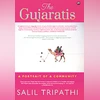
The Gujaratis: A portrait of a community
Author: Salil Tripathi
Publisher: Aleph
Pages: xii+730
Price: Rs 1,499
This doorstop of a book is doubly weighty. First, the sheer size, some 700-odd pages printed with a relatively small-sized font and narrow margins. And second, its mission — that of providing a portrait of a community that is home to unarguably the two most powerful leaders of Indian politics as well as industry in the last decade. It is also arguably the most vociferous and important community among the Indian diaspora.
The author Salil Tripathi is the descendant of one of the most illustrious Gujarati authors, Govardhanram Tripathi (whose Saraswatichandra, a four-part novel, is among the earliest in Gujarati and rated among the very best). He is also connected to a large number of the Gujarati elite (as he points out numerous times). He has a business degree from Dartmouth College in the United States, but has been a full-time writer all through his career. As he mentions in the book, he has worked with and published in virtually every major organ in India and abroad.
The book, he says in the epilogue, has been the labour of love: Eight years of interviewing 213 people and the reading of more than 100 books about the state and its people have gone into it.
So I began reading the book with great interest and was rewarded very quickly. Chapter 7 (out of the total 87) has a most illuminating discussion on Gujarati asmita (sense of identity). Mr Tripathi invokes poets, scholars and philosophers (including Mahatma Gandhi) and quotes the respected Gandhian scholar Tridip Suhrud as saying “Th[e] cultural vision that Gujarat made its own is …based in an imaginary past [as evoked in Kanhaiyalal] Munshi’s world, [it] is feudal, non-democratic”. The author adds: “Today’s Gujarat is closer to Munshi’s imagined past than what Narsinh [Mehta], [the poet] Narmad[ashankar Dave], [Govardhanram] Tripathi or Gandhi envisioned. The longevity of the BJP’s hold on power has profoundly contributed to that vision.”
The author believes that it is this vision that fuels the average Gujarati’s othering behaviour, especially towards the Muslims. In several pages, he attributes directly or indirectly the 2002 riots to this sense of victimhood and “hurt” pride.
But thereafter, the narrative, divided in 12 parts (the last of which is called The Way We Kill) covering the entire gamut of the Gujarat geography, history, culture in all its aspects, and commerce, goes downhill. His chapters on Gandhi and Narendra Modi are a bit better, but they cannot sustain a book seeking to cover this breadth at some length.
The trouble with the book is that it is too ambitious. It has to make choices. There are far too many omissions of a critical nature as a result, many of which appear idiosyncratic. While dealing with Gujarati politics, the author treats the period between Gandhi and Modi, a span of nearly 60 years, as transient. Hitendra Desai, who was chief minister between 1965 and 1972 and was responsible for many initiatives that made Gujarat an economic powerhouse, does not deserve a mention. We come across H M Patel as Haribhai Patel and he is named as the second of the only two Gujaratis who made it to the Indian Civil Service, nothing else. He is lucky; poor I G Patel does not even get his name in the book. V Kurien, dairy co-operatives and Operation Flood get less than three pages, when in fact, this is Gujarat’s singular achievement, entirely home-grown and nurtured (full disclosure: this reviewer worked closely with Dr Kurien and was the first director of Institute of Rural Management).
Hinditronics, basically a failed enterprise, gets several pages, but the Ramanbhai Amin-led Alembic, one of the pioneers of pharmaceuticals in India, gets none, nor does his brother Nanubhai and his vision of harnessing alternative energy sources in his Jyoti Ltd. Mr Tripathi mentions fondly Avinash Vyas, a journeyman tunesmith of no great achievement in the Mumbai film industry, but overlooks the Shah brothers, Kalyanji and Anandji, and Jaikishan Pancholi of the Shankar-Jaikishan duo. The three together made up one half of the three pairs of maestros who dominated Bollywood film music of the 1960s and 1970s. Neither Mehboob Khan, the maker of Mother India, Asha Parekh, among the highest paid heroines in her day, nor Alia Bhatt, unquestionably the finest actor today, appear in the book. Mentioning all omissions would be almost as long as the book, so I must stop. Business and philosophy discourses have often compared Gujarati-Jain ethics favourably with the Protestant ethic. That rich vein is entirely unexplored in the book. Its other problems include poor research leading to inaccuracies, repetitions and an exaggerated woke sense. Virtually anyone cited by the author is his friend, colleague or relation. That cannot be very representative of a region or people with rich traditions.
On page 448, the author asks whether Modi made Gujarat or Gujarat made Modi. Leaving aside the fact that he had asked the same question about Gandhi on page 39, that question should have been a fitting finale for the book, but it rambles on for another 250 pages. Given these limitations, a more appropriate subtitle for the book would have been Some Sketches of the Community. But then, I wouldn’t have read it and certainly not reviewed it!
Finally, it is a mystery to me how so many established publishers, blurb writers and commentators allow such self-indulgent, undisciplined writing to be published in the first place, leave alone lauding it.
The reviewer is an economist based in Vadodara and considers himself a true-blue Gujarati, and not just because of his long residence in the state




