How ordinary Indians shaped the making of the Constitution

The book under review is a most refreshing departure from this pattern. It discusses how people at large participated in what it correctly calls the assembling of the Constitution
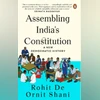
Assembling India's Constitution: A New Democratic History
Assembling India’s Constitution: A New Democratic History
Shreekant Sambrani
5 min read Last Updated : Oct 20 2025 | 9:39 PM IST

Don't want to miss the best from Business Standard?

Assembling India’s Constitution: A New Democratic History
by Rohit De and Ornit Shani
Published by Penguin Random House
xx+370  pages ₹799
  The 75th anniversary of the Indian Republic has spawned a cottage industry of books, lecture fests and television specials on various aspects of its Constitution.  Most of what has emerged from these efforts is well known and the analysis is often shallow and partisan, with, of course, genuflections of utmost reverence to the Basic Law of the country.  Most books parse debates in the Constituent Assembly in analysing how the document came to be drafted.  Some of the more perceptive works discuss the interpretations and consequences of its provisions and seek to find underlying patterns and biases. 
For the uninitiated, if there be any, the Indian Constitution is the longest among all at 1,46,000 plus words, amended 106 times during the three quarters of a century of its existence, and is generally lauded for its detail and depth. 
The book under review is a most refreshing departure from this pattern.  It discusses how people at large participated in what it correctly calls the assembling of the Constitution, from well before the formation of the Assembly until after its promulgation.  The authors’ credentials —Rohit De is on the faculty of Yale University in the United States and Ornit Shani is at the University of Haifa — include extensive research, well-reviewed books and numerous seminar or conference presentations on the Indian Constitution.  
While researching their earlier books (both published in 2018), the authors had independently accessed substantial archival material. Their subsequent conversations led to this joint work, carried out over six years, indicating the depth of research.  The book abundantly testifies to its authors’ erudition and industry. 
The archival material included requests for direct participation by individuals and interest groups, suggestions for inclusion in the provisions of the Constitution, comments and critiques of the various drafts circulated to the general public, reactions to the reports of debates in the Constituent Assembly, on numerous specific and general points.  Caste and community associations, linguistic groups, bodies representing women, children, various professions, were all involved, besides, of course, political parties, including even those who were represented in the Assembly. The 25-page index to the volume mainly lists various individuals and groups, showing the extent of the spread of interest in making the Constitution. 
The authors rightly point out, “Rather than letting the state invoke public interest, the public articulated their particular wants, often through a vision of a common good.”  Women’s groups were championed by Hansa Mehta, fresh from her exertions for gender justice by insisting on human rights as the term to be used. Her official residence in Delhi became the informal headquarters of numerous women’s rights groups.  Balkan-ji-bari, meaning children’s garden in Sindhi, an organisation actively promoting children’s rights and programmes, prepared a moving charter of children’s rights.  Various other bodies proposed similar manifestos for specific groups such as the disabled, specific tribals, Dalit caste and subcaste groups (then called Harijans) and many others, far too numerous to name. Interestingly, most of them pleaded their cases as representatives of some minority or the other, leading the authors to call this a coalition of minorities, giving the term a far more profound and significant meaning than presently implied in our political diatribes.  
Some of the presentations were well organised, such as a 55-page document from one Inder Lal of Saharanpur on the basic principles of Indian Constitution.  Others were not so.  A particularly terse query was from one A K Osman of Bayana railway station, which asked for the questionnaire “to solve the problem of services to minorities” on a neatly type-written postcard. All these were duly archived.  
This reviewer highly commends the book for its ability to hold the readers’ interest in what would otherwise be considered too esoteric a subject.  It is a treasure trove of information for the academically inclined.  It is profusely footnoted, mercifully in the main text itself, with full citations.  For the lay readers, the literally thousands of instances it mentions makes it a deeply allusive and highly readable record of our recent history.  
The Indian Constitution is far from perfect; it is certainly not etched in stone, as many of its new, mostly ill-informed acolytes pretend. It has its flaws and biases, as several scholars have pointed out. Despite this, Professor De and Professor Shani hold it in high esteem, especially in these times of declining democracies.  Their heroes are not the 282 men and 17 women who were members of the Assembly, not Benegal Narsing Rau, its constitutional advisor and administrative factotum, nor B R Ambedkar, the chairman of the drafting committee and the de facto author of the Constitution (although they laud handsomely the signal contributions of these worthies), but “Indians [who] turned [the process of constitution-making] into an open site of struggle …that produced a resilient constitution for India. … [T]he deep sense of ownership the public assumed over the Constitution through their engagement with its making became pivotal to the formation of India’s democracy against arduous challenges and many odds.” 
There can be no better summation of the  amrit kaal of the Constitution. 
 
The reviewer is a Baroda-based economist

One subscription. Two world-class reads.

Already subscribed? Log in

Subscribe to read the full story →
*Subscribe to Business Standard digital and get complimentary access to The New York Times

Smart Quarterly

₹900

3 Months

₹300/Month

SAVE 25%

Smart Essential

₹2,700

1 Year

₹225/Month

SAVE 46%
*Complimentary New York Times access for the 2nd year will be given after 12 months

Super Saver

₹3,900

2 Years

₹162/Month

Subscribe

Renews automatically, cancel anytime

Here’s what’s included in our digital subscription plans

Exclusive premium stories online

  • Over 30 premium stories daily, handpicked by our editors

Complimentary Access to The New York Times

  • News, Games, Cooking, Audio, Wirecutter & The Athletic

Business Standard Epaper

  • Digital replica of our daily newspaper — with options to read, save, and share

Curated Newsletters

  • Insights on markets, finance, politics, tech, and more delivered to your inbox

Market Analysis & Investment Insights

  • In-depth market analysis & insights with access to The Smart Investor

Archives

  • Repository of articles and publications dating back to 1997

Ad-free Reading

  • Uninterrupted reading experience with no advertisements

Seamless Access Across All Devices

  • Access Business Standard across devices — mobile, tablet, or PC, via web or app

Topics :Book ReviewsBook Reviews & FeaturesLiterature

Next Story



