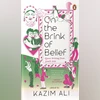
On the Brink of Belief: Queer Writing from South Asia
A new anthology of queer writing gathers varied voices of 24 emerging queer and trans writers from India, Pakistan, Bangladesh, Sri Lanka, and Nepal. A first-of-a-kind collection in which queerness meets faith, the central idea focuses on the subject of what it means to be queer and Muslim in a world increasingly hostile to both.
Emerging from The Queer Writers’ Room, a literary initiative by The Queer Muslim Project (TQMP) in collaboration with the International Writing Programme at the University of Iowa, the landmark book, which is divided into four parts, consists of creative essays, memoirs, poems and stories, and is edited by acclaimed poet, novelist, translator, essayist, and thinker Kazim Ali. Founded in 2017, TQMP is South Asia’s leading platform for queer, Muslim, and allied voices. Through storytelling, art and cultural programming, TQMP amplifies underrepresented perspectives and fosters transformative dialogue.
With mentorship from global authors, such as Ali, Christopher Merrill, Darius Stewart, and Maggie Millner, among others, who led generative workshops, lectures, and readings, the narratives in the book focus on what it means to be queer, Muslim, South Asian, or from the peripheries. “Our queerness and our Muslimness are not in conflict; they are the very frameworks through which we tell stories, challenge assumptions and reimagine the world. The stories we share treat queerness not just as identity but as portal and possibility,” explains Ali.
Most of the contributors in the book belong to the margins – cities, towns, and villages that traditionally lie outside the ambit of mainland cultures. Some of the themes that find place in the collection include faith, mythology, heritage, love, and other personal experiences. “As queer culture makers, storytellers and artists, we stand on the brink of belief. In our conversations with writers, we often returned to the question: Can our stories cut through the noise and root us in our shared humanity?” asks Ali in the book’s Foreword.
In the Introduction, Ali explains that he is queer for two reasons — one, because he is gay, and the other, because his body – “a half-Pakistani body by law if not by blood or ancestry — lies outside the mainstream of what the mother country now considers acceptable.” “So much about being queer or being a citizen of one country or the other, or of being a religious minority can be about feeling ‘wrong’,” he writes.
Ali elaborates that even the gods of the Hindu pantheon know that there is more to gender and sexuality than what a body presents itself as and what human laws attempt to codify. “When Vishnu was confronted with the destruction of the world at the hands of the demon Bhasmasura, he changed himself into Mohini, and only in her form was she then able to defeat him, not with violence but with art and love,” he writes. Further, Ali explains that the gods of Yoga, Shiva and Parvati, combined their essences to birth Ardhanarishvara, a god with two genders, because only in that reality could the god realise the truths of non-dualism.
Writer and community advocate Adnan Shaikh’s short memoir, ‘The Beauty and Complexity of Being Queer and Muslim,’ describes experiences of identity and faith while growing up in a small town. “I was made to feel that my identity was incompatible with my faith and that I had to choose one or the other,” writes Shaikh, who went onto learn about Persian and Urdu poets who had written about love and desire that transcends gender boundaries for centuries.
Organiser and writer Kiran Kumar’s memoir “Darling” thinks through questions of gender and the experience of boys going through puberty. Watching women’s cricket, and seeing athleticism and queerness so visibly on screen invoked in Kumar some powerful emotions of gender yearning.
“A quick headcount would suggest that nearly half of all women’s cricketers outside the subcontinent — where public queerness continues to be frowned upon — are queer. Many are married to or partnered with each other. They are allowed to love each other, cry together and play together, all at the same time,” writes Kumar, who too would love to play the sport with people they are allowed to love.
“Maybe the truth is that it is the rebel, the outsider, the exiled, who can shine most brightly in the night, lighting the path for the rest of us to find our way,” concludes Ali.

 "On the Brink of Belief: A book on gender, religion, and the margins")











