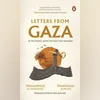
LETTERS FROM GAZA: By the People, From the Year that has Been
Authors: Mohammed Al-Zaqzooq & Mahmoud Alshaer
Publisher: Penguin Books
Pages: 188
Price: ₹599
It’s a cry from a world of death, destruction and loss. A cry without tears — they have dried up. Where parched voices no longer make a noise, but the emotion reverberates almost in surround sound. Letters from Gaza is tough to read in one go, it requires pausing every now and then to clear one’s visual memory and cherish the beauty of this compilation of poetry, monologues, letters and a few short stories. While the collection might have come together in the past year and half, each piece of writing is an amplification of voices on a genocide of the Palestinian people that not a single external agency has stuck its neck out to stop for 75 years.
As poet and teacher from Gaza, Doha Kahlout, asks in her piece “A Siege of Questions and No Answers”, “ . . . does the world actually see us? No answer seems meaningful. If it does, then where is it?” She talks about her days beginning with the search for water and ending with “bread dipped in exhaustion”. There is the daily queuing up for bread for hours, of going to sleep and waking up to the buzzing sound of drones overhead, the blast of missiles hitting buildings and of tanks rolling closer. Given the systematic bombing of the Gaza Strip by the Israeli Army since October 7, 2023, some of the 30 authors are no longer with us, others no one knows where to find them anymore. In such a situation, putting together a collection like this could not have been easy.
Each piece of prose or poetry conjures images of a complete lack of normalcy in any form. But they are beautifully written, evocatively descriptive and emotionally rich. One wonders, if the translations are so good, what might they have been like in the original Arabic. A war is abnormal, but homelessness with no end in sight? A week after the conflict began, the Israeli Defence Forces gave Gazans living in Gaza City and north of Wadi Gaza six hours to evacuate. Families left home with a single bag, and since then have been moving from tent to tent across this 25-mile strip of land bordering the Mediterranean Sea. As missiles and warnings followed, some families have become homeless as many as nine times. A question that keeps popping up in every other writing is: “Where should we go?” The writers and editors have been kind to readers and avoided pieces on rage and blame, neither is there a sense of hopelessness.
Each writer included in Letters from Gaza has a body of work behind them, some with multiple awards. Most of them have dedicated their life to writing about Palestine to enable our education. The majority, especially the younger generation, work in the area of providing psychosocial support to children’s groups. The crisp author’s biography at the end of each piece showcases not just their literary accomplishments but also makes each poem or letter more humane and relatable.
Beesan Nateel, for example, is author of a children’s book called Crazy Luna, and is described as having “the most vibrant red hair”. Or take 20-year-old Haidar al-Ghazali, who writes poetry and organises events called Palestine Called Life — children’s writing workshops to aid their emotional recovery. The day he lost his cousin, Haidar returned to work. He says, “Writing is the only thing that erases my pain. I write because
what we are going through is bigger than all of us.”
The word “martyr” isn’t used that often either. But one story that lingers much after reading it is Hanna Ahmad’s, “Now, Mohammed, Is Your Death Official?” It’s a haunting piece on the disappearance of her 35-year-old brother, who played football and had an extra bone in his left foot. The family end up searching for him in hospitals, in the names of those captured, amongst the bodies of martyrs. Hanna takes it upon herself to call the Red Cross periodically, telling them every single time how long it has been since her brother was last seen —102nd, 150th or the 200th day of absence. The officials wanted to give the family a death certificate to create closure, but “Baba refused to receive it because there is something that resembles certainty inside him that you are alive,” she writes.
Letters from Gaza is a genre of contemporary literature that began in 1956 with famous author and politician Ghassan Kanafani’s letter to his childhood friend Mustafa in Sacramento, USA, telling him “No, I’ll stay here, and I won’t ever leave.” Kanafani wrote to his friend a few hours before he was supposed to board a flight for the US. He had come home from Kuwait to find his 13-year-old niece Nadia’s leg amputated. Nadia had thrown herself on her younger siblings when a bomb hit their home. At age 12, Kanafani had watched his family become refugees during the 1948 war, fleeing to Syria.
His novel, Men in the Sun is possibly the most admired and quoted modern Arabic fiction. In 1972, at age 36, Kanafani and his niece Lamees Najim were killed by a car bomb planted by Mossad in his Austin 1100. It is Kanafani’s rich resistance literature and spirit that each letter from Gaza continues to honour.
All of them give us a ringside view into the human toll of an endless war — from the safety of our homes.
The reviewer is a freelance non-fiction writer