Indian Parliament: Shaping Foreign Policy
Considering that Parliament was conceived of as the pivot of our political edifice, the publication of Indian Parliament Shaping Foreign Policy, which examines the role of Parliament in foreign policymaking, is useful and well-timed. It comes at a time when opposition parties have demanded a discussion of foreign policy issues on the floor of Parliament, especially the impact of Donald Trump’s tariffs on April 2 and discussions on passing of the Immigration and Foreigners Bill of March 2025. Earlier the government had stonewalled demands for a discussion on India-China border issues. Written by a senior journalist, the book also merits attention given the growing perception that the role of Parliament, including those of the Parliamentary Committees, is receding.
There have been studies in the past that examine the role of Parliament in making foreign policy. Among them is the edited volume Foreign Policy and Legislatures, published in 1988, by the late Professor M L Sondhi — who had resigned from the Indian Foreign Service, taught at Jawaharlal Nehru University, and was also a Member of Parliament. The second one is Parliament and India’s China Policy written by Nancy Jetly of Jawaharlal Nehru University, which was published in 1973.
Mr Prasad’s book sifts through the Parliamentary debates on three major foreign policy issues in independent India and similar debates in the Constituent Assembly and the Provisional Parliament. The major foreign policy debates examined in the book cover India’s Peacekeeping Forces deployed to Sri Lanka, the World Trade Organization, and nuclear energy, including the stormy Indo-US Nuclear Deal or 123 Agreement.
Besides India’s nuanced stance on prevailing geopolitics, the government and Parliament had to take a call on India’s continued association with the Commonwealth. Interestingly, participating in the debate, the veteran Parliamentarian Frank Anthony pointed out that, “It is open to this House or Parliament at any time to break this link if they so choose….” The author cites an important illustration of role of Parliament in making of foreign policy during the Constituent Assembly concerning the United Nations Security Council Bill that included the enactment of sanctions. The keen interest and the role of Parliament were demonstrated when M Anathasayanam Ayyangar suggested that before taking recourse to the penal measure, the executive should consult the legislature when in session and place it for ratification later, when not in session. Mr Prasad says this was a preliminary attempt by the legislature to exert its influence over the decision-making process.
In the two related chapters on nuclear energy and nuclear cooperation, the author provides useful information culled from the statements and debates in Parliament. Though both “Civil Nuclear Cooperation” and the “Endgame: Left Intensifies Opposition and UPA Wins” are informative and insightful, a significant omission is the absence of any mention of Speaker Somnath Chatterjee’s ruling rejecting the Opposition demand for renegotiating the Indo-US Nuclear deal, which puts Parliament’s role in foreign policy-making in perspective. As Chatterjee stated, “… there is no requirement to obtain ratification from Parliament of any treaty or agreement for its operation or enforcement. Thus, Parliament can only discuss any treaty or agreement entered into by the government without affecting its finality or enforceability….” He ruled that the issue would be discussed under Rule 193 that has no provision for voting.
Though the book is a welcome addition on the subject, it suffers from some omissions. For instance, the chapter on Indian Peace Keeping Force is disproportionately tilted in favour of the bilateral relationship at the cost of a content analysis of the parliamentary debates. The book also lacks an exclusive chapter on India-China relations, not to mention the fact that defence minister Krishna Menon had to relinquish his position owing to parliamentary pressure after the India-China war of 1962.
The Chinese attack on India in October 1962 sparked off an intense debate in Parliament, subjecting Nehru’s deferential approach to China, including Panchsheel, and his advocacy for China’s admission to UN to severe criticism by both the Opposition and his own colleagues in the Congress.
Mr Prasad has made some references to the China debate in chapter on the Constituent Assembly and the Provisional Parliament. But there is no mention of the Indian Parliament’s resolution adopted on November 8, 1962 on China, which resolved “to drive out the aggressor from the sacred soil of India, however long and hard the struggle may be.” That resolution has interesting resonances when set against Sino-Indian relations to this day.
The reviewer is a former senior parliamentary official and a senior fellow of Indian Council of Social Science Research. The views are personal

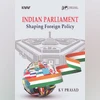 "K V Prasad's book explores Parliament's role in shaping foreign policy")









