More from Less for More: Innovation's Holy Grail
by Sushil Borde and Raghunath Mashelkar
Published by Penguin Business
Every morning, across India, thousands of hands descend into darkness. Sewers don’t clean themselves, though we live as if they do. The infrastructure of our comfort — drains, manholes — functions on that oldest hierarchy of all: Caste. Manual scavengers, belonging to communities marked “untouchable” for millennia, breathe toxic fumes so we don’t have to think about what happens after we flush. Infections, respiratory collapse, cardiovascular damage, death — they’re the terms of employment. On paper, manual scavenging has been illegal since 1993. In practice, it remains India’s open secret, a violence so routine it doesn’t even register as violence anymore.
Rashid, Vimal, Arun, and Nikhil decided to take matters into their own hands. In 2017, they founded Genrobotics with a robot called Bandicoot, a machine capable of cleaning 10 manholes daily without human exposure to toxins. But manual scavengers saw the robot as an existential threat. The founders’ response was to redesign the implementation model, so manual scavengers could become robot operators, their expertise retained while the risk disappeared. The solution has been deployed across multiple states and municipalities. This is what Raghunath Mashelkar and Sushil Borde call More from Less for More: Innovation that doesn’t choose between efficiency and justice.
We live in a country of contradictions. Gated communities with imported marble sit kilometres from settlements without running water. One India orders groceries via app, another India walks hours for drinking water. Can technology do anything to bridge this divergence? Mr Mashelkar and Mr Borde say yes. Their philosophy—More from Less for More—dreams audaciously.
The book begins thus: “How much more can we get? As much as human imagination allows. How much less can we use? As little as even zero. For how much more? For everyone, everywhere, without end. That is the power—and the promise of MLM: More from Less for More.”
As the authors explain: “Companies are often confused: ‘Given our cost structure, what segment can we serve?’ They could well ask, ‘Given that we need to cater to the unserved, what should our cost structure be?”. This framework shifts innovation from a market response to a moral imperative, from profit maximisation to problem-solving.
They identify two dominant innovation paradigms that have shaped global capitalism and deepened inequality. The first is More from More for Less: Premium products for premium customers, innovation designed for exclusivity. The second is Less from Less for More: Cheap products for poor people, mediocrity packaged as affordability. MLM refuses this binary, taking a third path instead, rooted in what the authors call Gandhian Engineering, the principle that inventions must benefit everyone while respecting resource limits.
Take Jaipur Foot. Traditional prosthetics in developed countries can run $10,000 or more, what with precision engineering and premium materials. Jaipur Foot questioned that very premise. Why not design for farmers who need to work fields, for labourers who can’t afford months of recovery? The result was a prosthetic that costs a mere $20 and restores mobility better than far more expensive alternatives. Or consider Reliance Jio, which saw a nation locked out of the digital economy by artificial pricing. By making data essentially free, Jio created an entire digital infrastructure of users and entrepreneurs who suddenly had access to tools previously unimaginable. The book catalogues dozens of such examples: Swaasa (respiratory diagnostics via smartphone for ₹1), iBreast (cancer screening for $1), Dozee (ICU-grade monitoring using any bed), SanketLife (ECG tests for ₹10–20). Each demonstrates that the barrier was merely imaginative.
This is fundamentally different from jugaad. The authors clarify, “Jugaad often disregards aesthetics and professional standards, which can lead to subpar products and services. A mindset that values makeshift solutions over quality innovation can hinder industries from competing in global markets, where adherence to high standards is essential.” While jugaad says make do with what you have, MLM tells you to reimagine what’s possible. The difference is the gap between temporary workarounds that reinforce inequality and permanent solutions that shatter it.
But how do organisations actually implement MLM? The authors offer strategic levers. Constraint-based innovation, the principle that limitations force creativity drove Indian Space Research Organisation’s Mangalyaan Mars mission, which cost less than the film Gravity while achieving what only a handful of nations have managed. Business model innovation freed Google’s search from per-use fees, bringing it to billions through advertising revenue. Workflow innovation remade Aravind Eye Care into one of the world’s most efficient surgical systems, performing cataract operations at costs Western hospitals can’t comprehend. National policies like Aadhaar and UPI created a digital infrastructure that startups could use without building from scratch. Each lever addresses a different barrier to affordable excellence, together forming a toolkit for organisations.
The authors conclude on a note of urgent appeal. “The twenty-first century is destined to be a century of hope, driven by the audacity of visionaries and the unstoppable momentum of innovation. The time to act is now. The century of hope begins today. The limitless human mind will shape a limitless future.”
The reviewer is a journalist, writer, and editor fascinated by the stories that shape our world. Instagram/X: aroomofwords

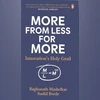 "More from Less for More: Can innovation bridge India's quality gap?")












 Connect with us on WhatsApp