A History of Santiniketan – Rabindranath Tagore and His Life’s Work 1861-1941
Published by Niyogi Books
In the autumn of 1916, two years into World War I, Rabindranath Tagore was visiting Los Angeles. Tagore’s school at Santiniketan, about 160 kilometres north of Calcutta, was yet to grow and transform itself into a university. In a letter to his son, Rathindranath, on October 11 that year, Tagore wrote: “The Santiniketan school must be made the thread linking India with the world. We must establish there a centre for humanistic research concerned with all the world’s people…the first step towards this great meeting of world humanity must be taken in these very fields of Bolpur. The task of my last years is to free the world from the coils of national chauvinism”.
Noted Tagore scholar, Uma Das Gupta, cites this letter in her book on Santiniketan to highlight one of the key factors that led to a school’s reincarnation as the Vishva-Bharati University with the motto Yatra Visvam Bhavati Eka Needam, which roughly means a place where the diverse world is brought together in a nest.
Most universities have been a product of a unique vision nurtured by their respective founders. Vishva-Bharati was no exception. In her book under review, Das Gupta brings to the fore that vision of Tagore with eloquence, backing it with meticulous research. In the process, she traces the origins of Tagore’s ideas behind the school, its evolution into a university and the many hurdles he faced in giving shape to his dream.
What cannot be ignored here is the fact that in a short period of five years, from 1916 to 1921, India saw the emergence of as many as three universities. Das Gupta doesn’t properly situate Tagore’s university project in the context of what was happening in the Indian education space at that time, but such a comparison is inevitable. Its absence, therefore, is a bit jarring in a book that is otherwise comprehensive in its scope and treatment.
Banaras Hindu University was born in 1916 with its key founder Madan Mohan Malaviya promising to offer an alternative to western education principles. Four years later, the Muhammadan Anglo-Oriental College, set up in 1877 in tune with the British education system but without compromising its Islamic values, was transformed into the Aligarh Muslim University. A year later, in 1921, the school that Tagore set up in Santiniketan in 1901 became Vishva-Bharati, a university that would be meant for the study of histories and cultures in a world threatened by national chauvinism, in addition to allowing the Indian mind realise its unity within its diversity.
In its vision, Vishva-Bharati was by far the most ambitious of all the three institutions set up in India in those five years. Das Gupta traces that ambition to the original thoughts that drove Tagore to set up a school in Santiniketan at the start of the twentieth century. She argues that Tagore could not have conceived of his school anywhere other than in a rural setting, which Santiniketan provided. “Our ideal institution will be situated under the shadow of trees in the open country far from the turmoil of cities,” Tagore had written.
Hence, Santiniketan could not have a second campus in Calcutta or in any other city. Indeed, education in Santiniketan was aimed at bringing the city and village closer to each other through social mingling, cultural understanding and the exchange of views as well as information. Despite a certain hostility that Hindu households bore towards Tagore’s experiments with the school in Santiniketan because of its close affinity with the Brahmo Samaj, a reformist movement, the school in Bolpur grew its roots slowly but steadily and over time expanded its footprint.
The transition to Vishva-Bharati in 1921 was a big leap, not just for Tagore’s vision but also for his faith. The four specific goals he set for the university were ambitious, if not daunting. This meant Tagore’s university had to concentrate on the different cultures of the East, approach the West from an Asian viewpoint, bring together different cultures of Asia through research and, most importantly, engage with the West in a bid to strengthen peace through a free exchange of ideas between the two hemispheres.
There are ten short chapters in this book that examine the various ideas that lay at the core of Vishva-Bharati — the meeting of the East and the West, the treatment of art, music, dance and drama, the study of art and architecture, the role of research and Tagore’s disagreements with the dominant idea of nationalism.
The book has been enriched by Das Gupta’s insights into the many setbacks that Tagore faced while giving shape to the idea of Vishva-Bharati. For instance, he disagreed with the commonly held view that the goals for achieving cooperation among Indians as a nation and cooperation with the world had to give precedence to first obtaining political independence for the country. His idea of nationalism differed from the nationalism pursued by the leading political forces at that time. But he showed no signs of wavering in his commitment to the ideals that he set for Vishva-Bharati.
The appendices comprising some original essays by Tagore on his university enhance the book’s overall appeal. One such document reveals the financial stress Vishva-Bharati faced within a decade of its birth even as Tagore showed no signs of scaling down his ambitions. While the university had already spent Rs 21 lakh in the first decade, its fresh plans envisaged an additional expenditure of Rs 27 lakh. Regrettably, though, these appendices have been poorly printed and annotations explaining their significance would have been a great help.

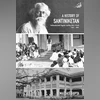 "A History of Santiniketan: A university against national chauvinism")









