CRICK: A Mind in Motion
By Matthew Cobb
Published by Basic Books
536 pages $36
Janice P Nimura
Biographers work on a spectrum: From the nimble narrative, propulsive and colourful and condensed, to the definitive doorstop, a storehouse within which all there is to know has been comprehensively gathered.
Two earlier biographies of Francis Crick, the British biologist who shared the 1962 Nobel Prize for figuring out the form and function of DNA, have already staked out the poles — Matt Ridley’s, slim and roguish; and Robert Olby’s, densely academic. Both were published within five years of Crick’s death in 2004.
With Crick: A Mind in Motion, the British biologist Matthew Cobb aims for the tricky “middle path”: A life vivid enough to engage readers who haven’t thought about the double helix since high school, and detailed enough to satisfy the scientists.
Cobb situates the science in the context of the man. A disclaimer in Cobb’s prologue suggests that he is aware this approach may be a challenge. “Crick’s scientific writings and ideas are described in a way that should be easy for the general reader to understand,” Cobb insists, “but if you find yourself struggling, then follow Crick’s advice to the readers of his own books and skip the hard bits.”
Crick’s life lends itself to storytelling. As an unremarkable physics student at University College London, he was recruited to conduct military research during World War II, a role in which he encountered prodigious minds and from which he emerged, at the age of 30, impatient to wrestle with big ideas.
The reality of the gene — the mechanism by which life perpetuates life — was still abstract, but X-ray crystallography had begun to make it possible to see into the architecture of individual molecules, the first step in understanding life’s clockwork. Crick eventually landed at Cambridge, keen to continue his pursuit of what he called “the chemical physics of biology.”
In the winter of 1953, his PhD still unfinished, Crick and his younger American colleague James Watson solved the structure of DNA. From the start, Crick favoured what he referred to as the “don’t worry method” of scientific discovery. Rather than trudging through years of painstaking and solitary experimental toil, he preferred to leave inconvenient facts by the wayside as he zoomed toward intuitive and elegantly simple models that could then be tested against the data often generated by others. Cobb calls him “an intellectual magpie, attracted by other people’s bright things.”
Crick could be as clear-sighted about himself as he was about molecular biology. His connection to Watson, he acknowledged, arose from “a certain youthful arrogance, a ruthlessness and an impatience with sloppy thinking.” Together, the two men talked and thought incessantly at high speed and top volume, practicing a kind of scientific parkour: Taking spectacular leaps and sometimes falling but always surging gleefully onward. Later, Crick summed up their style: “It’s true that by blundering about we stumbled on gold, but the fact remains that we were looking for gold.”
Cobb carefully addresses the controversy surrounding Watson and Crick’s use of the British molecular chemist Rosalind Franklin’s work, but fails to look more broadly at the way women scientists have been excluded from the kind of intimate, generative male collaboration that fuelled Crick’s brilliance.
The revelation of DNA’s structure is dispatched within Cobb’s first hundred pages. The bulk of the book follows Crick in assiduously researched chronological detail through five further decades of intense partnerships and subsequent leaps: The idea that the sequence of base pairs within the DNA molecule encoded genetic information; the triplet nature of that coded language; the machinery of DNA replication and protein production; and later, a pivot to visual perception and the biological basis of consciousness.
Cobb maps Crick’s life onto the near-century of human history it spanned, from his Edwardian-influenced origins through Cold War innovation and onward to countercultural California. There are wild parties, psychedelic revelations, invigorating encounters with luminaries across disciplines.
But as a scientist himself, Cobb seems more comfortable with the geneticists and conferences and journal articles. And as a full-throated admirer of Crick’s “galaxy brain,” he tends to gloss over the hard bits having to do with his subject’s less admirable moments. He credits Odile Speed, Crick’s wife of 55 years, with grounding his genius and discounts Crick’s countless infidelities as “an expression of his appetite for life.”
Later, as understanding of genetic differences began to collide with questions of moral behaviour, Crick endorsed the idea that certain humans should be encouraged to reproduce more than others. “It is by no means clear,” he said in a lecture on nature versus nurture, “that all races are equally gifted.” Cobb dismisses this as “a claim that at the time was unremarkable.” The time was 1968.
Crick’s defining work on DNA was a magnificent brocade robe of an achievement, and later in his life few were bold enough to question whether the great man was still fully clothed. Cobb acknowledges that a “Crick halo” sometimes raised the Nobelist’s ideas above criticism — but he leaves it in place. A candid consideration of the contrast between Crick’s shining mind and his occasionally tarnished views would further complicate and enrich this intriguing portrait of a gifted, self-absorbed, exuberant and intuitive man.
Flawed humans can be engines of history, and Crick was both.
The reviewer is the author of The Doctors Blackwell a finalist for the Pulitzer Prize for biography ©2025 The New York Times News Service

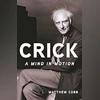 "Mind in Motion: A biography of Francis Crick balances his life with science")

