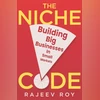
The Niche Code: Building Big Businesses in Small Markets
by Rajeev Roy
Published by Macmillan Business
288 pages ₹399
“Small is Beautiful” is a phrase attributed to the German-born British economist E F Schumacher. He advocated human-centred, decentralised and appropriate technologies in economics.
Can small be beautiful in business as well? In the book The Niche Code: Building Big Businesses in Small Markets, author Rajeev Roy tells us, in this mad pursuit of “unicorn” status, bigger may not always be better. There is business success possible through deep specialisation, not just mass appeal.
I was reminded of my friend Ganesh Subramanian and Shashi Bhat’s company, Dynatech Furnaces Pvt Ltd. The company was set up in 1985 and specialised in making world-class vacuum furnaces. They even had a manufacturing outfit in the US. Their specialised furnaces were tailor-made for just two industries: Automotive and aerospace. The company was acquired by a German company in 2011 and now goes by the name ALD-Dynatech Furnaces Pvt Ltd. Right through its 20-plus-year journey under its Indian promoters, the company stayed focused on its chosen niche, vacuum furnaces. The promoters found a niche they could stay in and did not try to chase the mass market for furnaces.
Germany has a breed of companies known globally as “Mittelstand companies”. They are Germany’s small and medium-sized enterprises (SMEs), forming the backbone of the economy, known for their global market leadership in niche industries, long-term strategic focus, innovation, and high-quality products. They are often family-owned or privately held and thrive through a combination of technical expertise, commitment to long-term customer and employee relationships, and significant investment in research and development.
In The Niche Code, Mr Roy has presented us with an array of Indian startups that focus on niche markets. The author is a management veteran who is now focussed on entrepreneurship education. He has trained over 1,000 entrepreneurs and has played a mentor’s role in numerous companies.
The book is presented in four sections. Why? Who? How? What Next? What is a niche? A niche is not just a market subset; it is a focussed intentional space built around specific unmet needs and deep customer understanding. The author takes the pain to warn that, often, entrepreneurs get into a flux because they start believing bigger is better and chasing the illusion of scale (several examples are quoted). The complexity of trying to create a big business kills agility and presents the danger of doing everything moderately well, instead of doing something very well. More than anything else, the power of restraint is needed. What are these niches? Where do you find them? Niches could be unmet needs, underserved communities, emerging trends, specialised skills, geographic niches, value-based niches, price extreme niches and hybrid niches.
But don’t all companies start small, addressing a niche? Yes, but companies become big because a niche itself explodes, or the company branches into multiple niches, or they go mainstream, and finally there are companies that don’t leave their niche at all.
What was fascinating to this reviewer was the number of Indian companies that are presented in the book — over 75. While there were a large number of personal care, beauty, fashion, coffee, shoe, travel accessories brands presented, I spotted some interesting niche businesses that have thrived staying in their niche. Let us look at a few.
In B School student projects I used to come across Zostel. A hostel for budget students travelling across India. I learnt that the company is focussed on one niche: The independent female traveller.
Capapie was a new brand that I discovered. What do they make? They make specially designed jackets that are worn in shooting competitions. I learnt that they have a global footprint and, in fact, 70 per cent of Olympic medal winners wear a Capapie jacket.
Adinath is focussed on supplying high-quality spares for pharmaceutical manufacturing equipment. Remember there are over a few thousand pharma plants in India but the market for spares is definitely a niche.
Makaibari is today a globally recognised brand for single-garden Darjeeling teas. I heard the brand story from Rudra Chatterjee, managing director of Luxmi Tea, at a recent CII Event where we were fellow panelists.
Jackfruit 365 makes special flour from raw jackfruit that has proven to be highly beneficial for Type 2 diabetes. So before you sign up for that expensive injection to reduce your HbA1C, check out Jackfruit 365.
Stage is a Haryanvi OTT platform that has built a vibrant viable business model. They have a million-plus paid subscribers and are now taking it to other states.
Have you heard of Stag? They are a company focussed on table tennis. If you have played TT in your club, chances are you played on a Stag TT Table, with Stag nets and Stag rackets.
I could go on, but let me stop and say that this book is a fascinating read that can give a prospective entrepreneur new ideas. Also if I am a venture capitalist looking for an opportunity to invest in a smart company, this book may be a useful place to hunt.
The reviewer is a bestselling author. His latest book, Marketing Mixology, presents four essential ingredients for marketing success