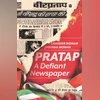
Pratap: The 'conscience of India' and a chronicle of press freedom

The book chronicles the rise and fall of the Indian press over roughly a century. It is a valuable resource for students and researchers of journalism, politics, law and literature

PRATAP: A Defiant Newspaper
Vipul Mudgal
5 min read Last Updated : Apr 29 2025 | 11:30 PM IST
PRATAP: A Defiant Newspaper
Authors: Chander Mohan and Jyotsna Mohan
Publisher: Harper Collins
Pages: 368
Price: ₹499
  As you dip into this personal history, the story turns into a thriller. The churning of the freedom movement unfolds through the biography of journalist Virendra Mohan, a “partner in crime” of Bhagat Singh and Chandra Shekhar Azad. What begins as a profile of Pratap, a defiant Urdu daily, becomes a chronicle of India’s press freedom before and after Independence, as well as the censorship of the Emergency and reporting of terrorism in Punjab. The authors often stray from the theme, but the side stories evoke serendipity.
 
You get life sketches of Lahore, the king of cities north of the Vindhyas, its place in the freedom movement, with its clubs, colleges, boulevards and poetry. Urdu is the language, and “inqualab” is in the air. The Jallianwala Bagh massacre has incensed the nation, and a militant movement is rising in Lahore and Kapurthala. There are tales of human bondage where nationalism reigns, but it does not ride on religion. Some stories are part of folklore, others are forgotten — such as the vignettes of a young Kamala, who smuggles her jewellery for the cause and is about to shoot the Governor before the assassination plot is shelved at the last minute. 
 
Virendra Mohan spent most of his youth in prison. He was arrested nine times for being part of the revolutionary movement, but eventually joined the Congress. At 18, he was first arrested in 1928 for the murder of British policeman John Saunders. He was in Lahore’s Central Jail on the day Bhagat Singh, Rajguru, and Sukhdev were hanged. The book fleetingly touches on the roles of Mahatma Gandhi, Lala Lajpat Rai, Jawaharlal Nehru, and Subhas Chandra Bose. But the protagonist is inspired by the Ghadar Party, of expatriate Punjabis, and the Hindustan Socialist Republican Association of Azad, Bhagat Singh and Ram Prasad Bismil. The rebels faced the worst of British brutality. In the first Lahore Conspiracy trial in 1915, some 42 revolutionaries were hanged and over a hundred condemned to cross the “kala pani.”
 
The authors, Chandra Mohan and his daughter Jyotsna Mohan, are descendants of Mahashay Krishan, Virendra’s father and the founder of Pratap in Urdu, which spawned Vir Pratap in Hindi. The narrative is random and understated but not submissive. One would have liked to sample Virendra Mohan’s editorials on the cataclysmic events of our times, such as Partition, Operation Bluestar and its aftermath. The Pratap papers were bought for their editorials, even when they were ceding ground to more pragmatic and better-produced competitors such as the Hind Samachar and Punjab Kesari.
 
The book reminds one of Katharine Graham’s personal history about her family’s association with the Washington Post and her experience of steering it through Watergate and Pentagon Papers scandals. Graham’s book won the Pulitzer. Pratap also deserves its place in history. Poet, lyricist Gulzar gets nostalgic: “…I was very young at the time; the elders would gather in Delhi’s Roshanara Bagh every morning and discuss the headlines in great detail. Pratap was like a freedom flag in the battle for Independence. It was respected like the conscience of India.” I hope the authors plan Urdu and Hindi editions for both sides of the border.  
 
Expectedly, the candour of Pratap’s editorials would attract British ire. Publication was often ceased for speaking truth to power. Once, when Mahashay Krishan was arrested for sedition against the crown (for reprinting Gandhiji’s article for which the Mahatma was sentenced to six years in jail), the influential Sir Ganga Ram tried to save him, but the editor was stubborn; he refused to apologise. The Tribune of Lahore often wrote about the forfeiture of the Urdu daily’s security deposit. The tradition continued after Independence. During the Emergency, the Pratap papers defied the powers by leaving the editorial space blank.
 
The book chronicles the rise and fall of the Indian press over roughly a century. It is a valuable resource for students and researchers of journalism, politics, law and literature. The absurdity called sedition continued for 75 years under the same Section 124A of  the Indian Penal Code that was used against Mahashay Krishan in 1920. Successive governments have freely used it to stifle dissent. Now, when sedition has been “‘repealed,” a brand-new offence under Section 152 of the Bharatiya Nyaya Sanhita is back with harsher provisions. Mahashay Krishan or Virendra Mohan would have written editorials for sure. The book testifies to another untouched reality of free India, the pitiable condition of its jails and the unaccountability of the police.
 
Those who lived or worked as journalists in Punjab in the 1980s would identify with the authors’ accounts of terrorism leading up to Operations Bluestar and Black Thunder. That was the time when Hindu and Sikh minds started to diverge. This was reflected in the coverage of the Urdu, Hindi and Punjabi Press. The so-called Sikh papers, such as Ajit  and the likes of Akali Patrika, were more critical of the police and eulogised “martyred” militants, while the “Mahashay Press”, having shifted from Lahore to Jalandhar, tended to support the police, overlooking human rights violations. Both sides were victims of violence in a hopelessly polarised Punjab.    
 
The book is an epitaph for a bygone era, of giant editors, a paper that no longer exists, a country that stands divided and an Indian language that is vilified as foreign. And that is good reason to archive these wonderful papers for posterity — lest we forget.   
The reviewer heads Common Cause, known for its PILs and the Status of Policing in India Reports

One subscription. Two world-class reads.

Already subscribed? Log in

Subscribe to read the full story →
*Subscribe to Business Standard digital and get complimentary access to The New York Times

Smart Quarterly

₹900

3 Months

₹300/Month

SAVE 25%

Smart Essential

₹2,700

1 Year

₹225/Month

SAVE 46%
*Complimentary New York Times access for the 2nd year will be given after 12 months

Super Saver

₹3,900

2 Years

₹162/Month

Subscribe

Renews automatically, cancel anytime

Here’s what’s included in our digital subscription plans

Exclusive premium stories online

  • Over 30 premium stories daily, handpicked by our editors

Complimentary Access to The New York Times

  • News, Games, Cooking, Audio, Wirecutter & The Athletic

Business Standard Epaper

  • Digital replica of our daily newspaper — with options to read, save, and share

Curated Newsletters

  • Insights on markets, finance, politics, tech, and more delivered to your inbox

Market Analysis & Investment Insights

  • In-depth market analysis & insights with access to The Smart Investor

Archives

  • Repository of articles and publications dating back to 1997

Ad-free Reading

  • Uninterrupted reading experience with no advertisements

Seamless Access Across All Devices

  • Access Business Standard across devices — mobile, tablet, or PC, via web or app

Topics :Book readingBOOK REVIEWBS ReadsNewspaperNewspapers in IndiaFreedom fightersUrdu language

Next Story