India Inked: Elections in the World’s Largest Democracy
Jujitsu is a method of fighting that makes use of few or no weapons and employs paralysing blows to subdue a usually armed opponent, leveraging the opponent’s weight. A reporter is a bit like a jujitsu fighter, a puny warrior battling to tell the real story against the might of the state. Poonam Agarwal’s account of how she finessed the system to lay bare the truth behind the supposedly politics-agnostic electoral bonds is an inspiring example of how as a reporter she used entirely legal tools available to her to expose the nexus between corporate funding, elections, and political parties. For this, she says, she came to be known in many quarters as the “Bond Girl”.
The electoral bonds scheme was meant to delink political donations and political parties by keeping the identity of the donors anonymous. In fact, it was just the opposite: With no “visible” serial number, corporate houses could buy electoral bonds sold by State Bank of India (SBI) and donate them to any party of their choice. Except that all bonds had a unique hidden alphanumeric number. So, all corporate houses had to do was buy the bonds that could then be redeemed by the political party and presumably, quietly let the party know how much their support was worth, by slipping them the alphanumeric number. A move to provide transparency to funding elections thus became a system of fostering cronyism.
The largesse benefited all parties, though Ms Agarwal has the Bharatiya Janata Party (BJP) specifically in her sights. While conceding that everyone “gained,” she says the central BJP government initially denied any knowledge of the existence of alphanumeric codes on the bonds. But once the Supreme Court came into the picture and virtually forced SBI to reveal the codes, the government took credit for embedding them in the bonds in the first place!
The way Ms Agarwal got to the bottom of the story is riveting. She bought two electoral bonds, apparently not such an easy job, and scanned them for serial numbers. There were none. She then submitted them to forensic testing and found the hidden number visible only to ultraviolet rays. Why would the government go to such great lengths to suppress this information?
Many warned the government about the proposal. Then Governor of the Reserve Bank of India (RBI) Urjit Patel wrote to finance minister Arun Jaitley, stating: “The issue of EBs [Electoral Bonds] in scrip [physical] form is fraught with the serious risk of money laundering.” He said the RBI alone should have the right to issue the bonds and these should be issued in digital form with the RBI as the depositary. Ms Agarwal says the government responded by saying that this would take away the key feature of the scheme: To protect the identity of the donor from the political party. Eventually, the government got its way. Accessing internal RBI communication, Ms Agarwal says on October 18, 2017, the RBI gave in. “If the government decides to issue electoral bonds in scrip form through SBI, the Bank should let it be,” Dr Patel wrote to his colleagues.
More challenges would follow until the Supreme Court drew a line under the issue, but not before asking SBI and the Election Commission of India (ECI) to upload a list of donations on the ECI website. However, another petition, seeking a special investigation into the scheme was turned down. But Ms Agarwal, along with colleagues, had won a significant part of the battle.
This book is about a lot more than just her expose. It is also an account of the evolution of India’s elections over the decades, shining the light on how democracy can be subverted. The book begins gently: How newly independent India’s first election (1951-52) was organised by Election Commissioner Sukumar Sen and his prescience about how forces and individuals could game the system. It goes on to discuss the changes in the appointment and composition of the ECI, though it does not talk about the circumstances (and politics) around the resignation of two top EC functionaries: Ashok Lavasa and Arun Goel. The book discusses the functioning of the electronic voting machines (EVMs) but does not dwell on the mechanics of how these can be manipulated, using the somewhat Luddite logic that there is no technology in the world that cannot be tampered with, and so EVMs are not tamper-proof either.
The book segues into another area of the threat to democracy: The press and its ownership. It asserts that press freedom in India is in danger and it has to do with the interests of the owners. It cites a number of indices to buttress its point that censorship in India is on the rise. This requires a more granular and nuanced discussion. She discusses the feasibility of the One Nation One Election (ONOE) issue extensively.
The author has an editorial standpoint — she is opposed to the BJP — and this comes through clearly. But that does not detract from the value of her research and persistence in exposing the Electoral Bonds mechanism, even if readers can only guess at the quid pro quo — the donation and the reward. She says it was T N Seshan as chief election commissioner who changed the way the commission worked. But there were others like R V S Peri Sastri who asserted themselves quietly as well. And she has not gone into the deals struck for elections to the Rajya Sabha and the Legislative Councils in the states. But for all that, this is an excellent book for all those who want to know how a part of the election system in India works—and how it is undermined.

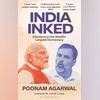 "Poonam Agarwal's book 'India Inked' decodes India's electoral practices")










 Connect with us on WhatsApp