How meritocracy manages to mask the rise of inherited wealth and privilege

Why meritocracy is insufficient to get rid of inequity
book review
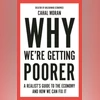
Why we’re getting poorer: A realist’s guide to the economy and how to fix it
Sanjeev Ahluwalia Mumbai
5 min read Last Updated : Apr 16 2025 | 11:16 PM IST

Don't want to miss the best from Business Standard?

Why we’re getting poorer: A realist’s guide to the economy and how to fix it
Author: Cahal Moran
Publisher: Harper Collins
Pages: 400
Price: ₹599
  Don’t judge this book by its clickbait title. The author actually agrees that poverty — no matter how defined — has reduced globally, though at a far slower pace than the rate at which wealth has concentrated at the top.

Also Read

 
The book is in two parts. Part one is titled “The Uneven Economy”. It chronicles the fact that “knowledge” workers and capitalists are rewarded much more than skilled wage earners, even though the latter are more “essential” in daily life, as we discovered during the Covid pandemic. Until “essentiality” translates into a fair share of the income pie, economies will tend to get hollowed out, become less resilient and more vulnerable to global disruptions — a view point similar to US President Donald Trump’s current trade and investment agenda. The increasing numbers of billionaires (up from 273 in 1990 to 2,781 in 2024) and their wealth growing faster than inflation (up from $582 billion to $14.2 trillion) are a consequence of the wider adoption of the market-based economy model that promotes the concentration of wealth. 
What, then, of “meritocracy” — that valued “invisible hand” of efficiency which allows only the most competitive to survive? Clearly, market economies do promote meritocracy much more than alternative medieval systems or modern state-controlled systems. But meritocracy is insufficient to get rid of inequity. In the US, over 30 per cent of children born poor stay poor and fewer  than 10 per cent become rich. In comparison, fewer than one in 10 children born rich end up poor. Inherited wealth, contacts, and attitudes still determine destiny. 
Is poverty getting better? The “elephant curve” devised by Lakner and Milanovic illustrates robust income growth over 1988-2008 across all income percentiles —ranging from 21 per cent growth at the low-income level to 80 per cent in the middle-income economies, largely courtesy China, and similar higher growth rates in the high-income percentiles. The sole exception are poor regions of rich countries, which either declined or grew slower than the richest income percentiles. Income growth rates at the top and at the bottom need to converge for inequity and the hot spots that perpetuate inequality — war, government capture and inequitable government policy — to end. This view aligns with recent (post-publication) events in the US, where those left behind are finding a sympathetic ear in President Trump. Sadly, the domestic problem is sought to be solved by heightening global inequity, as developing countries get negatively affected by lower aid flows, heightened climate impact, mercantilist global trade, and the end of a sense of social responsibility for the “precariat” — the bottom 15 per cent of people with low income and no wealth — living precarious lives.   
The second part of the book reviews four dysfunctionalities in the prevailing economic system. The author highlights dwindling access to decent public housing, even in rich countries, because governments have been substituted with corporate and private initiatives for high cost and inefficient public provisioning of critical consumer facing infrastructure and utilities. The NIMBY (Not in My Back Yard) mindset of early occupants is also responsible for new housing constraints. It is now contested by the YIMBYs (Yes, In My Back Yard) who promote new development — but sadly only of a type that would increase their own property values at someone else’s expense. Governments need to deal with the housing problem contextually. India seems ahead of the curve with the government’s “affordable homes” initiative targeting subsidised credit for 20 million homes , with links to  other programmes for supply of electricity, drinking water and sewage management for the poor and disadvantaged. 
The basics of money supply are explained in a way that is easy to understand — a must read for those befuddled by the algebra and statistics of money — and how significantly the value of money depends on trust because modern money is created out of thin air according to a set of rules that limit its creation. When central banks fail to respect monetary rules and allow too much money to circulate — usually to finance government borrowing — the nemesis of inflation most affects those who cannot pass on the inflated prices to others — wage earners and pensioned folk. Allowed to reign untamed, entire economies can collapse via hyperinflation where public trust in the currency is lost. 
Finally, the author explains why the global economy is broken. We have pushed cost efficiency via global integration and “just in time” supply management to a level where it compromises resilience and reliability — as evidenced during the Covid pandemic and the six-day blockage in 2021 of the Suez Canal by the ship Evergreen  . Redundancy in capacity cannot be compromised — though no one is willing to bear the cost of redundancy in good times. Most recently “near shoring” seems a cheaper option.
This is an opinionated book, long on identifying what does not work but short on how to fix the problem. The author’s “mantra” is to move away from representative democracy to direct participation, like the Demos in ancient Greece, by enhancing the role for common people. Brexit was one such recent experiment. Sadly, it was not an unqualified success. Nevertheless, this is a well-intentioned, informative, folksy read, on what ails modern societies and how fiddling with economic options promises better outcomes.  The reviewer is a distinguished fellow, Chintan Research Foundation, and was  previously with the IAS and World Bank
 

One subscription. Two world-class reads.

Already subscribed? Log in

Subscribe to read the full story →
*Subscribe to Business Standard digital and get complimentary access to The New York Times

Smart Quarterly

₹900

3 Months

₹300/Month

SAVE 25%

Smart Essential

₹2,700

1 Year

₹225/Month

SAVE 46%
*Complimentary New York Times access for the 2nd year will be given after 12 months

Super Saver

₹3,900

2 Years

₹162/Month

Subscribe

Renews automatically, cancel anytime

Here’s what’s included in our digital subscription plans

Exclusive premium stories online

  • Over 30 premium stories daily, handpicked by our editors

Complimentary Access to The New York Times

  • News, Games, Cooking, Audio, Wirecutter & The Athletic

Business Standard Epaper

  • Digital replica of our daily newspaper — with options to read, save, and share

Curated Newsletters

  • Insights on markets, finance, politics, tech, and more delivered to your inbox

Market Analysis & Investment Insights

  • In-depth market analysis & insights with access to The Smart Investor

Archives

  • Repository of articles and publications dating back to 1997

Ad-free Reading

  • Uninterrupted reading experience with no advertisements

Seamless Access Across All Devices

  • Access Business Standard across devices — mobile, tablet, or PC, via web or app

Topics :Donald Trumpeconomicsskilled workersBOOK REVIEWBook readingBS Reads

Next Story


