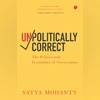
Satya Mohanty's 'Unpolitically Correct' exposes flaws in public policies

Retired bureaucrat Satya Mohanty's book aims to provoke outrage over policies that ignore public interest, exposing how new programmes are launched without ensuring integrity or inclusivity

Unpolitically correct: The Politics and Economics of Governance
Sanjeev S Ahluwalia
5 min read Last Updated : Mar 17 2025 | 11:03 PM IST
Unpolitically correct: The Politics and Economics of Governance
Author: Satya Mohanty
Publisher: Rupa
Pages: 232
Price: ₹387
  This is an unusual book. Retired senior bureaucrats tend to ruminate gently on what might have been but wasn’t. It is rare to find one determinedly highlighting where the government stumbled or, worse, was willingly complacent in ignoring public interest or actively harming public interest for political gain. The author’s intention is to provoke readers’ outrage and goad them to question government decisions — a form of informed political action.

Also Read

 
Should this book be taken seriously? The author bears no ill will towards the government. He did well in government, so this is not a case of sour grapes (disclosure: He was a batchmate in the IAS). His angst is against the slow downslide in government’s intent and capacity to nurture public interest. Nevertheless, it remains short of a balanced appraisal of government performance.
 
The focus is on government failures, not recognising that some are akin to global governance failures, as in failing to address increasing income inequality. Comparisons with China doing better on inequality are odious from a liberal viewpoint, given the blatant lack of concern for individual rights (think the one-child norm, the licensing of domestic migration and no judicial review of executive action). Also, the World Bank’s Gini index for India remained well below that for China (a higher score means more inequality) from 1993 onwards, peaking in 2017 at 36 versus China peaking at 44 in 2010. According to Surjit Bhalla, Karan Bhasin and Arvind Virmani (2022), the Indian free food programme reduced dire consumption poverty (on the basis of purchasing power parity at $1.9) to 1 per cent in 2020 from 12 per cent in 2012.
 
Governance imperfections highlighted include the low effectiveness of the Goods and Services Tax; less than universal vaccination; income-based variation in access to education and health services; a high cost, inefficient, expansive public sector; state governments bludgeoned into fiscal dependency; succumbing to crony capitalism and big business while agriculture and the small and medium sector industries lose competitiveness and gross domestic product share. Praise, albeit grudging, is reserved for a few government schemes such as the aspirational districts programme.
 
The author decries the trend to play up “breaking news” wins like India’s “Vaccination Maitri” programme for global supply of Covid- 19 vaccines and the subsidised Ayushman Bharat medical insurance for 260 million people to access private health care while starving the public health system of funds. Such branded schemes come at the cost of ignoring the tedious work behind the scenes, by anonymous bureaucrats allocating more funds for hiring doctors and nurses in public health facilities, establishing oversight mechanisms and regulating unfair practices in private hospitals.
 
The author is at his best when he narrates personal experiences to offer evidence that new programmes are launched without adequately ensuring their functional integrity and inclusivity. Covid-19 vaccines were used without adequate pre-trials and tests, potentially exposing recipients to negative outcomes, though it was a forced choice between protecting the aged and technical rigour. Digitising income tax assessment without debugging systemic faults harasses income taxpayers. The author’s digitally generated Income Tax Form 26AS was incorrect. An entry for quarterly interest earned was added twice. But an unwillingness to challenge a government document led his chartered accountant to advise him to bear the extra tax, rather than risk questioning “the system.”
 
In 2014, the author visited the subdivision where he began working. Colleges established 33 years ago still lacked functional science laboratories or tenured professors for mathematics and science, in sharp contrast to full staffing for history, political science and Sanskrit — clearly indicating lopsided national educational priorities. Allocations for health and education need to be doubled but additional expenditure must prioritise improvement of the quality of services rather than expanding access.
 
Left-liberal hand wringing dominates the narrative, especially in the sections on the rural economy. Consider the argument that agriculture is low productivity because land owning is skewed. This artificial skew is the outcome of a left-centric government policy of land redistribution post-Independence. Unsurprisingly, the small and marginal land holdings created were of low productivity. To alleviate the business risk for small farmers, inputs were subsidised and crops bought at higher than market rates, creating a giant government enterprise to placate a large, low-skill agricultural workforce, a development that merely kicked the problem forward. Combine this with a distrust of big business and it is unclear how sufficient good jobs can be created to absorb the surplus workforce, reduce dire poverty and inequality while shrinking unsustainable public employment and subsidies.
 
Land grabs by political cronies for building warehouses are decried even though it could avoid “distress sale” of produce by small farmers and generate good jobs. The solution proposed for small farmers in hock to moneylenders is to regulate money lending by capping interest rates. Sounds familiar? Similar anti-market sentiments killed formalised small private finance companies providing credit to small borrowers in 2010. The option presented is farmer co-operatives. But how many are like Amul? Aren’t these often controlled by politically powerful, local farming entrepreneurs who, expectedly, benefit the most?
 
There are fewer solutions proposed than the numbing scale of problems in the way government works, the inefficiencies it creates and questionable incentives behind government programmes. The downsides of direct government intervention are well known. Will things improve if big government is substituted or if it co-opts other economic agents — business, non-profits, political or religious organisations? Is parliamentary reform necessary to align government policy better with public objectives? What would deep judicial reform entail? A follow-on book could keep the pot boiling.
 
The reviewer is distinguished fellow, Chintan Research Foundation, and was previously with the IAS and the World Bank
 

One subscription. Two world-class reads.

Already subscribed? Log in

Subscribe to read the full story →
*Subscribe to Business Standard digital and get complimentary access to The New York Times

Smart Quarterly

₹900

3 Months

₹300/Month

SAVE 25%

Smart Essential

₹2,700

1 Year

₹225/Month

SAVE 46%
*Complimentary New York Times access for the 2nd year will be given after 12 months

Super Saver

₹3,900

2 Years

₹162/Month

Subscribe

Renews automatically, cancel anytime

Here’s what’s included in our digital subscription plans

Exclusive premium stories online

  • Over 30 premium stories daily, handpicked by our editors

Complimentary Access to The New York Times

  • News, Games, Cooking, Audio, Wirecutter & The Athletic

Business Standard Epaper

  • Digital replica of our daily newspaper — with options to read, save, and share

Curated Newsletters

  • Insights on markets, finance, politics, tech, and more delivered to your inbox

Market Analysis & Investment Insights

  • In-depth market analysis & insights with access to The Smart Investor

Archives

  • Repository of articles and publications dating back to 1997

Ad-free Reading

  • Uninterrupted reading experience with no advertisements

Seamless Access Across All Devices

  • Access Business Standard across devices — mobile, tablet, or PC, via web or app

Topics :booksBOOK REVIEWBook readingGovernment

Next Story