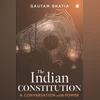
Gautam Bhatia's book offers a refreshing critique of India's Constitution

The basic dichotomy Dr Bhatia addresses is between the Constitution and courtrooms as sources of progressive and transformative social change and the Constitution as a statement of power

Book
Shreekant Sambrani
5 min read Last Updated : Mar 10 2025 | 11:32 PM IST
THE INDIAN CONSTITUTION: A conversation with power
Author: Gautam Bhatia
Publisher: HarperCollins
Pages: xxvi+348
Price: Rs 599
  Our Constitution has lately acquired the status of being etched in stone, not unlike Moses’ Tablets, and its framers are deemed oracles, if not demigods. Prime Minister Narendra Modi on the day he first entered the Lok Sabha, declared it to be his holy book. The Constitution became a major issue in the 2024 general election, with the opposition parties openly expressing their fears that the ruling National Democratic Alliance would drastically change the Constitution, if not abandon it altogether, if it was voted back to power with a thumping majority. Since then, there has been a virtual competition as to who worships the Constitution and its framers more.  In all this, we conveniently gloss over the paradox that the Constitution, the longest in the world, has already been amended 106 times since its adoption in 1950.
 
It is, therefore, extremely refreshing to read the latest book by the renowned constitutional scholar Gautam Bhatia.  His core argument is that “In the seven decades of the working of the Constitution, there has been a gradual drift towards enriching its first set of characteristics: Unitary, concentrated, representative, electoral, homogeneous, and Statist power, at the cost of federal, distributed, direct, guarantor, plural, and individual power.”  These are not the traits one associates with divinely ordained and unalterable documents.  The framers and interpreters of the Constitution were and are all human beings, perhaps wiser than most, but also fallible like the rest.
 
The basic dichotomy Dr Bhatia addresses is between the Constitution and courtrooms as sources of progressive and transformative social change and the Constitution as a statement of power.  He asserts, rightly, that only two chapters of the Constitution, Fundamental Rights (Part III) and Directive Principles of State Policy (Part IV) are material to this debate, and the remaining 90 per cent of the document has “no real bearing on the Constitution’s character or identity.”
 
He grounds his thesis in the fact the Indian Constitution is not a sui generis document like its US counterpart.  America’s Founding Fathers had to base their charter entirely on their own aspirations and visions, borrowing nothing from the colonial British rulers.  Our Constitution, by contrast, can be seen as a derivative of earlier laws to govern India under the British imperial rule.  More specifically, he considers the Government of India Act of 1935 to be the model followed in distributing the power between the Union and the states.
 
The book examines at length the issue of power and its various aspects.  A chapter each is devoted to power in relation to federalism, Parliamentarism, pluralism, institutions, rights, and finally, the people in whose name the Constitution is proclaimed. Throughout the analysis, the theme of the centralising drift of the Constitution, present even at its genesis and considerably strengthened in the 75 years of its rule, manifests itself in a number of cases. The most recent of these is the rather prolonged crisis of changes in the governing set-up in Maharashtra between 2022 and 2024.  The situation arising out of the abrogation of Article 370 and the subsequent reorganisation of the erstwhile state of Jammu & Kashmir in 2019 is also under scrutiny.  It is not surprising in the least that in all these cases, strict constitutionalism was interpreted as conforming to centralisation at the cost of plurality and individualism.
 
In what this reviewer considers to be the most incisive part of the book, the chapter titled “Power Contained”, the author examines cases arising out of various coercive measures regularly used by state power, such as laws against terrorism, money laundering and grounds for preventive detention.  The conclusion is devastating: “The courts have …taken what was a colonial justification of permanent emergency, and sanctified it with the authority of a post-colonial Constitution.”
 
We see daily a spectacle of leaders invoking the Constitution for any issue that troubles them and wave the booklet they carry in their vest-pockets to proclaim their allegiance to it and Dr B R Ambedkar (one wonders how the longest basic law document with approximately 145,000 words could fit into a neat little booklet).  But Dr Ambedkar himself said in his observations on the grammar of anarchy that the working of a constitution does not depend on its nature; it has more to do with the people who administer it.
 
One can only cite some limited instances in a review of this kind.  This latest offering by Dr Bhatia, a balanced analysis of the Constitution in relation to actual power in a society, should be read and understood in its entirety by all those who care about democratic values and models of governance in these fraught times. That applies not just to India, but also the world’s oldest democracy with the most succinct constitution in the world, the United States, where the current administration is waging unprecedented warfare against the very features that once defined America’s uniqueness.
 
Dr Bhatia’s sane advice “to chip away at encrusted constitutional common sense… to open a space …that brings the people back  into the Constitution” could not be more timely.
 
The reviewer is a Baroda-based economist
 

One subscription. Two world-class reads.

Already subscribed? Log in

Subscribe to read the full story →
*Subscribe to Business Standard digital and get complimentary access to The New York Times

Smart Quarterly

₹900

3 Months

₹300/Month

SAVE 25%

Smart Essential

₹2,700

1 Year

₹225/Month

SAVE 46%
*Complimentary New York Times access for the 2nd year will be given after 12 months

Super Saver

₹3,900

2 Years

₹162/Month

Subscribe

Renews automatically, cancel anytime

Here’s what’s included in our digital subscription plans

Exclusive premium stories online

  • Over 30 premium stories daily, handpicked by our editors

Complimentary Access to The New York Times

  • News, Games, Cooking, Audio, Wirecutter & The Athletic

Business Standard Epaper

  • Digital replica of our daily newspaper — with options to read, save, and share

Curated Newsletters

  • Insights on markets, finance, politics, tech, and more delivered to your inbox

Market Analysis & Investment Insights

  • In-depth market analysis & insights with access to The Smart Investor

Archives

  • Repository of articles and publications dating back to 1997

Ad-free Reading

  • Uninterrupted reading experience with no advertisements

Seamless Access Across All Devices

  • Access Business Standard across devices — mobile, tablet, or PC, via web or app

Topics :BookBS OpinionBOOK REVIEW

Next Story