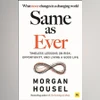
Same as Ever: Timeless lessons on risk, opportunity, and living a good life
Author: Morgan Housel
Publisher: Pan Macmillan/Harriman House
Pages: 185
Price: Rs 450
In an era when dictums such as “Change is the only constant” are drummed into us from an early age, Morgan Housel’s book, Same as Ever is a call for understanding, and benefiting from, the constants amid the flux.
Humans are obsessed with change because it offers them something new and exciting. But there is also a deep-seated desire within us for certainty, which leads us to try and peer into the future by resorting to predictions and forecasts.
Mr Housel, a seasoned financial writer with over 17 years of experience, was always struck by how bad we are at forecasting events, whether in the field of finance, economics, or politics. We fail to predict the next stock market fall, the next recession, the elections, and so on. (As he writes in this book, the number of economists who predicted the Great Depression was exactly zero.) And yet, pundits keep forecasting and people continue to follow them in droves — all because they fulfil our craving for certainty.
But if we are so bad at forecasting, especially events that take us by surprise and which, according to the author, are the only ones that truly matter, what is the way out? Over his years of reading and thinking, the author arrived at the notion that even in this constantly changing world, some things never change. In the history of any field — business, economics, entertainment, medicine, politics, etc — some themes repeat themselves over and over again. The characters change but the plot remains the same.
In Same as Ever, Mr Housel urges readers to rely on these constant themes to interpret the world and to build their expectations about the future. An understanding of these unchanging themes, he says, can help us prepare for what lies ahead with a sense of calm and acceptance.
Each of the 23 chapters in this book deals with one such unchanging theme. And what are some of the aspects that never change? People, says the author, will always be driven by greed and fear. They will always be affected by risk, jealousy, and tribal affiliations. Overconfidence and shortsightedness affect human endeavour today and will continue to do so in the future.
In the first chapter titled “The world hangs by a thread”, the author says that innumerable anecdotes from history reinforce the notion of how fragile the world is. Small events and circumstances have a big impact on the course of events, so much so that we are left wondering: If that event — little puffs of nothingness, as he calls them — had or had not occurred, how different would the world have been?
A story Mr Housel narrates comes from the historian David McCullough. At one stage in the Revolutionary War, the British had George Washington cornered outside Long Island. All they had to do was sail up the East River in New York and they could have wiped out Washington’s remaining troops. But they could not do so. Why? Because the wind was blowing in the wrong direction that night. That gave Washington and his troops enough time to get away. Journalist and television anchor Charlie Rose asked McCullough: “If the winds were blowing in the other direction that night, would there have been a United States of America?” And he replied, “It would all have been over.” Think of it: The birth and the very existence of today’s most powerful nation hinged on the winds blowing in one direction, and not the other, one night in the 1700s.
Mr Housel says once you realise how fragile the past is, it tells you we have no clue about what will happen in the future. He writes: “People say: To know where we’re going, you have to know where we have been. But more realistic is admitting that if you know where we’ve been, you realise we have no idea where we are going. Events compound in unfathomable ways.”
Mr Housel understands the power of stories—there is even a chapter in the book titled “Best story wins”—and deploys them with telling effect. Eschewing the lengthier format typical of business books (which are of around 270 pages), Mr Housel’s work is a compact 185 pages (excluding the notes). And since it is full of riveting stories, one is able to breeze through it in no time. If after reading the book you are left hungering for more, watch Mr Housel’s interviews on YouTube. A powerful speaker, he has the ability to enthral as he reels off one captivating story after another.
Most sequels tend to disappoint. Mr Housel’s first book The Psychology of Money sold 4 million copies globally. Thankfully, he has not wilted under the pressure of expectations and has delivered a remarkable second act. This book, with its timeless insights, is a must-read for all those keen to enhance their wisdom quotient.