THE WORLD AFTER GAZA
Author: Pankaj Mishra
Publisher: Juggernaut
Pages: 292
Price: Rs 799
The carnage in Gaza — witnessed by most of us on our television screens over the last few months — is important for many reasons: It is a painful reminder of the human capacity to inflict extraordinary destruction upon fellow human beings; it affirms the reality of our world order in which such violence can be carried out with near-total impunity, and, finally, it exposes the deep divisions in the global response to this horrendous event.
Pankaj Mishra, the pre-eminent commentator on the intellectual moorings of contemporary competing power structures, sees a congruence in the “shameful complicity in extreme barbarity” of those who witnessed the Holocaust and the millions of people who became “involuntary witnesses to an act of political evil” that is Israel’s annihilation of Gaza. This leads him to examine the polarised response to the Gaza violence — with the Western powers generally backing Israel, and large sections of the Global South condemning Israel and accusing it of genocide.
The author notes that, in Western discourse, the Holocaust “has set the standard of human evil”. But this is disputed by intellectuals of the former colonies for whom the defining experience has been the violence that colonial powers inflicted on “black and brown bodies [which] could be seized, broken and destroyed outside all norms and laws of war”. Thus, for them decolonisation, and not the defeat of Nazi Germany, has been “the central event of the twentieth century”.
Naziism, Mr Mishra points out, emerged from several decades of the rhetoric of racial and civilisational superiority and the accompanying violence that defined imperialism and, in fact, led to the Holocaust inflicted upon the Jewish community in Europe. Indeed, the racist theories of the Nazis that culminated in the “Final Solution” found a sympathetic echo in large parts of the Western world that, through much of the Second World War and after, restricted the migration of Jews fleeing Nazi terror.
Mr Mishra then traces the processes through which Western powers came to accept the Holocaust as the defining manifestation of evil and became strident supporters of Israel. For Germany, the acceptance of guilt for the concentration camps and enthusiastic appeasement of Israel were the necessary pathway to its integration into the European Union, its affiliation with the US, and its economic success after the war.
In the US, the “Americanisation of the Holocaust” became resonant only from the 1960s when American Jews, convinced that a second Holocaust was imminent, saw their salvation in close ties with Israel, and persuaded American conservatives to speak of a “Judeo-Christian civilisation”. A central role obtaining the US’ total support for Israel came from Christian Evangelists whose understanding of Biblical prophecy includes the need for a Jewish presence in Palestinian territories to enable the Second Coming of Jesus Christ.
This is ironic since the Second Coming entails the saving only of Christian believers and the annihilation of the Jewish people. Jews cynically view it as ensuring the political and military support for Israel of successive US administrations.
The Holocaust has also played a complex role in the trajectory of Israel’s own domestic politics. Israel’s Zionist founders, mainly from Europe, exhibited a disdain for Holocaust survivors and for Jewish migrants from West Asian countries, and extolled an aggressive masculine identity, not very different from the earlier “Aryanic” Germans of the Nazi movement.
This changed during the leadership of Menachem Begin who belonged to the “Revisionist” militarist tradition of Vladimir Jabotinsky. From 1977, he pursued militant and uncompromising policies vis-à-vis the Palestinians, which included the expansion of Jewish settlements in the occupied territories, backed by close ties with American Jews and the US political establishment. Begin shaped the Holocaust as Israel’s defining experience and, with the slogan “Never Again”, asserted that the country would be a strong military power so that the Holocaust would never be repeated. As a Jewish writer noted in 1977, the Jews had established themselves in West Asia as the “master race”.
Prime Minister Benjamin Netanyahu is Begin’s political heir. He now presides over Israel’s most racist and xenophobic government and, with full US and European support, has exercised the licence to inflict a catastrophe upon the Palestinians in Gaza, while enjoying an impunity that, in recent times, only the US has enjoyed in respect of the death and destruction it has inflicted in Vietnam, Afghanistan, Iraq and Libya. Mr Mishra notes that these powers viewed the Hamas attacks of October 7 on Israel as “white power [having] been publicly violated, [triggering] a rage bordering on the genocidal”.
What Mr Mishra could have discussed in greater detail is that the solidarity of the Global South, founded on the shared anti-colonial movements, is now splintering. Contemporary right-wing populist forces, shaped by narrow bases of collective identity, have led to bitter domestic polarisations within some developing countries. This has encouraged the affiliation of the erstwhile lead-role players of the anti-colonial movement, like India, with Mr Netanyahu’s Israel. India has ironically joined Western states in restricting free discussion of the Gaza conflict.
Gaza, Mr Mishra says, has pushed many people in different parts of the world “to a genuine reckoning with the deep malaise of their societies,” and to feel the need for fresh struggles, freedom, equality and dignity. Sadly, India is not likely to be amongst them.
The author is a former diplomat

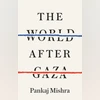 "The World After Gaza: Pankaj Mishra's book draws parallels with Holocaust")

