On the face of it, the government has hiked defence allocations by Rs 14,748 crore, with the current year’s revised estimates (RE) of Rs 345,106 crore enhanced to Rs 359,854 crore in the coming year. That modest rise of 3.5 per cent is well below the inflation level.
Inclusive of pension, the defence budget accounts for 16.8 per cent of government spending in 2017-18, which will be 2.14 per cent of the Gross Domestic Product. This figure is down from 17.1 per cent of spending and 2.29 per cent of GDP this year.
The drop comes despite the significantly increased salary outgo expected in the coming year, once the recommendations of the 7th Central Pay Commission are implemented. Added to the increased pension bill triggered last year by the implementation of the One Rank, One Pension formula, the 1.6 million-strong military’s manpower bill will account for over half the defence allocation. As has become the norm over the last 15 years, the capital budget — which pays for new equipment and force modernisation — has been dressed up for the budget party. While apparently increased by Rs 7,281 crore, from Rs 79,207 crore this year to Rs 86,488 crore in 2017-18, about a nine per cent hike, this has been achieved by under-spending the current year’s capital allocation. The Rs 86,189-crore capital budget allocation this year, is scaled down in the revised estimates to Rs 79,207 crore, which means the defence ministry has underspent its equipment modernisation budget by almost Rs 7,000 crore, some eight per cent of its allocation.
The preceding year, 2015-16, was even more worrying, with the defence ministry under-spending Rs 13,188 crore from its capital budget, almost 14 per cent of the year’s allocation.
There is little to suggest that this year’s allocation will be fully spent. With sanctions for procurement controlled by civilian bureaucrats in the defence and finance ministries, the military’s procurement officers openly complain that, towards the end of each financial year, the bureaucrats place an informal block on most procurements, causing the earmarked funds to lapse on March 31.
After the Bharatiya Janata Party (BJP) manifesto promised to expedite procurements, the military hoped this might change. However, the reverse has happened. Compared to the Rs 79,128 crore spent on capital procurements in 2013-14, the last year of the United Progressive Alliance government, the National Democratic Alliance spent Rs 80,884 crore in 2014-15; Rs 79,846 crore in 2015-16; and Rs 79,207 crore in 2016-17, according to the revised estimates.
“The capital budget has flat-lined, which is inexplicable for a country that is growing at seven per cent. We talk of building military strength, but the reality comes home with every budget”, says a senior general, talking anonymously.
India’s fledgling defence firms, critically dependent on stepped up procurement, are similarly unenthused. Says Rahul Chaudhary, who heads Tata Power (Strategic Engineering Division), a firm that is at the forefront of defence indigenisation: “The meagre rise in the capital outlay is inadequate for a country with active borders and a two-front threat. India is spending even less on defence that some NATO countries that face no security threats.
In contrast, micro, small and medium enterprises (MSMEs) in defence are welcoming the tax rebate of 5 per cent available to qualifying companies. “The tax rate reduction will lead to greater development of MSMEs and increased participation in defence,” says Puneet Kaura, chief of Samtel Avionics.
While the 1.3 million-strong army faces active counter-insurgency operations and mans a hostile border round the year, its procurement allocation of Rs 25,175 crore for the coming year is significantly lower than that of the Indian Air Force (IAF), which will get Rs 33,556 crore. The army, recently sign its first contract for critically needed helmets for soldiers, finds itself struggling to provide basic equipment like rifles, bulletproof jackets and helmets. Only 18 per cent of the army’s budget goes on new equipment, compared to 52 per cent of the navy’s and 58 per cent of the IAF’s budget.
The political focus, however, remains on providing sops, rather than equipment. The finance minister had nothing to say on equipment modernisation in his budget speech, mentioning instead a “Centralised Defence Travel System” that the government had set up to allow soldiers to book railway tickets on-line. With soldiers often travelling on leave without reservations, such a facility is likely to be welcomed.

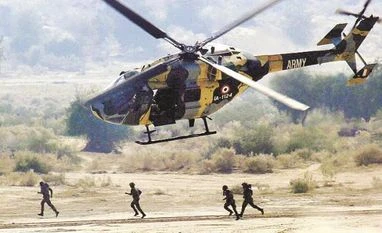 "Budget 2017 for defence: Govt refuses to bite the bullet")












 Connect with us on WhatsApp