- Cash payments
The Budget lays out measures to nudge the country towards a “more digital” and “less cash” economy. Earlier, cash payments for revenue expenditure in excess of Rs 20,000 were disallowed. This limit will be reduced to Rs 10,000. The disallowance has been extended to certain categories of capital expenditure incurred in cash in excess of Rs 10,000. Effectively, this could result in the government collecting taxes from the payor (through the tax impact of the disallowance) in addition to the recipient.
- Presumptive taxation
A six per cent presumptive rate on turnover/receipts received through banking channels will be applied to small businesses with turnover not exceeding Rs 2 crore. This could result in reduction of the tax rate by 25 per cent on non-cash transactions, when compared with the existing presumptive rate of eight per cent.
- Limitation on interest deductions
Following BEPS Action Plan 4, a new section is proposed to limit interest deductions claimed by Indian companies or Indian Permanent Establishments of foreign companies. Interest deductions on payments to non-resident associated enterprises (exceeding Rs 1 crore) would be restricted to 30 per cent of EBITDA, with the balance being eligible to be carried forward. Interest payments to third party lenders are also covered, where the underlying debt is backed by an implicit or explicit guarantee or equivalent deposit from overseas associated enterprises. Banks and insurance companies are excluded (Table 1).
- Place of effective management
PoEM rules to determine tax residency of corporates are applicable from 2016-17. While recent principles issued by the CBDT on PoEM are a welcome move, some issues need to be addressed on priority. Unless there is specific clarity on various aspects of PoEM, it may hinder the ability of Indian companies to go global. CFC rules could have been considered as an alternative.
- GAAR
After several deferrals, GAAR will apply from April 1, 2017. CBDT recently issued clarifications to address several concerns on GAAR. Implementation of the rules on the ground needs to be uniform, fair and rational, as promised by the CBDT. With this move, India will join a league of countries that have statutory GAAR (Table 2).
- Transfer for inadequate consideration
Receipt of money or property without consideration/for inadequate consideration will be taxed to the recipient, thereby extending the current provisions to firms and private companies. This will essentially limit transactions such as “gifts” in the corporate context.
- Reference to fair market value
Section 50CA has been inserted, which will require consideration on sale of shares to be at FMV for computing capital gains. Third party transactions also appear to be covered, resulting in the requirement of taxpayers to justify negotiated third party sale prices. The government must also prescribe unambiguous guidelines and time limits for determining such FMV to eliminate any subjectivity.
- Indirect transfers
- Conversion of preference shares
- Tax rates
- Start-ups
- Specified domestic transactions
- MAT
Secondary adjustments
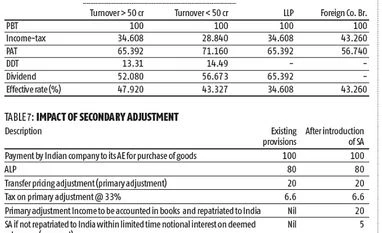
Indian companies will need to bring into their books, and repatriate into India, the difference between the transaction price and arm’s length price. Failure to do so will result in imputation of interest on such amounts (secondary adjustment).
The secondary adjustment will be applied where there is an adjustment to transfer price either through the taxpayer making a suo moto adjustment, accepting a transfer pricing adjustment made during assessment, accepting a safe harbour or an APA or MAP resolution. See Table 7 for the impact of this provision.
- Tax rates
- Long-term capital asset
- Loss from house property
- Other key measures
Conclusion
One subscription. Two world-class reads.
Already subscribed? Log in
Subscribe to read the full story →
Smart Quarterly
₹900
3 Months
₹300/Month
Smart Essential
₹2,700
1 Year
₹225/Month
Super Saver
₹3,900
2 Years
₹162/Month
Renews automatically, cancel anytime
Here’s what’s included in our digital subscription plans
Exclusive premium stories online
Over 30 premium stories daily, handpicked by our editors


Complimentary Access to The New York Times
News, Games, Cooking, Audio, Wirecutter & The Athletic
Business Standard Epaper
Digital replica of our daily newspaper — with options to read, save, and share


Curated Newsletters
Insights on markets, finance, politics, tech, and more delivered to your inbox
Market Analysis & Investment Insights
In-depth market analysis & insights with access to The Smart Investor


Archives
Repository of articles and publications dating back to 1997
Ad-free Reading
Uninterrupted reading experience with no advertisements


Seamless Access Across All Devices
Access Business Standard across devices — mobile, tablet, or PC, via web or app
)