Don't mimic advanced world: Economic Survey

Cautions against fiscal activism; FRBM Act important, but needs some modifications
Graph
Graph
Indivjal Dhasmana New Delhi
Last Updated : Feb 01 2017 | 2:55 AM IST
The Economic Survey 2016-17 cautioned against fiscal activism and blindly aping fiscal policies adopted by the advanced economies. Fiscal activism refers to too much reliance on counter-cyclical policies such as giving a boost to the economy when facing a downturn. In fact, in India’s case, there is a tendency to widen the fiscal deficit, both at the time of boom and downturn, pointed out the Survey.

If adopted in the Budget for 2017-18, the prescription may be contrary to those who are advocating the need to relax fiscal deficit targets significantly. 

The fiscal consolidation road map has pegged the Centre’s fiscal deficit at three per cent of the country’s gross domestic product (GDP) in 2017-18, from 3.5 per cent projected for the current financial year. However, there are some expectations that it might be breached, taking leverage from the N K Singh panel’s report on fiscal responsibility and budget management.  The Survey stressed that while India’s experience validates the policy contained in the Fiscal Responsibility and Budget Management (FRBM) Act of 2003, its operational framework should be tweaked to reflect the dynamics of today’s India.

How will that be done? The Survey left it to the Singh panel on FRBM to recommend. The panel has already given its report to the finance ministry, but the report was not made public.  The Survey also highlighted the country’s vulnerability because of its large primary deficit, a gap between revenues and non-interest expenditures. In simple words, governments in India — the Centre and states combined — are not collecting enough revenue to cover its running costs, let alone the interest on its debt obligations. 

It is here that the vulnerability of India towards its debt payments may arise if economic growth falters and interest rates rise. “But it is not just a completely theoretical possibility, either: It is exactly what happened to Greece,” the Survey said. 

It also said the situation in India has changed greatly since the FRBM was enshrined in law and the basic principles of prudent fiscal management elaborated 13 years ago. Back in 2003, the economy was fairly small and still relatively closed to the outside world, generating per capita incomes that lagged far behind that of other emerging markets. Today, India has become a middle-income country. Its economy is large, open, and growing faster than any other major economy in the world, the Survey pointed out.

In many ways, then, India’s economy is converging toward the large, open, prosperous economies of the West. But its trajectory is different in one fundamental way — while India’s pace of growth has quickened in the past quarter century, the dynamism of advanced countries has ebbed, particularly since the global financial crisis. 

This has led to a fundamental divergence of fiscal perspectives in two sets of countries. In 2003, there was common agreement that fiscal rules were better than discretion, that fiscal policy should be aimed at medium-term objectives such as reducing the stock of debt rather than shorter-term cyclical considerations. 

Now, advanced countries have moved away from these principles toward greater fiscal activism, giving counter-cyclical policies much more of a role and giving correspondingly less weight toward curbing the debt stock, said the Survey.

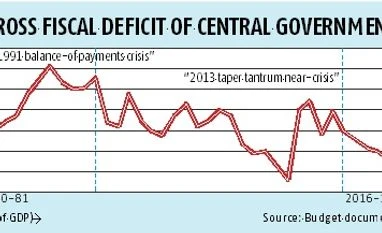
But India’s experience has taught the opposite lessons. It has reaffirmed the need for rules to contain fiscal deficits, because of the proclivity to spend during booms and undertake stimulus during downturns. The Survey highlighted the examples of 1991 and 2013 when the fiscal deficit rose significantly to buttress its point of view.  It has also highlighted the danger of relying on rapid growth rather than steady and gradual fiscal and primary balance adjustment to do the “heavy lifting” on debt reduction. 

In short, it has underscored the fundamental validity of the fiscal policy principles set out in the FRBM Act.

Even as these basic tenets of the FRBM Act remain valid, the operational framework designed in 2003 will need to be modified to reflect “the India of today, and even more importantly the India of tomorrow”. 

One subscription. Two world-class reads.

Already subscribed? Log in

Subscribe to read the full story →
*Subscribe to Business Standard digital and get complimentary access to The New York Times

Smart Quarterly

₹900

3 Months

₹300/Month

SAVE 25%

Smart Essential

₹2,700

1 Year

₹225/Month

SAVE 46%
*Complimentary New York Times access for the 2nd year will be given after 12 months

Super Saver

₹3,900

2 Years

₹162/Month

Subscribe

Renews automatically, cancel anytime

Here’s what’s included in our digital subscription plans

Exclusive premium stories online

  • Over 30 premium stories daily, handpicked by our editors

Complimentary Access to The New York Times

  • News, Games, Cooking, Audio, Wirecutter & The Athletic

Business Standard Epaper

  • Digital replica of our daily newspaper — with options to read, save, and share

Curated Newsletters

  • Insights on markets, finance, politics, tech, and more delivered to your inbox

Market Analysis & Investment Insights

  • In-depth market analysis & insights with access to The Smart Investor

Archives

  • Repository of articles and publications dating back to 1997

Ad-free Reading

  • Uninterrupted reading experience with no advertisements

Seamless Access Across All Devices

  • Access Business Standard across devices — mobile, tablet, or PC, via web or app

Next Story



