Home / Economy / News / In Budget, Rajasthan promises urban MGNREGA, but devil lies in detail
In Budget, Rajasthan promises urban MGNREGA, but devil lies in detail
Rajasthan CM Ashok Gehlot said that new scheme, titled Indira Gandhi Urban Employment Guarantee Scheme, has been allocated Rs 800 crore and will offer 100 days of employment to those in urban areas
premium
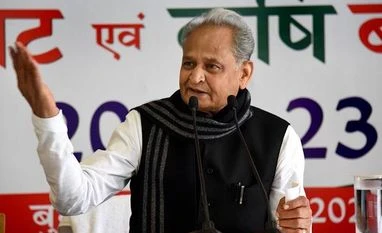
Rajasthan Chief Minister Ashok Gehlot addresses the media after presenting the state Budget 2022-23 in the Assembly, in Jaipur (Photo: PTI)
3 min read Last Updated : Feb 24 2022 | 1:11 AM IST
The Rajasthan government today announced that it will soon introduce an urban employment guarantee programme on the lines of MGNREGA, thus becoming the sixth state in the country which has so far framed such schemes.
Though, the details of the programme are still awaited, but several civil society activists and others who have long been calling for such focused interventions also from the Central government to ameliorate growing urban employment following the COVID slowdown welcomed the Rs 800 crore allocated for the programme as so far most states have kept their urban jobs schemes grossly ‘under-funded’.
Rajasthan Chief Minister Ashok Gehlot said that the new scheme, titled Indira Gandhi Urban Employment Guarantee Scheme, has been allocated Rs 800 crore and will offer 100 days of employment to those living in urban areas.
Incidentally, Gehlot has been one of the chief ministers who had written to Union urban Development Minister Hardeep Puri in June 2020 to introduce an urban employment guarantee scheme after the first COVID lockdown.
Before Rajasthan, Himachal Pradesh, Odisha, Jharkhand, Kerala and Tamil Nadu had introduced urban employment programmes but none of them provided guaranteed employment like MGNREGA.
The programmes also had little imagination as far as nature of works to undertaken and most are works being done by the PWD, civil society activists said.
The concept of guaranteed minimum wages is also not well defined in several of the existing urban employment schemes unlike MGNREGA where annually the minimum wages are centrally fixed.
“The basic and most fundamental requirement of a guaranteed urban employment programme should be that it should provide a legal guaranteed for employment and also unemployment wages for those who don’t get work under the programme. That apart, just like in panchayats for MGNREGA, the Urban Local Bodies needs to be strengthened which other state schemes so far don’t have. They just allocated a budget of Rs 60-100 crore which is grossly inadequate,” Rakshita from the People’s Action for Employment Guarantee (PAEG) told Business Standard.
Just after the first wave of COVID-19, Himachal Pradesh notified such a scheme, followed by Odisha and Jharkhand.
The Himachal Pradesh scheme, called the Mukhya Mantri Shahri Ajeevika Guarantee Yojana, seeks to provide 120 days of guaranteed wage employment to every household in urban areas, and the Odisha initiative called the Urban Wage Employment Initiative is an employment scheme with an initial allocation of ~100 crore for six months starting from April 2020.
In both programmes, the urban local bodies will identify projects, enroll job seekers and ensure timely payment of wages, monitoring of works etc. EoM
What should an ideal urban employment guarantee scheme contain?
It should be guaranteed legislation not a government welfare scheme. Legal backing providing minimum work days is must
It should allocate adequate funds to strengthen the Urban Local Bodies
All workers should be entitled to statutory minimum wages which should be regularly revised like MGNREGA
Just like in MGNREGA, machinery should not be allowed to use except in unusual circumstances or when project cost crosses a certain threshold
Use of contractors should be prohibited unless project cost crosses a fixed threshold
Kind of works need to well defined, just replicating MGNREGA for urban areas is not feasible
Special initiatives should be done to protect the employment of urban self-employed like rag pickers, rehri wallahs etc




