Key social and welfare schemes face fiscal surgery
Allocation for Swachh Bharat Abhiyan, mid-day meal scheme cut; government says funds to come from states
Business Standard A day after the prime minister talked about the Swachh Bharat Abhiyan at length, Finance Minister Arun Jaitley more than halved the central government's financial support to his much-celebrated scheme. From the revised estimate of Rs 12,100 crore for the previous financial year, the allocation was cut sharply to Rs 6,236 crore.
The substantial decrease, the government explained, came from the fact that under the 14th Finance Commission, the revenue expenditure for the scheme would come from the states. The Integrated Child Development Scheme, or ICDS, suffered a similar fate with its Budget allocation more than halved from the revised Rs 16,316 crore to Rs 8,000 crore.
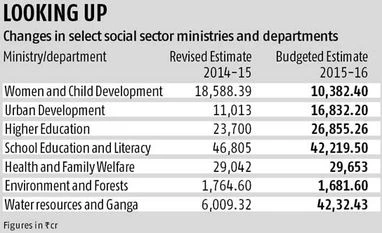
The cut came through a spectrum of social sector schemes and ministries, with the renaming of the schemes obfuscating some of the fiscal surgery at first glance.
Education: Teaching India While these changes were not announced in the speech, the finance minister did announce the coming launch of the Pradhan Mantri Suraksha Bima Yojana to cover accidental death risk of Rs 2 lakh for a premium of only Rs 12 per year. He also announced revision of the existing scheme as Atal Pension Yojana, where the Centre would contribute 50 per cent of the beneficiaries' premium limited to Rs 1,000 each year, for five years, in the new accounts opened before December 31, 2015. The third insurance scheme announced was the Pradhan Mantri Jeevan Jyoti Bima Yojana. This would cover both natural and accidental death risk of Rs 2 lakh at a premium of Rs 330 per year. But like the Jan Dhan scheme-linked insurance, only the details will explain the fiscal implications, as well as the width of the social security net. The cuts in some existing central schemes have created uncertainty about their future. While the Budget documents said states would meet the revenue expenditures from the additional shares the 14th Finance Commission has granted them, the Centre will not be able to force the states to do so.
The Mid-day Meal Scheme, considered one of the more efficient food and nutrition projects, saw a cut from Rs 11,770 crore to Rs 9,236 crore.
Between the prime minister's speech on Friday and the finance minister's announcement on Saturday, the Mahatma Gandhi National Rural Employment Gaurantee Scheme continued to languish. It got an additional allocation of only Rs 1,694 crore over the previous year's revised estimate of Rs 32,992 crore. The minister promised to provide an additional Rs 5,000 crore, if possible, although under the law, the scheme is demand-driven. Last year, the labour budget had been drawn at around Rs 60,000 crore, but the demand was artificially curtailed to remain within limits.
The government announced the winding up of 12 schemes from central funds, leaving it to the states to use their additional resources. This included the Backward Region Grant Fund with a revised estimate of Rs 2,837 crore last year, the tourist infrastructure development scheme of Rs 495 crore and development of 6,000 model schools at the block level, pegged at Rs 1,020 crore last year under the revised estimates.
The housing-for-all scheme got an additional Rs 1,607 crore over the previous year's revised estimate of Rs 12,393 crore-not reflective of the ambitious scale of work the government requires to do to achieve its housing-for-all promise by 2022.
The urban development ministry saw a repackaging of the erstwhile JnNURM scheme that was wound down last year. Its budgeted estimate had been Rs 6,2167 crore, but was revised down to Rs 240 crore. The 100 smart cities project of the government got Rs 2,000 crore and the urban rejuvenation of 500 habitations got Rs 3,898 crore. The overall support for the urban development ministry was raised to Rs 16,832 crore from the previous year's revised estimate of Rs 11,013 crore. But it stayed below the previous year's original budgeted amount of Rs 17,628 crore.

 "Key social and welfare schemes face fiscal surgery")


 Connect with us on WhatsApp