
Reduction in oil subsidies isn't predicated upon lower prices: Ashok Lavasa
Interview with Finance Secretary
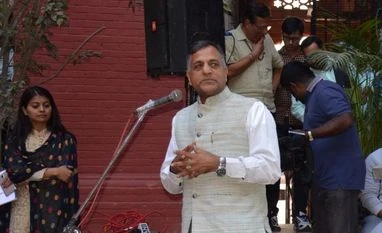 "Reduction in oil subsidies isn't predicated upon lower prices: Ashok Lavasa")
premium
WebinarsNew
Deep DiveNew
Explore Business Standard
Interview with Finance Secretary
Ashok Lavasa, the Union government's finance secretary, to Indivjal Dhasmana on various aspects of the Union Budget. Including on political funding, which he insists is an improvement. Edited excerpts:
What is the assumption for global crude oil rates?
The general feeling is that these could increase. If they do, there is a range within which we can manage. There is also an opinion that a and when the prices go beyond a certain level, shale oil will come in the market and have a dampening effect. We have worked a range and feel if prices remain within this, we will manage it.
What is that range?
$65-70 a barrel.
After many years, this Budget has improved upon a quality of expenditure in a sense that we have seen squeezing of revenue expenditure and increasing of capital expenditure. This poses challenges, as spending money on the revenue side is easier than on capex.
Increased allocation is substantially in those sectors using funds quite efficiently and there is a certain momentum in that sector. Take the BharatNet programme, for providing information technology backbone connectivity to villages and remote areas. There is an appetite and government's expenditure in this sector will give us wherewithal with which we want to go ahead with digitalisation. Similarly, there is the Grameen Sadak Yojana, there since 2002. Now, we are at a stage when we want to complete the remaining roads. This is something for which the machinery is well geared to implement quickly. Also, the railways have an appetite for spending.
The railways did not meet the capex target for the current year.
Yes, that is where the challenge is. Certainly, there are some sectors where we like to pose a challenge, that there is a requirement for spending in the sector. Safety, for instance, is something for which the railways have been demanding money. So, we said, we will create a Railway Safety Fund. Where there is a need, evidenced by what is happening, they must gear themselves up.
Similarly, in the roads sector, there has been de-bottlenecking of standard projects and the pace at which they are completing work per kilometre has improved a lot. For rural roads, it is 113 km compared to 70-80 in 2011-12. Also, this year, 80 per cent of allocated expenditure has been spent and that gives us a lot of confidence.
The Budget has been modest on subsidies. It has shown a decrease in fuel subsidy from Rs 30,000 crore for 2016-17 to Rs 25,000 crore in 2017-18. Yet, prices seem to be rising. What are the assumptions that you will be able to rein in subsidies?
Reduction in petroleum subsidies is not predicated upon lower prices. It is predicated upon lots of reforms that are coming in the kerosene sector. There is an increase in the kerosene price which is gradual, there is reduction in the quota which states are using to give kerosene through the Public Distribution System route. In Haryana, for instance, eight districts have been declared kerosene-free. By the end of this year, it hopes to make the entire state so. Chandigarh is kerosene-free. Aiding this is Direct Benefits Transfer and Aadhaar seeding, through which we can track. For instance, if a household has electricity and cooking gas, why does it need kerosene?
Is something similar happening in fertiliser?
The main culprit in that sector is urea. What gives us a little hope is that despite the area under cultivation increasing, consumption of urea remains the same. There is a major requirement for farmers to understand that excessive use of urea should be avoided.
The concept of outcome budgeting has been given a big push. Are you seeing a phasing out of schemes because these criteria are not met?
We have told all the departments that in 2017-18, we'd like you to focus on a few schemes, where you can actually identify and spell out the outcomes. All the ministries have given specific outcomes they expect as a result of investment in a particular scheme or sector. We have also said we will ask NITI Aayog to make an evaluation. There will be a third-party evaluation. It could be the Aayog but if the Aayog wants to engage an external agency, they can. Every scheme that has been taken up, every investment that has been made, must have a well-defined outcome.
Do you expect some schemes to be phased out, as a result?
They would be. We have already dropped a number of schemes in this Budget.
After the N K Singh committee recommendations on fiscal responsibility and budget management (FRBM), what will be the criterion to judge performance on fiscal consolidation - the debt to GDP ratio or fiscal deficit?
The panel gave reports only a few days ahead of the Budget. We will examine that report. They have, by and large, said the path of fiscal deficit (containment) needs to be followed. They are not substituting that with any other parameter. After staying at three per cent (of gross domestic prouct) for three years from 2017-18, the panel has suggested coming down by 0.2 percentage points. We consciously decided to go to 3.2 per cent in the next financial year against 3.5 per cent in the current year, as there is so much development work to do. They also suggested an escape route but we felt we should not resort to that till the whole report is examined. Then, the government will decide what is required in amendments to the FRBM Act.
Debt as percentage of GDP is not on the table.
If you manage your fiscal deficit, eventually, you will contain your debt to GDP as well. There is no contradiction between the two.
The Budget has talked of reforms in political funding. Sceptics say that reducing the ceiling of cash donation to Rs 2,000 from the present Rs 20,000 does not make sense unless there is a limit on the number of donors, as political parties can always go for a higher number of receipts and get away with it.
There could always be means which people can find to get away with. The new system will give an opportunity to at least those who want to be clean on political funding. It will create an environment in which people want to be law abiding. If a majority of people are law abiding, those who are not get isolated. It is up to political parties to choose if they want to create millions of small donors.
What will be the contours of electoral bonds?
Every time there is an electoral bond to be issued, there will be a scheme which will be brought out by the government. Banks will be designated to issue these bonds. A person who will buy these bonds to donate to political parties will have to pay from his bank account. So, that money is clean. Within the period of the scheme, he can donate to the political parties he wants to. It will be a very short span. Maybe 10 days, 15 days.
Will there be a coupon rate?
No, these are not tradeable.
Already subscribed? Log in
Subscribe to read the full story →

3 Months
₹300/Month
1 Year
₹225/Month
2 Years
₹162/Month
Renews automatically, cancel anytime

Over 30 premium stories daily, handpicked by our editors


News, Games, Cooking, Audio, Wirecutter & The Athletic
Digital replica of our daily newspaper — with options to read, save, and share


Insights on markets, finance, politics, tech, and more delivered to your inbox
In-depth market analysis & insights with access to The Smart Investor


Repository of articles and publications dating back to 1997
Uninterrupted reading experience with no advertisements


Access Business Standard across devices — mobile, tablet, or PC, via web or app
First Published: Feb 03 2017 | 1:57 AM IST


