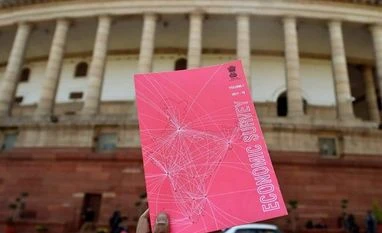
The colour of this year’s Economic Survey is pink. It was chosen, Chief Economic Advisor Arvind Subramanian tells us in its preface, “as a symbol of support for the growing movement to end violence against women, which spans continents”.
The ‘Consortium of Pub-going, Loose and Forward Women’, which in 2009 had launched the ‘pink chaddi campaign’ to protest Sri Ram Sena’s attacks on women visiting pubs, or Uttar Pradesh’s ‘Gulabi Gang’, the pink sari-wearing women vigilantes, should be chuffed that a government publication as important as the Economic Survey has acknowledged their efforts, even if tangentially.
But, the choice of colour pink for the survey report’s cover and blurbs also invited some tongue-in-cheek remarks. “The cover of the Economic Survey 2018 is pink. The economy, though, is in the red,” Trinamool Congress Rajya Sabha leader Derek O’Brien tweeted. But its reference to ‘pink’ revolution as a symbol of women’s empowerment left some in the Bharatiya Janata Party (BJP) confused. During his Lok Sabha campaign in 2014, and also the UP assembly polls in 2017, Modi had accused his political rivals of being guilty of promoting pink revolution, or beef exports.
On the whole, the Survey succeeds for a second year in succession at making the esoteric world of government economic planning accessible to common people. Both Finance Minister Arun Jaitley and Subramanian have noted that the Survey has become part of the pedagogy at several academic institutions. The challenge, after the immensely engaging survey of 2017, was enormous. Subramanian, admitting the dangers of staleness he faced, quoted TS Eliot: “For last year’s words belong to last year’s language. And next year’s words await another voice.”
Unfortunately, the staleness is dictated by circumstances. With the Lok Sabha elections around the corner, and his comments on the goods and services tax (GST) having already frequently and potently used by Opposition leaders, the CEA has pulled punches in critiquing demonetisation and the GST implementation. He has also revealed a secret. The Survey mentions that its authors had access to and based inferences on the data from the Employees’ Provident Fund Organisation (EPFO) and the Employees’ State Insurance Corporation (ESIC).
In a recent interview, the PM had referred to an “independent study” that has based its inferences on EPFO data to state that his government had created seven million new jobs in 2017. EPFO officials had been intrigued at how their data had found its way to the authors of that report.
Chapter 6 of the Survey deals with climate change and agriculture, starting with lines from a song from Manoj Kumar starrer Upkar and a couplet from Ram Charit Maanas of Tulsidas. The chapter states that Bollywood movies have played a key role in creating and reinforcing the mythology of the Indian farmer - Mother India, Do Beegha Zameen, Upkaar, Lagaan and, more recently, Peepli Live. The authors of the Survey, however, have ignored to acknowledge the spate of recent farm protests.
The Survey quotes poet Rabindranath Tagore on his vision of village swaraj, which was similar to Mahatma Gandhi’s ideal of ‘Gram Swaraj’. Elsewhere, the Survey quotes BR Ambedkar, who had famously derided the village as “a sink of localism, a den of ignorance, narrow mindedness and communalism” to stress the point “that in the long run people need to move and be moved out of agriculture for non-economic reasons.”
Chapter 7 of the Survey talks of the deep societal meta-preference in favor of sons. The Survey quotes from poems on the lot of women written by Subramania Bharati and Maithlisharan Gupt.

 "References from Eliot to Tagore, Survey's pink cover draws varied reactions")












