Union Budget 2019: Defence salary bill leaves less for new weaponry

Government sources argue this year's capital allocation of Rs 108,248 crore cannot be increased further, since it already accounts for one-third of the central government capital expenditure

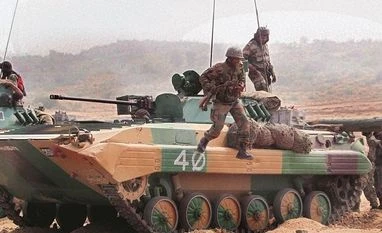
military, armed force, army, army tank
Ajai Shukla New Delhi
3 min read Last Updated : Jul 07 2019 | 1:43 AM IST
The modest 6.35 per cent rise in defence allocations – from Rs 405,193 crore in last year’s revised estimates, to Rs 431,011 crore in Friday’s Budget – presents an even more worrying picture when the budget is disaggregated.

A Business Standard analysis of the defence budget in a three-year window indicates that most of this scanty rise is accounted for by the revenue heads of manpower and running expenses. Meanwhile, the important capital budget component, which funds equipment modernisation, has grown significantly slower.

From the baseline of the 2016-17 budget to the present, three annual increments have raised spending on the three services by a total of 23 per cent. During this period, allocations for manpower (including salaries and pensions) have grown by 26 per cent, while running costs have grown by 25 per cent. In comparison, the capital budget has grown by only 15 per cent, averaging barely four per cent each year.

This factors in allocations made to the army, navy, air force and coast guard; but not to the defence ministry, the Ordnance Factories (OFs) and the Defence R&D Organisation (DRDO). It also assumes the defence budget will be spent in full this year, rather than returning a part of it unspent, as has happened in preceding years.

Government sources argue this year’s capital allocation of Rs 108,248 crore cannot be increased further, since it already accounts for one-third of the central government capital expenditure of Rs 3,38,569 crore.

Defence industry executives also underline a compensatory factor: the benefits of customs exemption that Finance Minister Nirmala Sitharaman announced on the import of defence goods that are not made in the country. This will make defence imports cheaper by 10.3 per cent, which is the basic customs duty, and effectively increase the capital allocation by 5.15 per cent, assuming half of all capital procurements are imported.

Effectively reduced by 10.3 per cent will be the prices of Rafale fighters, P-8I maritime patrol aircraft, naval helicopters, Apache and Chinook helicopters from the US and S-400 missile systems, Krivak class frigates and a nuclear submarine in the pipeline from Moscow.  

There is uncertainty over who will control the DRDO’s research budget, which amounts to Rs 10,484 crore this year. In her budget speech, Sitharaman announced that the government proposed to establish a National Research Foundation (NRF) to “fund, coordinate and promote research in the country.”

“NRF will assimilate the research grants being given by various Ministries independent of each other”, she said. It is unclear whether the DRDO budget will be subsumed under this.

Besides the DRDO’s research budget, the government allocated Rs 95 crore towards “Make” category projects, which involve Indian companies developing complex defence platforms. Last year, the defence budget had allocated Rs 142 crore under this head, but the revised estimates brought it down to Rs 2 crore, indicating that the money had remained unspent.

The budget has dissatisfied all three services, who believe their role entitles them to a larger share of the defence budget. The army, by far the largest service, which is involved in counter insurgency duties year-round, notes that its share has come down over the last three years from 68.5 per cent to 66.5 per cent of the military budget.

The navy, which backstops the country’s Indo-Pacific strategy and requires more warships, wants more than the 13.75 per cent that its allocation is stagnating at. The air force, whose budget has grown by almost two percentage points, wants a larger capital budget to fund a slew of fighter purchases in the pipeline. 

One subscription. Two world-class reads.

Already subscribed? Log in

Subscribe to read the full story →
*Subscribe to Business Standard digital and get complimentary access to The New York Times

Smart Quarterly

₹900

3 Months

₹300/Month

SAVE 25%

Smart Essential

₹2,700

1 Year

₹225/Month

SAVE 46%
*Complimentary New York Times access for the 2nd year will be given after 12 months

Super Saver

₹3,900

2 Years

₹162/Month

Subscribe

Renews automatically, cancel anytime

Here’s what’s included in our digital subscription plans

Exclusive premium stories online

  • Over 30 premium stories daily, handpicked by our editors

Complimentary Access to The New York Times

  • News, Games, Cooking, Audio, Wirecutter & The Athletic

Business Standard Epaper

  • Digital replica of our daily newspaper — with options to read, save, and share

Curated Newsletters

  • Insights on markets, finance, politics, tech, and more delivered to your inbox

Market Analysis & Investment Insights

  • In-depth market analysis & insights with access to The Smart Investor

Archives

  • Repository of articles and publications dating back to 1997

Ad-free Reading

  • Uninterrupted reading experience with no advertisements

Seamless Access Across All Devices

  • Access Business Standard across devices — mobile, tablet, or PC, via web or app

Topics :Union Budget 2019budget 2019

Next Story




