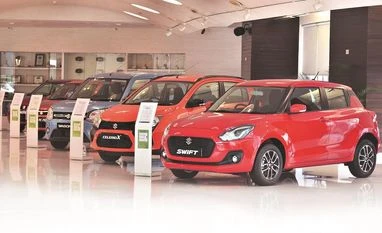
Why Maruti remains big on small cars, even when India shifts to larger cars

MSIL, the quintessential maker of small cars, has not fallen short of taking a bet on small hatchbacks even when there seems to be a structural shift in the Indian market towards larger cars

Maruti Suzuki cars
Maruti Suzuki cars
Sohini Das Mumbai
6 min read Last Updated : Dec 18 2023 | 11:34 PM IST
At the end of October, while declaring its financial results, Maruti Suzuki India Ltd (MSIL) reported that sharp growth in its utility vehicle (UV) sales had taken its revenue and net profit to record levels. However, Chairman R C Bhargava chose to
speak passionately about small cars, which had shown a drop in a rising market.

“Without growth at the entry level and the small car segment in a market like India, sustained high levels of growth in the car industry are very unlikely,” Bhargava said.
 
MSIL, the quintessential maker of small cars, has not fallen short of taking a bet on small hatchbacks even when there seems to be a structural shift in the Indian market towards larger cars. Hatchbacks enjoyed a 46 per cent share of the passenger vehicle market in 2018-19. It came down to 34.4 per cent in 2022-23. Passenger vehicles consist of passenger cars — hatchbacks and sedans — and utility vehicles.
 
However, in terms of absolute numbers, sales of hatchbacks increased from 1,151,765 units in 2021-22 to 1,338,636 units in 2022-23.
 
Shashank Srivastava, senior executive officer, marketing and sales, MSIL, believes that in FY24 this number is likely to touch 1.2 million units — a slight decline, but still a tidy number.
 
“It is still a substantial volume. MSIL sold 946,000 passenger cars in FY23, which is more than its nearest rival’s total sales for that year,” Srivastava says. The sheer volumes, according to him, are the reason why no manufacturer can completely ignore this segment.
 
“By 2030-31, around 25 per cent of the passenger vehicle market would be passenger cars. In volume terms it would be 1.5 million to 1.6 million cars if we consider the passenger vehicle market to be 6 million units,” he says.


First-time fervour
 
MSIL’s optimism stems from the fact that 65 per cent of India’s population is under 35 years of age and around 45 per cent of car buyers are still first-time buyers. “We still don’t have an evolved public transport system and the need for private mobility is high. Many cannot afford a higher-end vehicle. Therefore, as the economy grows, we are expecting this segment will make a comeback,” Srivastava says.
 
Not everyone is on the same page. In a recent interview with CNBC-TV18, Shailesh Chandra, managing director, Tata Motors Passenger Vehi­cles and Tata Passenger Electric Mobility, said the 54 per cent drop in sales of entry-level cars in July-September this year should worry auto majors.
 
“It is definitely a cause for concern for players strong in hatchback and sedan segments,” Chandra had said,.“This is because there is a continuous gravitation of demand towards SUVs — sedans and hatchbacks will be under pressure.”
Srivastava, however, reasons that all car companies may not remain committed to this segment because their volumes do not sustain the unit economics. Several carmakers pulled the plug on their small car models in the last few years. Volkswagen stopped the Polo, Nissan no longer makes the Micra, Hyundai does not make the Santro anymore, and Maruti discontinued
the Alto 800.
 
Puneet Gupta, director-mobility, S&P Global, says several factors have played a role in the decline of the small car market. “For starters, prices of cars have gone up by 40 to 45 per cent in the last few years owing to changes in safety regulations, emission norms, etc. The gap between the price of a two-wheeler and an entry-level car is going up steadily. Gone are the days when one could afford a car starting at Rs3 lakh or so,” Gupta tells Business Standard.
 
Since a large portion of the Indian car market is of first-time buyers, the used-car market comes into play. “As the new car goes out of their reach, many are going for a used car, instead. The used car market has also become more organised. So, many are now switching from a two-wheeler to a used car, premium hatch or sedan, and then they upgrade to a mini SUV,” Gupta says.
 
Indeed, market sources say there is healthy growth in sales of mini-SUVs, such as Tata Punch and Hyundai’s Exter.
A senior executive with a car company says the Indian market, in some aspects, is going the same way as Europe. “Europe also witnessed a clear preference for bigger cars. At present, the average price of a car in India has gone up from Rs5-6 lakh a few years back to around Rs10 lakh. So, most are opting to go for a bigger car with better safety features,” he says. However, he also points out that Europe is now witnessing a revival of the small electric car.
 
India may go down the same lane.
 
Gupta of S&P Global agrees. “Eventually, small, lightweight, tech-savvy electric cars may become popular in India. That could trigger the revival of the small car in this market,” he says, adding that this is more likely to happen around 2030, when battery prices come down.

Electric charge
 
Some companies are already racing down the electric lane. French automaker Renault, whose small car Kwid is losing sales every month, is considering bringing in a new electric car to India based on the Spring Electric architecture, which is available in Europe. For this, Renault and its part­ner Nissan together plan to invest Rs5,300 crore.
Venkatram Mamillapalle, country chief executive officer (CEO) and managing director, Renault India, spoke in August about plans to launch new vehicles in 2024, among them the Spring-based electric car, which is close to the Kwid. It would be made in Renault’s India plant.
 
There is indeed a market for small electric cars, usually as a second car in the family, as demonstrated by Tata’s Tiago electric and MG’s Comet. Others such as Mahindra and Mahindra have chosen to stay away from the small car segment altogether.
“When you see the adoption cycle of EVs, we feel the SUV customer would adapt to an EV faster. Many SUV customers are multi-car households, as are our M&M customers,” Rajesh Jejurikar, ex­ecutive director and CEO of auto and farm sectors, M&M, told Business Standard earlier this year.
 
Maruti, however, remains interested and invested in small cars. Unsurprisingly, it enjoys nearly 90 per cent share of the entry-level hatchback market and more than 70 per cent share of the mid-size hatch market. In premium hatches, which is the Baleno’s playfield, it has a 62 per cent share.
And it is counting on the rising income levels of the Indian middle class.


One subscription. Two world-class reads.

Already subscribed? Log in

Subscribe to read the full story →
*Subscribe to Business Standard digital and get complimentary access to The New York Times

Smart Quarterly

₹900

3 Months

₹300/Month

SAVE 25%

Smart Essential

₹2,700

1 Year

₹225/Month

SAVE 46%
*Complimentary New York Times access for the 2nd year will be given after 12 months

Super Saver

₹3,900

2 Years

₹162/Month

Subscribe

Renews automatically, cancel anytime

Here’s what’s included in our digital subscription plans

Exclusive premium stories online

  • Over 30 premium stories daily, handpicked by our editors

Complimentary Access to The New York Times

  • News, Games, Cooking, Audio, Wirecutter & The Athletic

Business Standard Epaper

  • Digital replica of our daily newspaper — with options to read, save, and share

Curated Newsletters

  • Insights on markets, finance, politics, tech, and more delivered to your inbox

Market Analysis & Investment Insights

  • In-depth market analysis & insights with access to The Smart Investor

Archives

  • Repository of articles and publications dating back to 1997

Ad-free Reading

  • Uninterrupted reading experience with no advertisements

Seamless Access Across All Devices

  • Access Business Standard across devices — mobile, tablet, or PC, via web or app

Topics :Maruti SuzukiMaruti Suzuki EVMaruti Suzuki Balenoautomobile manufacturer

Next Story