Material recycling leads $ 668 mn funding for circular economy technologies
Next-generation recycling is on the march as waste collection and sorting get a digital push from innovations in software, data analytics, and robotics, says Lux Research
BS B2B Bureau Boston, Massachusetts Material recycling innovations received the most funding among ‘circular economy’ technologies - innovations that reduce waste or convert waste into valuable new products - according to Lux Research. Of the total funding of $ 668 million from 2011 through the first quarter of 2016, material recycling captured a 69 percent share and accounted for 65 percent of the total 155 deals. Waste-to-energy, a dominant force a decade ago, got 16 percent of the funding, followed by wastewater treatment.
“Waste collection and sorting are experiencing disruptive changes due to the innovations based on software, data analytics, and robotics. The sorting segment has a hotspot in robotic-based technologies, and may integrate into collection or processing segments in the future,” said Jerrold Wang, Lux Research analyst and lead author of the report titled, ‘Observing trends from VC investment activities to material recycling fields’.
Lux Research analysts used Pitchbook data from 2011 to the first quarter of 2016 to evaluate funding for circular economy-related innovations including material recycling technologies.
As per the report, the US matched Europe in the amount of investment but saw more deals -$ 310 million in funding for 84 deals, compared to $ 308 million for 52 deals in Europe. Among individual countries, the UK led Europe with 11 deals worth over $10 million in funding.
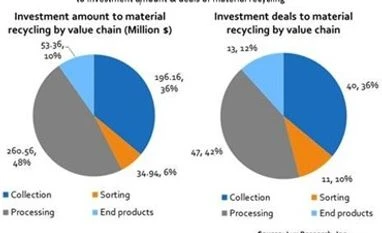
Within the material recycling segment, waste processing topped funding with a 48 percent share and number of deals with a 42 percent share. Waste collection came second in both, with an identical 36 percent share in both funds and deals. Waste processing was dominated by material-specific technologies, while waste collection had switched from these technologies to software and data analytics.
In terms of funding stage, waste collection got more late stage deals, many related to IT innovations. Seed-stage investment in waste processing covered a wide range of materials, while later stage deals focused on commonly recycled materials.

 "Material recycling leads $ 668 mn funding for circular economy technologies")


 Connect with us on WhatsApp