Polimotor 2 to use Solvay's KetaSpire PEEK for 3D-printed fuel intake runner
The Polimotor 2 project aims to develop an all-plastic, four-cylinder, double-overhead CAM engine that weighs about 41 kgs less than today's standard automotive engine
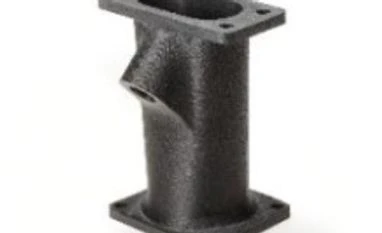
3D-printed fuel intake runner made using Solvay’s KetaSpire PEEK polymer
The Polimotor 2 project, led by legendary automotive innovator Matti Holtzberg, will feature a 3D-printed fuel intake runner fabricated from a reinforced grade of Solvay’s KetaSpire polyetheretherketone (PEEK). Arevo Labs, a leader in additive manufacturing technology for composite parts, produced the part using its innovative Reinforced Filament Fusion technology. Solvay is the principal material sponsor for this highly anticipated technical project, which aims to design and manufacture a next-generation, all-plastic engine for competitive racing in 2016.
“The intake runners in the original Polimotor engine were made from aluminium, but today the automotive industry relies almost entirely on injection-moulded nylon. That choice of materials is changing now too, as automakers seek innovative new alternatives like Solvay’s PEEK that can withstand rising under-the-hood temperatures caused by the growing use of turbochargers and engine downsizing, both of which are resulting in higher specific power outputs,” said Holtzberg, who is also president of Composite Castings LLC, based in West Palm Beach, Florida (USA).
Appearing in both racing and production-scale cars, intake runners are typically integrated with an engine’s plenum, which is the pressurised chamber that uniformly distributes air flow between an engine’s air inlet and its cylinders. A transition piece between the cylinder head and the plenum chamber, an intake’s function is to inject fuel into the air stream just as it enters the engine and its performance has a direct influence on the engine’s horsepower.
Replacement of the original aluminium runner with PEEK reduced the part’s weight by 50 percent. The specific material chosen for Polimotor 2 was a custom-formulated grade of KetaSpire KT-820 PEEK reinforced by a 10 percent carbon fibre loading. One of Solvay’s highest performing polymers, KetaSpire PEEK offers excellent chemical resistance to automotive fuels as well as reliable mechanical performance at continuous-use temperatures up to 240°C (464°F). These qualities made it a highly suitable candidate for Polimotor 2’s fuel intake runner, which encounters temperatures reaching 150°C (302°F) near the pistons in the intake port.
Like conventional filament fusion 3D printing processes, Arevo’s technology bonds polymer filaments on top of or alongside each other in successive stages to ultimately form complex shapes. Thus it can quickly convert digital designs into functional parts without the time or cost required to first build a moulding tool and prototype. However, the company’s Reinforced Filament Fusion platform offers the unique ability to print with reinforced PEEK polymers. When combined with Arevo’s process control software, the platform can help optimise the mechanical properties of printed parts.
The Polimotor 2 project aims to develop an all-plastic, four-cylinder, double-overhead CAM engine that weighs between 138 to 148 lbs (63-67 kg), or about 90 lbs (41 kgs) less than today’s standard production engine. In addition to the current fuel intake runner application, Holtzberg’s groundbreaking program will leverage Solvay’s advanced polymer technology to develop up to ten engine parts. These include a water pump, oil pump, water inlet/outlet, throttle body, fuel rail and other high-performance components.

 "Polimotor 2 to use Solvay's KetaSpire PEEK for 3D-printed fuel intake runner")


 Connect with us on WhatsApp