Over 4 million Beedi workers likely to get relief on pension math

Labour min to examine classifying beedi industry as 'seasonal' establishments
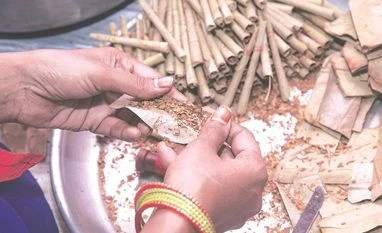
beedi worker
The study by the EPFO showed that a pensioner from the beedi industry had 32 NCP days per year, compared to 15 NCP days for all other pensioners
Shiva Rajora New Delhi
3 min read Last Updated : May 13 2025 | 9:58 PM IST
In a move that could benefit over 4 million beedi workers in nearly 8,000 establishments covered under the Employees’ Provident Fund Organisation (EPFO), the Union labour ministry is going to examine classifying the beedi industry as “seasonal” establishments. The move will relax the “non-contributory period” (NCP) norms under the Employees’ Pension Scheme, 1995 (EPS-95) for beedi workers, making it easier for them to qualify for pension benefits.
 
A non-contributory period (NCP) refers to a period when an employee is absent from work and does not receive wages. During such periods, no contribution is made to the employee's provident fund (PF) or pension account. This provision was introduced by EPFO under EPS-95 in 2015, making it mandatory for a subscriber to contribute for 240 days per year for at least 10 years to become eligible for pension. If an industry is classified as “seasonal” activity, however, the number of contributing days in a year is reduced to 120.
 
The issue was discussed in the last meeting of the Central Board of Trustees (CBT) of the EPFO, held on February 28, with vice-chairman (Union Minister of State for Labour & Employment) recommending “sharing of relevant data and revisiting the matter to understand the specific reason of unavailability of raw material (tendu leaves),” draft minutes of the meeting show.
 
The vice-chairman of the apex decision-making body of the social security organisation further directed holding field visits and ‘taking assistance’ from the state labour departments to re-examine the issue.
 
Sunkari Mallesam, member of the CBT, raised the issue and said beedi workers become ineligible for pensions under EPS-95 due to non-contributory days, as they are not employed round the year due to unavailability of tendu leaves. “Beedi making is a cottage industry, with women constituting the majority of the workforce. Availability of work is irregular due to unavailability of tendu leaves all the year around. Hence, it takes workers around 20 years to become eligible for pension under the scheme,” Mallesam told Business Standard.
 
Currently, plantations like tea, coffee, rubber, cardamom, besides fireclay and gypsum mines, among others, are considered “seasonal” establishments.
 
Meanwhile, the central provident fund commissioner (CPFC) said at the meeting that the issue had been thoroughly discussed earlier, and a comprehensive study was conducted, the findings of which were shared in previous meetings. He added that no seasonality was observed in the industry, so reconsidering the beedi industry as a seasonal industry would not be appropriate, and re-examination of the issue was not warranted.
 
The study by the EPFO showed that a pensioner from the beedi industry had 32 NCP days per year, compared to 15 NCP days for all other pensioners.
 
“This difference is small and indicates that there is no visible off-season effect on the contributory service in the beedi industry. The average NCP days are found to be fewer in the beedi industry compared with the building & construction, textiles & garments, engineering, and expert services,” the study had noted. 
Easing measures
 
> Unavailability of tendu leaves (raw material) causes work disruption
> Over 4 million beedi workers across 8,000 establishments under EPFO may benefit
> The classification will reduce required non-contributory period days to 120 per year
> Industries like tea, coffee, rubber plantations, and gypsum mines already classified as seasonal
> EPFO argues no strong seasonality is observed

One subscription. Two world-class reads.

Already subscribed? Log in

Subscribe to read the full story →
*Subscribe to Business Standard digital and get complimentary access to The New York Times

Smart Quarterly

₹900

3 Months

₹300/Month

SAVE 25%

Smart Essential

₹2,700

1 Year

₹225/Month

SAVE 46%
*Complimentary New York Times access for the 2nd year will be given after 12 months

Super Saver

₹3,900

2 Years

₹162/Month

Subscribe

Renews automatically, cancel anytime

Here’s what’s included in our digital subscription plans

Exclusive premium stories online

  • Over 30 premium stories daily, handpicked by our editors

Complimentary Access to The New York Times

  • News, Games, Cooking, Audio, Wirecutter & The Athletic

Business Standard Epaper

  • Digital replica of our daily newspaper — with options to read, save, and share

Curated Newsletters

  • Insights on markets, finance, politics, tech, and more delivered to your inbox

Market Analysis & Investment Insights

  • In-depth market analysis & insights with access to The Smart Investor

Archives

  • Repository of articles and publications dating back to 1997

Ad-free Reading

  • Uninterrupted reading experience with no advertisements

Seamless Access Across All Devices

  • Access Business Standard across devices — mobile, tablet, or PC, via web or app

Topics :EPFObeediAgriculture

Next Story


