Union Finance Minister
Nirmala Sitharaman on Thursday introduced the Income Tax Bill, 2025, in the Lok Sabha and urged Speaker Om Birla to constitute a select committee to examine the proposed piece of legislation.
“The terms and conditions regarding the committee will also be decided by the honourable Speaker. The committee shall make a report by the first day of the next session,” Sitharaman said after the House passed a motion by voice vote allowing the introduction of the Bill, amid protests from Opposition parties.
According to the “Frequently Asked Questions” (FAQs) released by the Central Board of Direct Taxes (CBDT), after a Bill is passed by Parliament and it becomes an Act, new rules and forms will be notified and simultaneously software development will be carried out to set up the systems and processes for various administrative and quasi-judicial functions.
The FAQs said a section-wise mapping of the old and new laws would be made available on the official website of the Income Tax Department.
The CBDT said the documents (Direct Tax Codes) prepared in 2009 and 2019 were referred while preparing the Bill. The FAQs said about 1,200 provisos and 900 explanations had been removed from the draft Bill.
The FAQs stated that all the provisions pertaining to salaries and deductions such as gratuity, leave encashment, commutation of pension, compensation on the voluntary retirement scheme and retrenchment compensation had been consolidated at one place for ease of understanding so that the taxpayer did not have to refer to separate chapters for filing his income-tax return.
Justifying the introduction of the concept of “tax year” in place of “previous year” and “assessment year”, the FAQs stated that many of the comparable tax jurisdictions in the world were using one single term for denoting the unit period of taxation.
“This term shall be referred to in respect of all transactions and income for that period,” it added.
Aditi Goyal, partner at Trilegal, said while the attempt to make the law simple was laudatory, a few aspects required consideration. “For instance, the definition of income in the new Bill has more than 20 line items. The last line item classifies ‘any other income referred to in section 2(24) of the Income Tax Act, 1961’ as income as well. This would imply that to this extent, the new law would need to be read along with the existing Act, which should ideally not be the case, given the intent with which the new law has been proposed,” she added.
During the discussion before the introduction of the Bill, West Bengal Member of Parliament (MP) Saugata Roy said there was no need to revise the Income Tax Act, 1961, because it was serving the purpose. He said that the Bill was not needed to be introduced because the basic purpose remained the same and termed the changes “mechanical”.
N K Premachandran, MP from Kerala’s Kollam, and Chandigarh MP Manish Tewari opposed the new Bill, alleging that it had more Sections than the old Act.
Responding to these arguments, Sitharaman said: “They’re not mechanical changes. Substantial changes are being made. The number of words has come down by half, sections and chapters have been reduced.”
On the number of Sections in the new Bill, Sitharaman clarified that while the IT Act, 1961, initially had 298 Sections, amendments over the years too them to 819.
“From that, we’re bringing it down to 536. So, he should look at what it is today rather than what it was in 1961,” she said.
The Road Ahead
* Select committee to submit its report by the first day of the next session
* Section-wise mapping of old and new laws to be available online
* 1,200 provisos and 900 explanations removed for simplification
* 'Tax year’ replaces ‘previous year’ and ‘assessment year’ for clarity
* Salary-related provisions consolidated for easier tax filing
* New rules and forms to be notified after the bill is passed by the Parliament
* Direct Tax Codes from 2009 and 2019 were referenced in drafting the bill

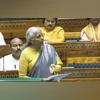 "FM Nirmala Sitharaman introduces new Income-Tax Bill in Lok Sabha")


