After a gap of more than two years amid a tumultuous bilateral relationship, India and Canada have finalised a broad framework and agreed to restart negotiations for a Comprehensive Economic Partnership Agreement (Cepa).
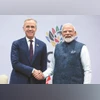
Prime Minister Narendra Modi and his Canadian counterpart, Mark Carney, met late on Sunday on the sidelines of the G20 Summit in Johannesburg and agreed to advance relations in trade, investment, technology & innovation, energy, education, defence, and the space sector.
“India and Canada have great potential in strengthening trade and investment linkages. We have set a target of $50 billion by 2030 for our bilateral trade. Canadian Pension Funds are also showing keen interest in Indian companies,” Modi posted on X.
Speaking at the Indo-Canadian Business Chamber’s annual national convention on Monday in New Delhi, Union Commerce and Industry Minister Piyush Goyal said both countries had finalised the terms of reference and decided to launch and fast-track free-trade agreement negotiations.
“The recent meetings that Prime Minister Modi and Prime Minister Mark Carney have had, including the one very recently at the G20 Summit, clearly give a direction for the future of the Canada-India relationship. They have agreed to begin negotiations for a high-ambition comprehensive economic partnership agreement,” the minister said.
Goyal further said that the two countries were natural allies that did not compete with each other, creating significant opportunities for businesses and investors.
In March 2022, New Delhi and Ottawa formally relaunched talks for a comprehensive trade deal to create new opportunities for boosting trade and investment flows. It was also decided that an early progress trade agreement (EPTA) would be a transitional step towards a CEPA.
However, talks stalled more than two years ago as ties between India and Canada plummeted to an all-time low following a diplomatic spat over the killing of the Khalistani separatist Hardeep Singh Nijjar in June 2023. The then Canadian prime minister, Justin Trudeau, had alleged a potential India link to the killing, with New Delhi categorically rejecting the allegations. Negotiations at that point were at an advanced stage and both sides had hoped to finalise the deal by the end of 2023.
Eye on critical minerals
Goyal said India saw considerable scope for collaboration with Canada in critical minerals, mineral processing technologies, clean energy, nuclear energy, and supply-chain diversification. India also offered strong advantages in emerging technologies such as artificial intelligence, machine learning, and next-generation data centres.
“There is a lot that we can learn from Canada and a lot we can offer Canada. There is a lot of potential on critical minerals, critical minerals processing technologies. There is a good possibility on nuclear energy -- particularly with our engagement with Canada on uranium supplies,” the minister said, adding that supply chains could be diversified on both sides.
India–Canada cooperation on critical minerals has gained momentum, accelerated at the June 2025 G7 summit where Modi and Carney met to lead India to endorse Canada’s Critical Minerals Action Plan.
India-Canada cooperation on critical minerals has gained momentum after the June 2025 G7 Summit where Modi and Carney met and led India to endorse Canada’s Critical Minerals Action Plan.
This was reinforced by high-level engagements throughout 2025, including the Canadian foreign minister, Anita Anand’s visit to Delhi and discussions on mineral reserves, mining expertise and uranium supply.
Canada, meanwhile, has committed nearly 4 billion Canadian dollars to its critical minerals sector since unveiling its Critical Minerals Strategy in 2022. This includes a new 2 billion Canadian dollar sovereign fund to expand mining, refining and processing capacity with foreign partners. It creates strong complementarities with India’s expanding overseas sourcing strategy
Trade relations
Despite Canada’s strategic importance for India, the volume of trade between the two countries remains limited. India exported goods worth $2.26 billion during the first six months (April-September) of the 2025-26 financial year, up 12.9 per cent year on year. Major Indian exports include medicines, garments, diamonds, chemicals, gems and jewellery, seafood, engineering goods and rice. The share of exports stood at only 1 per cent.
Imports from Canada, meanwhile, contracted 38.4 per cent to $1.48 billion during April-September. India’s import dependency on Canada, compared with the rest of the world, is only 0.4 per cent and is dominated by items such as pulses, crude oil, fertilisers, aircraft and aviation equipment, diamonds and bituminous coal.
Start, stop, restart
- Nov 2010: Talks launched
- Aug 2017: 10th round of negotiations concluded; virtual talks followed in 2020
- Mar 2022: Talks formally re-launched
- Sep 2023: Talks stalled amid diplomatic tensions

 "India and Canada to reboot trade deal negotiations after 2 years")


