Kolkata leather units hit by US tariffs, eye UK and EU markets for relief

With US tariffs on leather products doubled to 50%, exporters in Kolkata face shrinking orders and margin pressure, while betting on UK and EU deals for recovery
leather industry, Kolkata leather industry
Exporters are still pinning hopes on an eventual India–US trade deal.
Ishita Ayan Dutt Kolkata
6 min read Last Updated : Sep 09 2025 | 12:25 AM IST

Don't want to miss the best from Business Standard?

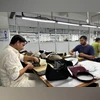
Across four floors of a Kolkata leather factory, about 380 workers stitch and assemble handbags and wallets at a steady tempo. The pieces, many bearing the unmistakable ‘Boss’ logo, are neatly stacked in rows ready to move to the next table for another task -- the rhythm of work seemingly untouched by the US tariff-led disruption. 
 
The United States (US) – Crescent Exports’ biggest market – has raised tariffs to 50 per cent, a blow that has slowed the flow of orders. But for now, the bustle of the manufacturing unit spread across 85,000 square feet masks the uncertainty of shrinking margins and potential impact on employment. 
 
“We had strong orders from the US, but the additional 25 per cent tariff imposed by the US has really shaken us,” M Azhar, managing director of Crescent Exports Syndicate, said. About 60 per cent of Azhar’s business is US-focused, where orders are now on hold. 
 
The company runs three units out of the Calcutta Leather Complex (CLC) -- a vast 1,100-acre hub at Bantala on Kolkata’s eastern fringes. 
 
Spread out like a self-contained complex, it brings together tanneries, processing and manufacturing units even as pockets of manufacturing still linger in the old Tangra, Topsia and Tiljala neighbourhoods -- the original base of leather trade in Kolkata. The tanneries shifted here in the early 2000s following a Supreme Court order. 
 
When the additional 25 per cent penalty for buying Russian oil landed, it caught the units doing business with the US completely off guard. 
 
This was over and above the 25 per cent reciprocal tariff announced by the US on August 1 and implemented on August 7. The Russian penalty applied to shipments after 21 days -- from August 27 onwards -- and most exporters made good of the window.
 
The scramble
 
“Whatever goods were ready before the August 27 deadline, we rushed them out by air. Normally, most of our shipments go by sea, but we thought it would be good to recover as much of the money as possible,” Azhar said. 
 
The company manufactures handbags and wallets for Hugo Boss’ global markets, but shipments to the US are now on hold. Apart from Hugo Boss, Azhar also supplies to department stores like Macy’s, Walmart there. 
 
For Kevin Juneja, managing director, JC International, the additional 25 per cent tariff was a shocker. “We didn’t see it coming, our clients didn’t see it coming.” 
 
About 30 per cent of Juneja’s business is in the US. “Typically, October-December is a slow quarter for the industry -- it may be slower this year.” 
 
“At the moment, there is stalemate; customers are probably exploring other countries -- the difference is about 25 per cent with competing countries. And that potentially puts a dent on future orders,” Juneja explained. 
 
However, the existing orders are still being sent out. April to mid-October is the peak season for leather exports -- especially with Christmas around the corner.
 
The ripple effect
 
Both Christmas in the West and festivities at home have been clouded by the US tariff. And there’s bound to be repercussions on the ecosystem. 
 
Azhar has three factories. “I may have to shut down at least one of the units if this is not resolved,” he said.
 
That call will be taken after the festival season. Leather is a labour-intensive trade and across three factories, Crescent has about 1,500 workers. 
 
Juneja’s business is vertically integrated. As part of forward integration, it has a partnership with a design house in the UK. “If the US business shrinks, we will have to shrink our design house capabilities,” Juneja said. 
 
The leather sector in India, especially in states like Tamil Nadu, Uttar Pradesh, West Bengal and Punjab are heavily dependent on exports with the US being a key market, Nari Kalwani, chairman and managing director, Asian Leather Private Limited, said. 
 
“MSMEs, which make up the backbone of this industry, are now facing reduced orders, rising inventories, job losses, declining profitability and long-term loss of market share in the US — a market that has taken years to develop,” he pointed out. 
 
Rahul Guha, senior director, Crisil Ratings, said that with the increase in the US import tariff to 50 per cent, India’s overall export volumes of leather products are expected to decline year-over-year (YoY) by around 15-20 per cent, despite a 3 per cent growth in the first quarter (Q1) in the current fiscal, “As a result, players’ operating margins are expected to come under pressure.”
 
Rethinking strategy
 
Exporters are still pinning hopes on an eventual India-US trade deal, even as they recalibrate strategies to contain losses. Fresh messaging between Donald Trump and Prime Minister Narendra Modi over the weekend has offered a glimmer of hope. In the interim, alternative options are keeping hopes alive. 
 
Ramesh Juneja, director, JC International and vice chairman of Council for Leather Exports, said, “The FTA with the UK has to be ratified in the UK Parliament. Once that happens, business will double.” 
 
Diversifying into new markets doesn’t happen overnight. But exporters also believe that some realignment is possible. The US offers volume but thin margins; Europe, fewer orders, but better returns.
“We are trying to get more orders from Europe,” Azhar said. He added that exporters were also talking about setting up a manufacturing base in Vietnam and Sri Lanka. “But these are long-term strategies.” 
 
In GST reforms, the reduction in rate from 12 per cent to 5 per cent on intermediate leather goods is prompting some exporters to explore the domestic market. “The domestic market will boom with the reduction in GST and may provide an opportunity. But we have to plan it out -- it’s a different market with its own set of preferences,” Azhar pointed. 
 
Kevin Juneja, however, said: “Leather is a costly product and at that price point it is slow-moving in India.” 
 
For exporters, the quickest fix right now would be a US-India rapprochement. 
Under pressure
  • India exported around $4.3 billion worth of leather and leather products in FY25
  • The US is the largest importer of Indian leather, accounting for around 20 per cent of the country’s exports
  • Tamil Nadu, UP, and West Bengal are top contributors to Indian leather exports
  • West Bengal has about 538 tanneries, 230 leather footwear units and 436 leather goods units; about 700,000 are employed directly and indirectly
 

One subscription. Two world-class reads.

Already subscribed? Log in

Subscribe to read the full story →
*Subscribe to Business Standard digital and get complimentary access to The New York Times

Smart Quarterly

₹900

3 Months

₹300/Month

SAVE 25%

Smart Essential

₹2,700

1 Year

₹225/Month

SAVE 46%
*Complimentary New York Times access for the 2nd year will be given after 12 months

Super Saver

₹3,900

2 Years

₹162/Month

Subscribe

Renews automatically, cancel anytime

Here’s what’s included in our digital subscription plans

Exclusive premium stories online

  • Over 30 premium stories daily, handpicked by our editors

Complimentary Access to The New York Times

  • News, Games, Cooking, Audio, Wirecutter & The Athletic

Business Standard Epaper

  • Digital replica of our daily newspaper — with options to read, save, and share

Curated Newsletters

  • Insights on markets, finance, politics, tech, and more delivered to your inbox

Market Analysis & Investment Insights

  • In-depth market analysis & insights with access to The Smart Investor

Archives

  • Repository of articles and publications dating back to 1997

Ad-free Reading

  • Uninterrupted reading experience with no advertisements

Seamless Access Across All Devices

  • Access Business Standard across devices — mobile, tablet, or PC, via web or app

Topics :Trump tariffstrump tariffKolkataleather industry in IndiaLeather industry

Next Story



