Home / Economy / News / Trump's tariffs: Mobile makers assembling phones in India set to gain
Trump's tariffs: Mobile makers assembling phones in India set to gain
In many other countries, including Saudi Arabia, Brazil, Turkiye, Egypt and the UAE, the US has imposed a reciprocal duty of only 10 per cent
premium
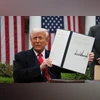
US President Donald Trump holds a signed executive order on tariffs, in the Rose Garden at the White House in Washington, DC, April 2, 2025. (Photo: Reuters)
5 min read Last Updated : Apr 04 2025 | 12:27 AM IST
India could gain a competitive advantage over key global rivals — China and Vietnam — in exporting smartphones to the United States, led by companies like Apple Inc. However, it might also face the risk of losing future business for assembling phones if global smartphone companies decided to shift production to countries like Brazil, Turkiye or Saudi Arabia, which now attract lower US duties.
The US administration announced new reciprocal tariffs early Thursday morning India time. While India now faces a 27 per cent tariff on exports to the US, China’s tariff has increased to 54 per cent from 20 per cent earlier, and Vietnam has been hit with a new tariff of 46 per cent. Earlier, mobile phones were imported duty-free into the US.
In many other countries, including Saudi Arabia, Brazil, Turkiye, Egypt and the UAE, the US has imposed a reciprocal duty of only 10 per cent. Many smartphone companies say they will relook at their strategy and hedge their bets. The good news for India is that the tariff advantage wipes out its cost disability in production — estimated at 8-12 per cent compared to Vietnam, and 13-15 per cent versus China, even after factoring in the production-linked incentive. As of 2024, India exported smartphones worth $5 billion to the US, which made it the largest category of Indian exports by value under Harmonised System codes.
Indian Cellular and Electronics Association President Pankaj Mohindroo said: “India has emerged favourably placed in the first round of reciprocal tariff announcements, especially compared to key electronics export competitors like China, Vietnam, Thailand and Indonesia, following the relentless efforts by our negotiators and leaders. While some countries like Brazil and Egypt enjoy marginally better tariff outcomes, India’s positioning — particularly with China and Vietnam facing combined tariffs of 54-79 per cent and 46 per cent, respectively — offers a valuable near-term window of export competitiveness.” However, despite the advantage, there is concern that the tariff hike would make phones far more expensive for US consumers, potentially leading to a sharp fall in demand — impacting the entire value chain.
That is why India is banking on a bilateral trade agreement (BTA). Industry representatives have suggested the government bring down import duties on mobile devices to zero from the current 16.5 per cent. Mohindroo said: “The true long-term inflexion point for India's electronics trade with the US will rest on the successful conclusion of a BTA. It must now become the cornerstone of our trade strategy, unlocking stable market access, tariff predictability, and a framework for scaling high-value electronics exports.”
Global smartphone players are likely to explore alternatives. In Brazil, for instance, Apple already operates a Foxconn plant in Sao Paulo, which is now mass-producing the iPhone 16 — the first time a newly launched iPhone has been manufactured in Brazil. Earlier, the plant was limited to producing older models like the iPhone 14 and 15. The facility was established to bypass Brazil’s high import tariffs and avoid supply-chain disruptions.
Apple Inc Chief Executive Tim Cook recently visited Saudi Arabia and met the crown prince, who is offering a range of incentives to set up an electronics and high-tech hub to attract investors — leveraging labour from India and other countries. Turkiye, too, has a vibrant mobile manufacturing industry, with companies like Xiaomi, Vivo, TCL, Oppo and General Mobile operating assembly units that cater to both domestic and global markets.
Apple currently assembles around 85 per cent of its iPhones in China and about 14 per cent by value in India. A small portion is produced in Brazil. The company also has a significant presence in Vietnam, where products such as iPads (assembled by BYD), AirPods, MacBooks and Apple Watches are manufactured. Samsung, apart from India, also has a major presence in Vietnam, with large investments producing phones that account for 50 per cent of its global exports.
Thailand’s loss may be India’s gain in AC mkt
The US decision to impose 37 per cent reciprocal tariffs on Thailand — second largest exporter of air conditioner (AC) after China — may emerge as an opportunity for India. Even though India is a small player in this market, the business has quickly localised with PLI scheme. “It is an opportunity as we have a tariff advantage, but we will get a better picture after the bilateral talks with US,” said a senior executive of an AC manufacturing firm, which is a beneficiary of the PLI scheme. US imported ACs worth $14 billion, of which, $3 billion came from China. The fresh tariffs brought the total levies on China to 54 per cent. However, Chinese firms like Midea and Hisense have set up plants in Mexico, which is a major AC exporter to US ($6.8 billion). The country faces 25 per cent tariffs from the US.





