Home / Economy / News / India is in top tier of AI economies, not second rung: Vaishnaw at Davos
India is in top tier of AI economies, not second rung: Vaishnaw at Davos
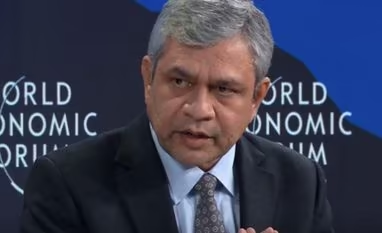
Speaking during a panel discussion at the World Economic Forum (WEF) annual meeting in Davos, Vaishnaw questioned the basis on which the IMF had drawn its assessment
Union Minister for Electronics and Information Technology Ashwini Vaishnaw. (Photo: PIB)
Union Minister Ashwini Vaishnaw on Wednesday pushed back against comments by International Monetary Fund (IMF) Managing Director Kristalina Georgieva, as he rejected the statement that India belongs to a "second category" of artificial intelligence (AI) economies and asserted that the country is firmly among the global leaders.
Speaking during a panel discussion at the World Economic Forum (WEF) annual meeting in Davos, Vaishnaw questioned the basis on which the IMF had drawn its assessment.
“I don’t know what the IMF criteria have been, but Stanford places India third globally in AI penetration, AI preparedness and AI talent,” the minister said, adding, “I don’t think your classification of India in the second tier is correct. India is clearly in the first.”
Five-layer roadmap for AI growth
Vaishnaw said India’s AI ambitions rest on progress across five foundational layers: applications, models, chips, infrastructure and energy. He further argued that coordinated movement across all of them strengthens the country’s position in the global technology landscape.
He also said that India is pursuing an independent AI strategy rather than aligning itself wholesale with either the US or China.
India’s comparative advantage lies in large-scale deployment and practical use of AI, rather than an exclusive focus on building the largest models, the Minister for Electronics and Information Technology said.
“At the application layer, India is likely to emerge as the world’s biggest supplier of AI-driven services,” he said, adding that meaningful returns are generated through enterprise adoption and productivity gains.
Efficiency over size in AI models
Vaishnav also challenged the notion that leadership in AI is defined by the size of models alone. He said that most real-world applications do not require extremely large systems.
“Nearly 95 per cent of AI use cases can be addressed using models in the 20–50 billion parameter range,” Vaishnaw said, pointing out that India already has such models deployed across sectors.
He cautioned against linking geopolitical influence to ownership of massive AI systems. “The economics of what I call the fifth industrial revolution will be driven by return on investment, delivering the highest value at the lowest cost,” he said.
Drawing parallels with India’s digital public infrastructure, Vaishnaw said the government is working to ensure AI adoption spreads across the economy. One of the biggest challenges, he said, is access to computing power.
To address this, India has adopted a public–private partnership approach, empanelling around 38,000 GPUs as a shared national compute facility. The subsidised platform provides affordable access to students, researchers, startups and innovators at roughly one-third of prevailing global costs.
The minister outlined four pillars of India’s AI strategy: a common compute facility, a free set of AI models suited to most practical needs, large-scale skilling initiatives aimed at training 10 million people, and enabling India’s IT sector to transition towards AI-led productivity for domestic and global enterprises.
Regulation must blend law and technology
On the question of governance, Vaishnaw stressed that AI regulation cannot rely on legal frameworks alone and must be backed by technical safeguards.
“Technological tools are essential to address risks such as bias and deepfakes,” he said, adding that detection systems must be robust enough to withstand judicial scrutiny. He noted that India is developing capabilities to identify deepfakes, mitigate bias and ensure proper ‘unlearning’ of models before they are deployed at scale.
The discussion was moderated by Ian Bremmer, with panelists including Brad Smith and Khalid Al-Falih.

 "India is in top tier of AI economies, not second rung: Vaishnaw at Davos")


