As the ruling National Democratic Alliance (NDA) comes back to power with a thumping majority in Bihar, how the state fulfils its promises made to the farm sector, will be of interest.
This would particularly relate to the topping up of PM KISAN instalments by ₹3,000 per annum and ensuring guaranteed minimum support price (MSP) for paddy, wheat, maize and pulses through procurement at the panchayat level.
Bihar is predominantly an agrarian state dominated by small and marginal landholdings that in 2015-16 constituted around 97 per cent of the total operational landholding of Bihar. Nationally, this stood at 86.1 per cent.
The average size of land holding in Bihar, according to a State Level Bankers Committee (SLBC) report, was 0.39 hectares, and for marginal farmers, it was 0.25 hectares in 2015-16. At the all India level, it was 1.08 hectares and 0.38 hectares, respectively.
Clearly, farming in the state is dominated by small holders owning less than one hectare of land. Bihar, according to the latest record, has around 7.5 million PM KISAN beneficiaries.
According to the Reserve Bank of India (RBI), Bihar’s gross value added (GVA) in agriculture and allied activities is around ₹45,85,281 lakh in 2023-24 at constant prices. This was significantly lower than bigger agricultural states like Madhya Pradesh, Gujarat, Maharashtra, Uttar Pradesh and even West Bengal. Bihar’s GVA was, in fact much, closer to Haryana and Odisha.
The state’s net sown area as in 2022-23 was around 5.11 million hectares of which around 3.12 million hectares was net irrigated, the RBI data showed. Cropping intensity in Bihar was 142 per cent, which was quite high given the size of the state.
Due to very small landholding in Bihar, share-cropping or tenant farming is one of the most dominant features of farming.
According to official data, sharecropping in Bihar has increased from 22.67 per cent in 2012-13 to 25.1 per cent in 2018-19.
Nationally, during the same period, it has risen from 10.88 per cent to 13 per cent of total operational land holding.
Ensuring that the benefits of PM KISAN trickle down to tenant farmers will be a big challenge for the Bihar government.
The ruling NDA, apart from promising topping up of
PM-KISAN disbursements through a special scheme called Karpoori Thakur Kisan Samman Nidhi,’ has also promised investment of ₹100,000 crore in building agriculture infrastructure in the state.
Bihar, according to some data, has a cold storage capacity of just around 1.5 million tonnes.
But vegetable production in the state was around 17 million tonnes in 2023-24 and fruit production 4.5 million tonnes.
The state is one of the foremost producers of horticulture crops in the country.
For allied sectors, the NDA — in its manifesto — has also promised a special assistance of ₹2,500 per month for all fishermen called the ‘Jubba Sahni Matsya Palak Assistance Scheme’.
However, of all the promises of the NDA, the one on guaranteed MSP for four crops through procurement at panchayat is a tricky one as Bihar unlike other states does not have an established mechanism of mandis and APMCs.
According to a draft national policy framework on agricultural marketing released by the Centre in 2024, mandis in Bihar are in a deplorable condition since the abolition of the APMC Act in 2006.
APMC Acts are legislations that govern the functioning of mandis in most states and regulate buying and selling of agricultural produce.
The draft also talked of a ‘dire’ need to improve the agriculture marketing ecosystem in the state to tap the immense potential for processing of fruits, vegetables and ‘makhana’ (fox nut) in the state to bring better return to farmers and create job opportunities in the rural sector.
The draft said that at the time of the repeal of the state APMC act in 2006, there were around 95 APMCs under the state agriculture marketing board.
Mapping state’s agri lands
97% share of small and marginal farmers in operational holdings*
0.39 hectare average landholding*
7.5 mn PM-KISAN beneficiaries**
5.11-mn-hectare net sown area#
3.12-mn-hectare net irrigated area#
142% cropping intensity#
*In 2015-16 **In 2025 # In 2022-23
Sources: RBI and industry

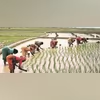 "As NDA returns to power in Bihar, all eyes turn to its farm promises")

