As Bihar moves towards the
2025 Assembly elections in November, political discourse once again centres on complex caste equations, enduring rivalries, and shifting alliances. For over three decades, the state’s politics has been defined by the power struggle between two towering figures, Lalu Prasad Yadav and Nitish Kumar, whose contrasting visions of social justice and governance have shaped Bihar’s political journey.
Looking back at the politics of Lalu Prasad Yadav and Nitish Kumar is essential to understanding the state’s political evolution. Lalu Yadav’s rise in the 1990s signalled a shift from traditional power centres to a politics rooted in social justice and the empowerment of backward castes. Nitish Kumar, by contrast, built his image around governance, development, and coalition-building across caste lines. Together, their political strategies and long-standing rivalry have defined how the people of Bihar vote, the issues that dominate elections, and the leadership choices available to them.
Mandal Awakening: Lalu Yadav’s rise
The Mandal Awakening in Bihar marked the political ascent of Lalu Prasad Yadav and the birth of his party, the Rashtriya Janata Dal (RJD). Lalu began his political career as a student leader and later rose through the ranks of the Janata Dal. In 1990, he became Bihar’s chief minister, representing the Mandal Commission’s emphasis on empowering the Other Backward Classes (OBCs). His politics revolved around giving voice to backward castes and minorities.
In 1997, after facing corruption allegations, Lalu broke away from the Janata Dal and formed the RJD. The party soon became a major political force, with Lalu championing backward caste leadership, grassroots empowerment, and minority inclusion. His populist style resonated with rural and lower-income groups. Under his leadership, the RJD continues to remain an influential player in Bihar’s political landscape.
Nitish Kumar: From Janata Dal to JD(U)
Incumbent Chief Minister Nitish Kumar entered politics during the JP Movement of the 1970s. Trained as an electrical engineer, he was elected to the Bihar Assembly in 1985 and quickly rose in both state and national politics. His early partnership with Lalu Prasad Yadav helped bring the latter to power in 1990, but their alliance collapsed in 1994.
Along with George Fernandes, Kumar founded the Samata Party, which later evolved into the Janata Dal (United). In 2000, he briefly became chief minister with the BJP’s support, foreshadowing the stable NDA government he would later lead from 2005. Re-elected in 2010, he earned credit for restoring law and order and launching welfare schemes. However, in 2013, he broke with the BJP after Narendra Modi’s rise, declaring, “Mitti mein mil jayenge, BJP ke saath wapas nahi jayenge (We will perish but will not join forces with the BJP again).”
After resigning in 2014, he returned in 2015 with the RJD and Congress under the Mahagathbandhan, only to switch back to the NDA in 2017. In 2022, Kumar once again severed ties with the BJP, reuniting with the RJD and Congress, and even hosting the INDIA bloc’s first meeting. Yet on January 28, 2024, he returned to the NDA, unsettling the opposition bloc.
Critics labelled him opportunistic, while supporters argued that his moves reflected Bihar’s caste realities. His political journey, from Janata Dal to Samata to JD(U), highlights his adaptability and continued influence in Bihar’s political arena.
Changing castes and emerging coalitions in Bihar politics
Beyond individual leaders, caste dynamics have long shaped party strategies and voter behaviour in Bihar. The categories of Extremely Backward Classes (EBCs), Other Backward Classes (OBCs), and Dalits play pivotal roles in the state’s politics.
The 2023 caste survey (Jaati Adharit Ganana) revealed the following composition:
• Extremely Backward Classes (EBCs): 36 per cent
• Backward Classes (OBCs): 27.1 per cent
• Scheduled Castes: 19.7 per cent
• Scheduled Tribes: 1.7 per cent
• Upper Castes: 15.5 per cent
Among OBCs, Yadavs were the largest group at 14.27 per cent, while Brahmins, Bhumihars, Kushwahas, and Kurmis formed smaller segments. Hindus constituted 81.99 per cent of the population, and Muslims 17.7 per cent.
Together, these backward groups form a vast majority of Bihar’s population, shaping its electoral calculations. Traditionally, Yadavs, part of the OBC bloc, have been a dominant caste supporting the RJD. However, leaders such as Tejashwi Yadav are now seeking to broaden their base by including non-Yadav OBCs and EBCs in their coalition.
On the other hand, Nitish Kumar’s JD(U) created the Mahadalit category from within the Dalits in 2007 to appeal to the most marginalised communities and expand its political base.
The BJP, too, is intensifying its efforts to consolidate support in the state. On September 3, just weeks before the Assembly polls, Union Home Minister Amit Shah met senior Bihar BJP leaders to assess the political situation ahead of the elections.
During an earlier visit, Shah criticised the RJD for the “jungle raj” during Lalu’s tenure while highlighting the NDA’s development initiatives for Bihar. “People don’t want the return of ‘jungle raj’, gang war and abduction industry in Bihar. The NDA will once again form a government in the state with a thumping majority in the Assembly polls,” he said.
Overview of Bihar’s Legislative Assembly
The Bihar Legislative Assembly comprises 243 seats. In the 2020 elections:
• NDA (BJP, JD(U), VIP, HAM(S)): 125 seats
• Mahagathbandhan (RJD, Congress, Left parties): 110 seats
• RJD emerged as the single largest party with 75 seats; BJP won 74; JD(U) secured 43
Road to 2025: What’s at stake in Bihar
As Bihar approaches the 2025 Assembly elections, voters face a familiar choice between seasoned leaders such as Lalu Prasad Yadav and Nitish Kumar, or new leadership seeking to redefine the political landscape. With caste numbers continuing to play a decisive role, parties are striving to build coalitions that cut across communities. The outcome will hinge on strategic alliances and each party’s ability to appeal to Bihar’s diverse electorate.

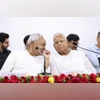 "From Lalu to Nitish: Tracing Bihar's politics through caste equation")


 Connect with us on WhatsApp