Reminding Mithilanchal and North Bihar of the horrors of “jungle raj” during the rule of the Rashtriya Janata Dal (RJD)-Congress combine, Prime Minister Narendra Modi said it was the National Democratic Alliance (NDA) that was the most inclusive and most dedicated to “sushashan” (good governance).
Launching his formal election campaign ahead of the Assembly polls in Bihar, he promised more industrial and policy initiatives in the state if the NDA returned to power.
Addressing a big gathering in Doodhpura, Samastipur — about which Modi himself quipped, that though “I have spent my life in Gujarat, I would not have been able to get such a large crowd for a public meeting there so soon after Deepawali” — Modi launched a strong appeal to the Extremely Backward Classes (EBCs), assuring them that the NDA alone would be able to secure their interests. He paid glowing tributes to Karpoori Thakur, former chief minister of Bihar, after visiting his birthplace just outside the town, renamed Karpoorigram, and reminded the crowd that it was the NDA that bestowed the Bharat Ratna on the “jana nayak” (leader of the masses).
In public perception, Thakur, born into the nai (barber) community and whose life and political career were defined by his advocacy for the marginalised and social justice, is seen as a socialist more attuned to parties like the RJD. Getting support from the EBCs, which constitute nearly 36 per cent of Bihar’s population, according to the 2023 Caste Census, is crucial for the Bharatiya Janata Party’s (BJP’s) success in the Assembly elections. Spread across 112 sub-castes — from the Nishads and Mallahs in the Mithilanchal and Kosi regions to the Kumhars in urban Patna — they influence around 120 Assembly seats in regions such as Mithila, Magadh, and Seemanchal. In his speech Modi listed the steps the Bihar government under the NDA had taken for empowering the EBCs, like extending the Kisan Credit Card scheme to those engaged in fishery. He reminded the audience that not so long ago, because fishing was not viable, Bihar used to buy fish from neighbouring states. “Fish production in Bihar has doubled in the last 10 years and now Bihar is in a position to sell fish to other states,” he said. He cited the steps the government had taken to promote makhana, cultivated and produced by the Mallah community, and said his dream was that makhana should reach every corner of the globe as the go-to health snack. “I presented makhana to a delighted Prime Minister of the Mauritius when he visited India. Makhana producers will benefit from the Makhana Board, which we have constituted,” he said.
The PM listed other measures for the small farmer. “They (small farmers) had no recourse to credit. They could not even cross the threshold of banks in times of need. The PM Kisan Samman Nidhi has ensured ₹28,000 crore in the bank accounts of small farmers in Bihar,” he said. “In Samastipur alone, ₹800 crore has reached the accounts of small farmers.”
Modi also reminded listeners of all the steps the NDA government had taken for low-income groups: Free food, free electricity, toilets, subsidised housing, clean water, but “above all, a sense of self respect”. The government has extended 10 per cent reservation to the economically backward, EBCs, Mahadalit, and socially deprived; it has extended reservation for the Scheduled Castes and Scheduled Tribes for another 10 years; it has given statutory status to the OBC (Other Backward Classes) Commission, a demand pending for years; it has extended reservation in medicine to the EBCs. Most of all, the New Education Policy enables Hindi speakers to study any subject in their own language.
But the “hand” and the “lantern” (the election symbols, respectively, of the Congress and the RJD) were out to stymie all this: Their leaders were out on bail on charges of embezzling hundreds of crores of public money, he said. Asking people suddenly to turn on the torchlight on their mobiles, he said: “I can see a sea of lights. In the midst of all this, do you really need a ‘lantern’?” Other states had voted for the NDA/BJP and “under Nitish Kumar’s stewardship, we will return to power here too,” he said.
Bihar has got three times more central funding in the Past 11 years than during the tenure of the previous government. The state now has six-lane highways, new railway lines, fast trains, a new airport in Darbhanga and new power plants. “Our priority is to bring new industry here and the day is not far when young people will set up a startup in every village” he said.
He said women had been the biggest victims of Maoism: and from much of Bihar, Maoism had now been rooted out. But threats of lawlessness, extortion and kidnapping lingered so long as the RJD was around.
The PM’s speech was notable for what he said – but also for what he did not say. Elsewhere in Bihar, leaders of his party have been highlighting the dangers posed by illegal migrants. In fact, the Special Intensive Revision of electoral rolls brought this into the foreground. However, in his speech Modi made no references to this. He also did not refer to the issue of minorities, especially in the context of the fact that Samastipur was the place where his senior party colleague, L K Advani, was arrested by Lalu Prasad’s government in September 1990, to prevent the Rath Yatra.

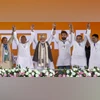 "PM Narendra Modi enters Bihar election campaign with EBC outreach")


 Connect with us on WhatsApp