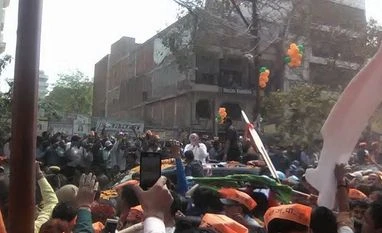
The concluding seventh phase polling of the Uttar Pradesh assembly election on Wednesday would be a virtual test for Bharatiya Janata Party (BJP) mascot and Prime Minister Narendra Modi to prove that Modi wave was still a potent element in Indian politics.
It was the euphemistic Modi wave which helped BJP romp home victorious in 2014 Lok Sabha poll. It was the first time that a non-Congress government had attained majority in Parliament on its own.
Ever since, BJP has been successful in all the state assembly polls across India.
However, UP poll is the biggest acid test for Modi, since the state accounts for the largest assembly segments at 403, while the PM himself represents the temple town of Varanasi in Parliament.
In Varanasi, Modi had recently camped for three days on the trot holding public meetings, rallies, roadshows, visiting temples etc to galvanise voters amid internal revolt over denial of party tickets.
Although Modi is not contesting this election, yet the broad contours of the entire electioneering and narrative had been built, both by BJP and the opposition parties, around him or his major decisions, such as demonetisation.
To say UP poll 2017 has been fought in true US presidential election style would not be an exaggeration in true sense with Modi taking up the entire opposition single handedly.
Modi addressed almost two dozen rallies, public meetings and roadshows to rally support for party candidates. Although, BJP has not announced its chief ministerial candidate, the party is seeking votes in Modi’s name and his perceptible upright and tough decision maker public image.
In his rallies, Modi tried to leverage demonetisation to his benefit by terming the step as an anti-corruption crusade and tarring the opponents as those adversely impacted by it.
So far, BJP has been successful in several local bodies polls across India post-demonetisation, which was announced on the night of November 8, 2016. This indicated that the general public had rather welcomed demonetisation despite facing hardships.
The pre-poll alliance between Congress and the ruling Samajwadi Party (SP) at the 11th hour had also dramatically changed the dynamics of the state politics and made the situation even more fluid and difficult to predict.
Meanwhile, voting in this phase would be held across 40 constituencies forming 7 districts viz. Varanasi, Jaunpur, Ghazipur, Chandauli, Mirzapur, Bhadohi and Sonebhadra. Some of these areas are naxal infested and polling in such segments would culminate an hour earlier at 1600 hrs for security reasons.
Over 14 million voters are eligible to vote at 15,000 polling booths. A total of 535 candidates are trying their luck in this round. Prominent candidates in fray include former cabinet minister Om Prakash, Paras Nath Yadav, Shailendra Yadav, Surendra Patel, Dhananjay Singh, Ajay Rai etc.