India and Singapore on Thursday unveiled a road map to expand their strategic partnership by deepening trade, ensuring better market access and jointly developing a National Centre of Excellence in Chennai on advanced manufacturing.
Prime Minister Narendra Modi and his Singapore counterpart Lawrence Wong, who is on a three-day visit to India, held delegation-level talks in the national capital. The two countries signed five agreements to foster greater cooperation in sectors such as shipping, space, skilling, and civil aviation.
Wong’s India visit, his first since he became prime minister in May 2024, has come in the wake of the disruption in international trade because of the US tariffs, which the Singapore PM has criticised.
Officials said that there was no specific discussion between the two leaders over Washington’s tariffs, but they acknowledged the need to boost trade and investment relationships.
They discussed exploring as many Preferential Trade Agreements or Free Trade Agreements as possible, to try and diversify our supply chains and make them more resilient, Indian officials said.
The two sides also decided to initiate the third review of their Comprehensive Economic Cooperation Agreement (CECA) and “substantial review” of the Asean-India Trade in Goods Agreement (AITIGA) in 2025.
India-Singapore bilateral trade has grown from about $6.7 billion in 2004-05 to nearly $35 billion in 2024-25.
As for investments, Singapore was the largest source of foreign direct investment into India in FY25, and it is also the largest source for cumulative FDI into India, amounting to nearly $170 billion.
The two leaders adopted a road map for the India-Singapore Comprehensive Strategic Partnership to facilitate bilateral engagements across eight priority areas, including economic cooperation, skills development, digitalisation, sustainability, connectivity, healthcare and medicine, defence and security cooperation.
According to a joint statement issued after the talks, Singapore promised to support the growth of India’s semiconductor industry and ecosystem. The two countries will jointly build sustainable industrial parks and next-generation industrial parks with advanced manufacturing capabilities, in India
They also signed an MoU on green shipping to facilitate collaboration to build a Green and Digital Shipping Corridor (GDSC).
The two prime ministers also virtually inaugurated a container terminal at Nhava Sheva port in Mumbai. The Port of Singapore Authority International has invested over USD one billion in the project.
“Today, we have charted a detailed roadmap for the future of our partnership. Our cooperation will not remain confined to traditional areas,” PM Modi said in his statement to the media after talks with Wong.
“We have resolved that, in order to further accelerate our bilateral trade, a time-bound review will be undertaken of our comprehensive economic cooperation agreement, as well as our free trade agreement with Asean (Association of Southeast Asian Nations),” Modi said.
In his remarks, Wong said, “In a world marked by great uncertainty and turbulence, the partnership between India and Singapore becomes even more important because this is a partnership rooted in shared values, mutual respect and a deep reservoir of trust.”
The joint statement said Singapore acknowledges India’s interest in the Malacca Straits Patrol. In the media briefing after the talks, Indian officials said there was a suggestion that India could consider joining the Asean electricity grid.
It is learnt that the two sides also explored the possibility of civil nuclear cooperation in the domain of small modular reactors (SMRs).

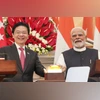 "India and Singapore unveil roadmap to expand strategic partnership")

