
Indo-Pacific must be free from coercion, stresses unity, says Rajnath
Rajnath Singh said the ADMM-Plus can be that bridge to connect strategic dialogue to practical outcomes and take the region forward towards peace and shared prosperity
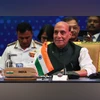 "Indo-Pacific must be free from coercion, stresses unity, says Rajnath")
WebinarsNew
Deep DiveNew
Explore Business Standard
Rajnath Singh said the ADMM-Plus can be that bridge to connect strategic dialogue to practical outcomes and take the region forward towards peace and shared prosperity
India's emphasis on rule of law and freedom of navigation in the Indo-Pacific is not against any country, but to safeguard interests of all stakeholders, Defence Minister Rajnath Singh said on Saturday amid mounting global concerns over China's aggressive military posturing in the region.
In an address at a conclave of defence ministers of ASEAN member states and the bloc's dialogue partners in Kuala Lumpur, Singh said India believes that the Indo-Pacific should remain open, inclusive, and free from any form of "coercion".
He also pitched for an approach of "collective security" to ensure sovereignty of every nation in the region.
"India's emphasis on the rule of law, particularly the United Nations Convention on the Law of the Sea (UNCLOS), and its advocacy for freedom of navigation and overflight in the Indo-Pacific, are not directed against any country but are meant to safeguard the collective interests of all regional stakeholders," he said.
His remarks came amid consistent demands by several ASEAN member states as well as democratic nations for adherence to UNCLOS in the face of Beijing's increasing military muscle flexing in the contested South China Sea.
In his speech at the ASEAN Defence Ministers' Meeting Plus (ADMM-Plus) conclave, Singh said India's strategic engagement with ASEAN is not transactional but long-term and principle-driven, and it rests on a shared belief that the region should remain open, inclusive, and free from "coercion".
"The security of the future will not depend solely on military capabilities, but on the management of shared resources, the security of digital and physical infrastructure, and a collective response to humanitarian crises," he said.
Singh said the ADMM-Plus can be that bridge to connect strategic dialogue to practical outcomes and take the region forward towards peace and shared prosperity.
"India views its role in this framework through the lens of a spirit of partnership and cooperation. Our approach is not transactional, but rather long-term and principle-driven," he said.
"We believe that the Indo-Pacific should remain open, inclusive, and free from any form of coercion," he noted.
The ADMM-Plus is a platform comprising 11-nation ASEAN (Association of Southeast Asian Nations) and its eight dialogue partners -- India, China, Australia, Japan, New Zealand, Republic of Korea, Russia and the United States.
"Let us all together reaffirm our commitment to safeguarding and strengthening the ASEAN-led, inclusive regional security architecture, which has served our region so admirably," Singh said.
He said India is ready to enhance cooperation in all areas of mutual interests, promote dialogue, and ensure peace and stability through robust regional mechanisms.
"The experience of the past 15 years teaches us some things in a clear manner, namely that inclusive cooperation is effective; regional ownership brings legitimacy, and collective security strengthens everyone's individual sovereignty," he said.
"In the coming years, these same principles will continue to guide India's approach towards ADMM-Plus and ASEAN," he added.
Singh said India is ready to continue making constructive contributions in this endeavour in the spirit of its vision MAHASAGAR or Mutual and Holistic Advancement for Security and Growth across Regions.
"India sees its defence cooperation with ASEAN and Plus countries as a contribution to regional peace, stability, and capacity-building," he said.
The defence minister noted that the ADMM-Plus have proven in the last 15 years that cooperation based on trust, inclusivity, and respect for sovereignty is not only necessary but also possible.
"Now, its next phase must adapt itself to emerging realities in accordance with these foundations," he said.
"The evolution of ADMM-Plus reflects the changing security realities of our region. Now this platform is also active in new areas such as cyber threats, maritime domain awareness, and critical infrastructure protection," he said.
"This platform has proven that non-traditional security cooperation can be an effective medium for building trust between nations." The defence minister said the ADMM-Plus for India is an integral part of its 'Act East Policy' and broader Indo-Pacific vision.
The ADMM-Plus is a key platform under the overarching framework of ASEAN.
India became the dialogue partner of ASEAN in 1992 and the inaugural ADMM-Plus was convened in Hanoi in October 2010.
"India has always emphasised the need to integrate climate resilience into defence cooperation. The relationship between environmental stress, resource scarcity, and conflict makes this subject an essential component of the regional security agenda," he said.
Singh said India's Indo-Pacific security vision links defence cooperation with economic development, technology sharing, and human resource advancement.
"This strong connection between the interlinkages of Security, Growth, and sustainability is the true spirit of the partnership between India and ASEAN," he said.
Singh said the emphasis placed on "inclusivity and sustainability" under Malaysia's chairmanship of ASEAN is both timely and highly relevant.
"In the context of security, inclusivity means that all countries, regardless of their size or capacity, become equal partners in building the regional order and benefit from it," he said.
"Sustainability means creating such security architectures that are resilient to shocks, can adapt to new challenges, and are based on long-term cooperation rather than short-term alignment," he said.
Singh also held separate bilateral meetings with his Singaporean counterpart Chan Chun Sing, New Zealand's Defence Minister Judith Collins and Vietnam's Phan Van Giang and South Korea's Defence Minister Ahn Gyu-back.
(Only the headline and picture of this report may have been reworked by the Business Standard staff; the rest of the content is auto-generated from a syndicated feed.)
First Published: Nov 01 2025 | 8:02 PM IST

