Pointing to the Centre’s decision to partner France for an advanced military aero-engine as the template for future collaboration, Indian Air Force (IAF) Chief Air Chief Marshal A. P. Singh said on Wednesday that this is the right moment for India to enter into a strategic partnership with a trusted country for developing next-generation air power platforms and weapons.
Describing the creation of a strong military — particularly a robust Air Force — as a necessity in an increasingly turbulent global environment, the IAF chief said while India possesses the requisite mindset and human capital, it continues to face gaps, to some extent, in technology.
The IAF chief was speaking at the 22nd Subroto Mukerjee Seminar, organised in the national capital by the Centre for Aerospace Power and Strategic Studies (CAPSS) on the theme ‘National Security Imperatives’.
While assuring that the gap could be bridged over time, he underscored that the IAF’s requirements and timelines are also shaped by developments in India’s neighbourhood. He stressed that the armed forces — and the country — must remain prepared for adversity.
“While continuing to support all ongoing research and development (R&D) efforts, we need to take quick decisions to invest in other Make in India programmes so that we get the technology, and we get the products, the weapons and the platforms that we need in the near future. We need to catch up with technology,” he said.
Elaborating on how such programmes could help India bridge the gap in next-generation air power technologies, the IAF chief said that while the country could succeed on its own, that path would inevitably take longer. In line with global trends, he added, India, therefore, needs to partner another country to accelerate the process.
“We are all into strategic partnerships. This is the right time to get into a strategic partnership for the development of next-generation platforms and weapons, on the lines of the decision we have taken for the engine for the future aircraft,” he said.
Warning against expending resources and effort on roles that the armed forces are unlikely to be called upon to perform for another 10 to 15 years, the IAF chief said the focus must instead remain on what is required today and over the next decade.
Immediate operational needs, he stressed, should take precedence. “We must understand that every service has a core competency, and it is best that we concentrate on our primary roles while leveraging the core competencies of the services and other agencies.”
The IAF chief also highlighted autonomous technologies —ranging from swarm drones and manned–unmanned teaming to counter-drone systems and more complex unmanned combat aerial vehicles — as capabilities that need to be acquired at the earliest. It could be done indigenously or through a hybrid pipeline combining imports with Make in India.
The retirement of the last two MiG-21 Bison squadrons in September 2025 has reduced the IAF’s combat strength to 29 active fighter squadrons — the lowest level in 60 years — against a sanctioned strength of 42. This has left the force searching for options to shore up its numbers, particularly as it has yet to receive a single Tejas Mark-1A aircraft, of which 180 are on order with public sector major Hindustan Aeronautics Ltd.
In a development that may ease some of the pressure, the Ministry of Defence’s Defence Procurement Board last week accorded its recommendation to a proposal to acquire 114 Rafale combat aircraft from French manufacturer Dassault Aviation.
The proposal will next be considered by the Defence Acquisition Council, headed by Defence Minister Rajnath Singh, before being taken up for final approval by the Cabinet Committee on Security, chaired by Prime Minister Narendra Modi.
The IAF has previously inducted 36 Rafale fighter jets, while the Indian Navy has placed orders for 26 marine variants of the aircraft.
According to defence sources, the jets will be procured under a ‘Make in India’ framework, with Dassault Aviation partnering an Indian firm. The deal is expected to include transfer of technology, with indigenous content in the aircraft eventually rising to between 55 per cent and 60 per cent. It will also be possible to integrate Indian weapons across the fleet.
The IAF chief’s remarks come at a moment when China’s inventory of advanced stealth fighters has expanded to substantial numbers, and amid reports that Pakistan could also acquire a limited number of such platforms in the coming years.
The first flight of the prototype of India’s indigenous stealth fighter—the Advanced Medium Combat Aircraft (AMCA)—is expected by the end of 2028 or 2029, a defence source had earlier told Business Standard. Series production is projected to begin around 2035, with the IAF likely to induct seven squadrons, totalling 126 jets.

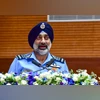 "Right time for strategic partnership on next-gen jets, weapons: IAF chief")

