
Siachen Day: Indian Army honours bravehearts of world's highest battlefield
The day marks the historic launch of Operation Meghdoot in 1984, when the Indian Army established full control over the Siachen Glacier
 "Siachen Day: Indian Army honours bravehearts of world's highest battlefield")
Explore Business Standard

Associate Sponsors
Co-sponsor
The day marks the historic launch of Operation Meghdoot in 1984, when the Indian Army established full control over the Siachen Glacier
April 13 marks Siachen Day, commemorating the Indian Army's Operation Meghdoot in 1984. On this day, Indian troops landed at Bilafond La Pass and captured key positions on the Siachen Glacier, securing a strategic advantage in the disputed region of Kashmir, the world's highest battlefield.
The poem "Quartered in snow, Silent to remain, When the clarion calls, They shall rise and march again" beautifully captures the spirit of the Indian Army's presence in Siachen. It highlights the soldiers' ability to remain vigilant and prepared, even in the harshest of conditions, and to respond swiftly when called upon to defend the nation.
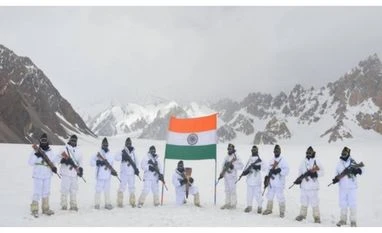
Indian soldiers have been stationed in the harsh environment of the Siachen Glacier for decades, enduring extreme temperatures and challenging terrain.
The day marks the historic launch of Operation Meghdoot in 1984, when the Indian Army established full control over the Siachen Glacier, thwarting adversarial attempts to claim the strategically vital region. It celebrated the 41st anniversary of the famous Operation, which was carried out by the Indian forces.
Siachen has been a bone of contention between India and Pakistan ever since the Karachi Agreement of 1949, when the area was left undivided due to the hostile terrain and extremely rough weather.
Operation Meghdoot was India's bold military response to what New Delhi calls Pakistan's "cartographic aggression" in the uncharted territory of Ladakh, north of map reference NJ9842, where New Delhi and Islamabad had agreed the Line of Control (LoC) ran up to.
Intelligence inputs about impending Pakistani military action prompted India to secure strategic heights on Siachen, deploying troops via airlifts and air-dropping supplies to high-altitude airfields.
The primary objective behind this operation was to pre-empt the seizure of Sia La and Bilafond La passes by the Pakistan Army.
Launched on April 13, 1984, this military operation was unique as the first assault launched on the world's highest battlefield.
It was launched under the leadership of Lieutenant General Manohar Lal Chibber, Lieutenant General PN Hoon, and Major General Shiv Sharma.
It is distinguished by being one of the greatest examples of seamless coordination and synergy between the Indian Army and the Air Force.
The military action resulted in Indian troops gaining control of the entire Siachen Glacier.
According to a press release from last year, the operation involved the IAF airlifting Indian Army soldiers and dropping them on the glacial peaks. Although the operation began in 1984, IAF helicopters have been operating in the Siachen Glacier since 1978, flying the Chetak helicopter, which was the first IAF helicopter to land in the Glacier in October 1978.
The Indian Army launched Operation Meghdoot to secure strategic heights on Siachen with the deployment of troops. Playing an irreplaceable role in this effort, IAF's tactical and strategic airlifters, An-12s, An-32s, and IL-76s transported stores and troops and air-dropped supplies to high-altitude airfields, from where Mi-17, Mi-8, Chetak, and Cheetah helicopters ferried men and material to dizzying heights on the glacier, far above the limits set by the helicopter manufacturers.
Located at a height of around 20,000 feet in the Karakoram Mountain range, the Siachen Glacier is known as the highest militarised zone around the world.
It is located so strategically that while it dominates Shaksgam Valley (ceded to China by Pakistan in 1963) in the north, controls the routes coming from Gilgit Baltistan to Leh from the west, and at the same time, it dominates the ancient Karakoram Pass in the eastern side too.
Further, towards the west, it borders nearly the entire of the Gilgit Baltistan, which too is an Indian territory illegally occupied by Pakistan in 1948.
Every year, the day honours all the Siachen Warriors who have served their motherland while successfully thwarting the enemy's evil designs over the years. To this day, the Siachen Warriors continue to guard the 'Frozen Frontier' with tenacity and resolve against all odds.
(Only the headline and picture of this report may have been reworked by the Business Standard staff; the rest of the content is auto-generated from a syndicated feed.)
First Published: Apr 13 2025 | 8:56 AM IST


