Bad air to unseasonal rain: It is time to look up and heed the warnings

The time has come to look around and induce climate action in decision-making
Pollution
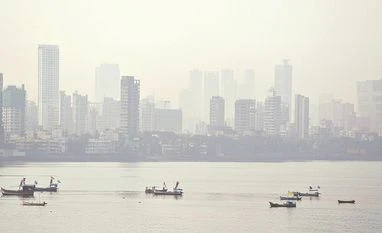
A view of the skyline in Mumbai, which recorded its highest ever October temperature last week
Shreya Jai New Delhi
6 min read Last Updated : Oct 26 2023 | 10:51 PM IST
The seaside financial capital of India logged its highest ever October temperature last week. Accustomed to a gentle breeze this time of the year, the city sweated in a heatwave created by high levels of humidity. As monsoon withdrawal was delayed, the warm sea and surface caused an anticyclonic impact on wind movement.

The result was brown dust and smog covering Mumbai — an image usually associated with Delhi. Not that Delhi is having an easy time. The landlocked political capital drowned under unseasonal rains, well before the monsoon, as its poor infrastructure came under pressure from the bulging Yamuna.

Indeed, the impact of climate change is manifesting itself across the country, from the east (West Bengal sweltered under extreme heatwaves and below normal rains) to the west (people died of heatstroke at an election rally in Maharashtra despite temperatures not that high), and from the south (it rained so much in Karnataka tomato prices went through the roof) to the north (Uttarakhand shook with landslides caused by heavy rains).


Not just bad weather

Your morning coffee will not only get costlier but will also taste different. Research reports show a warming planet will decrease the areas under coffee cultivation.

For instance, in Kerala, irregular rainfall and changes in temperature and humidity levels would affect coffee production in the state. The popular Arabica and Robusta var­ieties will need to be planted in newer regions. This will mean realigning the global trading and supply chain for coffee. A similar shift will unfold in production and trading of other popular crops: sugarcane, cotton, wheat, maize, soybean, etc. 

The rising sea levels will change the face of some of the best beach vacation spots on both the east as well as west coast of the country. A study by the National Centre for Coastal Rese­a­rch in 2018 said 38 per cent of India’s coast­line was under varying degrees of erosion. “Due to global warming, the average rise of sea level is of the order of 1.5-10 mm per year. A rise of 
1 mm in sea level can cause inundation (flood­ing) of about 0.5 mm per year,” the report said, citing the United Nations’ Inter­governmental Panel on Climate Change.

This also means fishermen will have to go deeper for their catch. As shores shrink, they will lose their homes and move up and inside cities.

At the same time, unseasonal and heavy rains will destroy the hill stations. As hills face a mishap every month due to both natural as well as man made calamities, the population there will move down.

Climate change-induced migration will put pressure on the urban centres, whose infrastructure is already creaking under ever increasing population. Bengaluru is an example of a city collapsing on itself.

A 2021 report by ActionAid and Climate Action Network South Asia says 37.5 million people in South Asia will be displaced by 2030 and an estimated 62.9 million by 2050. India alone will see 45 million people being forced to migrate by 2050 due to climate disasters, three times more than the present figure.


Waking up to reality

There are 152 countries that have declared a target year for becoming net carbon zero, that is the amount of carbon emissions emitted are completely offset. Carbon emissions are the biggest known cause of global warming. India has set the date for achieving net zero by 2070.

“We pledged at COP-21 in 2015 that we will reduce our emissions intensity by 33 per cent by 2030; we did this by 2022. So, in Glasgow, we have said that by 2030 we will have 50 per cent of our capacity coming from renewables and that we will reduce our emission intensity by 45 per cent. We will achieve that too well before time,” R K Singh, the Union minister for power, new and renewable energy, said in August this year.

Experts point out that most nations, inclu­ding India, focus on mitigation (reduction of emissions) rather than adaptation (bolstering the economy against climate shocks).

“In climate action discussions, India’s foc­us has been predominantly on international negotiations, which mainly centre on mitiga­tion and finance. The National Democratic Alliance government in its first Budget set up a new National Adaptation Fund. This was a step in the right direction, and an increased budget allocation was expected for it over the years. However, soon after, it was subsumed into the budgetary grant of the Ministry of Environment, Forest and Climate Change. Since then, there have been no budgetary an­nouncements regarding adaptation, dimi­nishing the attention it initially received,” said Harjeet Singh, head, global political strategy, Climate Action Network International.

A recent study by the Centre for Policy Re­search (CPR) analysed the Heat Action Plans of states and found them to be “insufficient and non-transparent.” HAPs are standard op­erating procedures for states, cities, and municipal bodies to tackle heat-related impacts.

Aditya Pillai, associate fellow, CPR, who authored the report, told Business Standard in April: “Every state needs to design its own climate adaptation plan. It starts with the states understanding what is coming, creating an economic buffer and planning for the same, building capacity, while also being able to make sure they are able to keep things together at the socioeconomic level.”

Emphasising that adaptation needed to be recognised as a public good, Singh said, cons­ul­tation between the Centre and states were crucial, and listed initiatives such as incent­ivising natural farming soil and water conser­vation and climate proofing of the infrastructure.

Redrawing the business calendar

From capital and consumer goods to retail and agricultural processing industries, even coal mining — all had to redraw their business calendars this year. April to June was cooler in the north but warmer in the east of the country. Mon­soon months were warmer than usual and it was an extended summer this year. It is an El Niño year when a tropical country such as India faces more heat and less rain. Global warming exacerbates the impact of weather phenomena such as El Niño.

Consumer durables and beverages companies, which get most of their sales in the summer, took a hit as temperatures dropped in the summer months. Beverage sales were down 27.6 per cent in value in the April-June quarter, according to data from retail intelligence firm Bizom.

Singh of Climate Action Network Inter­national, who has been instrumental in set­ting up a separate Loss and Damage Fund for nations vulnerable to climate impact, says even the private sector has a role to play. “It is vital for the private sector to take environmental impact assessments seriously. A climate-compatible approach to infra­struct­ure not only safeguards the environment but also ensures the longevity and viability of their investments,” he says.

The Teesta-III dam, which crumbled recently in Sikkim, was said to have flouted environmental norms. Similarly, there were multiple scientific warnings on glacial melting in Sikkim that could flood the Teesta.

The time has come to heed the warnings. The time has come to look around and induce climate action in decision-making. The time to look up and say, the weather is bad, is gone.


One subscription. Two world-class reads.

Already subscribed? Log in

Subscribe to read the full story →
*Subscribe to Business Standard digital and get complimentary access to The New York Times

Smart Quarterly

₹900

3 Months

₹300/Month

SAVE 25%

Smart Essential

₹2,700

1 Year

₹225/Month

SAVE 46%
*Complimentary New York Times access for the 2nd year will be given after 12 months

Super Saver

₹3,900

2 Years

₹162/Month

Subscribe

Renews automatically, cancel anytime

Here’s what’s included in our digital subscription plans

Exclusive premium stories online

  • Over 30 premium stories daily, handpicked by our editors

Complimentary Access to The New York Times

  • News, Games, Cooking, Audio, Wirecutter & The Athletic

Business Standard Epaper

  • Digital replica of our daily newspaper — with options to read, save, and share

Curated Newsletters

  • Insights on markets, finance, politics, tech, and more delivered to your inbox

Market Analysis & Investment Insights

  • In-depth market analysis & insights with access to The Smart Investor

Archives

  • Repository of articles and publications dating back to 1997

Ad-free Reading

  • Uninterrupted reading experience with no advertisements

Seamless Access Across All Devices

  • Access Business Standard across devices — mobile, tablet, or PC, via web or app

Topics :Climate ChangeAir pollution studyDelhi Pollutionclimate plan

Next Story


