
Bhutan King arrives in Delhi; scheduled to meet PM Modi, EAM Jaishankar
"The visit will further strengthen close bonds of friendship and cooperation with a valued partner," MEA said
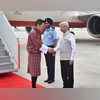 "Bhutan King arrives in Delhi; scheduled to meet PM Modi, EAM Jaishankar")
Explore Business Standard

Associate Sponsors
Co-sponsor
"The visit will further strengthen close bonds of friendship and cooperation with a valued partner," MEA said
Bhutan King Jigme Khesar Namgyel Wangchuck arrived here on Sunday to a red carpet welcome with External Affairs Minister S Jaishankar receiving him at the airport, reflecting the importance India has attached to the trip.
Wangchuck's high-profile trip to India comes amid renewed push by Bhutan and China for an early settlement of their decades-old boundary dispute.
New Delhi has been keeping a close eye on the negotiations between Bhutan and China on their boundary row as it could have implications for India's security interests, especially in the Doklam tri-junction.
Wangchuck began his eight-day visit to India from Guwahati on November 3.
"His Majesty the King of Bhutan warmly received by EAM @DrSJaishankar upon his arrival in New Delhi. His Majesty is on an official visit to India," External Affairs Ministry spokesperson Arindam Bagchi said on 'X'.
"The visit will further strengthen close bonds of friendship and cooperation with a valued partner," he said.
The King of Bhutan is scheduled to meet Prime Minister Narendra Modi and Jaishankar.
The Ministry of External Affairs on November 2 had said that the Bhutan King's visit would provide an opportunity to both the sides to review the entire gamut of bilateral cooperation and to further advance the exemplary bilateral partnership, across diverse sectors.
Last month, Bhutan Foreign Minister Tandi Dorji held talks with his Chinese counterpart Wang Yi in Beijing.
A Chinese readout on the talks said Bhutan firmly abides by the one-China principle and stands ready to work with China for an early settlement of the boundary issue and advance the political process of establishing diplomatic relations.
In August, China and Bhutan agreed to expedite and take simultaneous steps to implement a "three-step roadmap to resolve their festering boundary dispute.
In October 2021, Bhutan and China had signed an agreement on the "three-step roadmap" to expedite negotiations to resolve their boundary dispute.
The signing of the pact came four years after the Indian and Chinese armies were locked in a 73-day stand-off at the Doklam tri-junction after China tried to extend a road in the area that Bhutan claimed belonged to it.
In 2017, the India-China stand-off in the Doklam plateau even triggered fears of a larger conflict between the two neighbours. Bhutan had said the area belonged to it and India supported the Bhutanese claim.
First Published: Nov 05 2023 | 6:22 PM IST

